August 23, 2026 · 10 min read
What MPG Does a Sprinter Van Really Get?
What MPG Does a Sprinter Van Really Get?

Most Sprinter vans on the road today typically average between high teens and low twenties mpg in mixed real-world driving on diesel, with gas-powered models generally delivering somewhat lower mileage. That range is not a factory promise. Mercedes-Benz frequently skips EPA fuel economy testing on commercial-class Sprinter configurations, so there’s no window sticker to point to. Instead, the numbers travelers, fleet buyers, and rental customers rely on come from owner-logged data on Fuelly and independent long-term testing from outlets like MotorTrend.
Here’s what that means for a trip:
- A diesel Sprinter achieving around 20 mpg with a typical fuel tank capacity will cover several hundred miles per fill-up.
- Gas models and heavier AWD conversions typically shave that down closer to 350 to 400 miles.
- Light, unloaded cargo vans on the highway can stretch toward 500+ miles between stops.
Key Takeaways
Sprinter van mpg depends far more on wheelbase, roof height, weight, and drivetrain than on any single factory rating, and owner-logged data remains the most reliable planning tool available.
| Point | Details |
|---|---|
| Expect 17 to low 20s mpg | Diesel Sprinters typically land here in mixed real-world driving; gas trims run a few mpg lower. |
| No EPA sticker, no problem | Rely on Fuelly owner logs and MotorTrend long-term tests since many configs skip EPA testing. |
| Configuration drives the range | 144-inch, low-roof, RWD diesel builds beat 170-inch, high-roof, AWD builds by several mpg. |
| Plan for 400 to 500 miles per tank | A 24.5-gallon tank at 20 mpg gives that range; budget 80 to 90% of it for remote routes. |
| Weight and roof gear cost real mpg | Heavy conversions, roof racks, and AWD systems compound fuel penalties at highway speed. |
Table of Contents
- Sprinter Van MPG by Configuration
- What Actually Changes Your Sprinter’s Fuel Economy
- How Reliable Is Real-World Sprinter MPG Data?
- How Far Can You Go on a Full Tank?
- What This Means for Choosing a Rental Van
- Does Cold Weather Really Hurt Sprinter MPG?
- How Does Sprinter MPG Compare to Other Vans in Its Class?
- What the Numbers Actually Tell Renters
- Sources
Sprinter Van MPG by Configuration
Not all Sprinters return the same mileage, and the gap between the best and worst setups is wider than most first-time renters expect. Wheelbase, roof height, drivetrain, and fuel type each move the needle, sometimes by several mpg at once.
- Wheelbase: The 144-inch wheelbase is lighter and more aerodynamically compact than the 170-inch version, and it typically returns 1 to 3 mpg better on the highway, according to patterns aggregated by The Vansmith.
- Roof height: High-roof vans push more air at highway speed than low-roof or standard-roof models, which drags average mpg down, particularly on long interstate runs.
- Fuel type: Diesel Sprinters generally outperform gas versions in highway mpg, while gas models trade a couple of mpg for wider fuel availability and simpler maintenance in regions with limited diesel infrastructure.
- Drivetrain: AWD and 4x4 Sprinters commonly lose about 1 to 2 mpg compared to rear-wheel-drive versions, a tradeoff for the added traction and mechanical drag.
- Build weight: Camper conversions and heavily equipped passenger builds trend toward the lower end of the range, sometimes into the mid-teens, based on real-world reporting from OzkCustoms.
Owner-logged averages on Fuelly back this pattern up across hundreds of tracked Sprinter 2500s, with year-by-year figures commonly settling in the high teens to low 20s depending on the exact build. MotorTrend’s own testing echoes the same spread, reinforcing that configuration, not luck, drives most of the difference between one Sprinter’s mpg and another’s.
What Actually Changes Your Sprinter’s Fuel Economy
Four factors do almost all the work in swinging a Sprinter’s real-world mpg up or down: weight, aerodynamics, tires and drivetrain, and how you drive and maintain the van.
Weight is the most intuitive. A cargo van hauling tools and a passenger van loaded with 15 people and luggage are not the same vehicle at the pump. Heavier conversions and fully loaded passenger runs pull mpg toward the bottom of the typical range.
Aerodynamics matters more than most drivers assume. Aerodynamic drag increases with the square of speed, so a roof rack or rooftop cargo box that costs you half a mpg at 55 mph can cost you two or three times that at 75 mph. High-roof Sprinters already push more air than low-roof models; add gear on top and highway mpg drops further, faster, the harder you push the throttle.
Tires and drivetrain play a quieter role. Aggressive all-terrain treads increase rolling resistance, and AWD systems add mechanical drag. Stack those two together with a heavy build and the penalties compound rather than simply add up.
Driving habits and maintenance are the levers you actually control day to day:
- Keep tires at the manufacturer-recommended pressure; underinflated tires quietly bleed mpg.
- Replace air filters on schedule, especially if you run unpaved routes often.
- Hold a steady cruising speed instead of surging and braking in traffic.
- Skip unnecessary idling, particularly in cold weather.
Pro Tip: If you’re building out a Sprinter for camper or cargo use, weigh the mpg tradeoff before adding roof racks or oversized tires. A loaded roof rack at highway speed can undo more fuel economy than a lighter payload inside the van ever will.
How Reliable Is Real-World Sprinter MPG Data?
Two very different data sources shape almost everything written about Sprinter fuel economy, and knowing how each one works helps you judge the numbers correctly.
Fuelly’s strength is scale. The site aggregates owner-logged fill-ups across hundreds of Sprinter 2500s, which smooths out individual driving quirks but also mixes wheelbases, roof heights, and drivetrains into one bucket. If you’re comparing your specific build, filter Fuelly’s data by engine and configuration rather than trusting the blended average alone.
MotorTrend’s yearlong test of an AWD Sprinter 2500 crew van averaged about 20.1 mpg overall, with small, largely anecdotal mpg differences observed between standard diesel, B20 biodiesel, and renewable diesel blends.
That 20.1 mpg figure is one AWD test vehicle over one year, not a universal Sprinter average, but it lines up well with Fuelly’s broader owner logs, which is reassuring. The fuel-blend differences MotorTrend logged shouldn’t be read as proof that one diesel blend reliably beats another; the sample sizes are too small for that.
Edmunds fills a different gap. Its Sprinter model pages flag when a configuration was never EPA-tested, which explains why you won’t find an official window-sticker mpg number for many commercial-class builds. For planning purposes, weight owner logs heavily if you’re buying or renting a specific configuration, and treat controlled tests like MotorTrend’s as a useful sanity check rather than the final word.
How Far Can You Go on a Full Tank?
Most current Sprinter models carry a typical fuel tank commonly referenced at about 24.5 gallons, which makes range calculations straightforward once you know your expected mpg.
| Average MPG | Estimated Range per Tank |
|---|---|
| 15 mpg | 350 miles |
| mid-teens mpg | about 400 miles |
| 20 mpg | toward 500 miles |
| low 20s mpg | more than 500 miles |
At $3.80 per gallon, a 20 mpg Sprinter costs roughly 19 cents per mile in fuel, which is a useful baseline to swap your local diesel or gas price into. For trip planning, The Vansmith recommends budgeting only 80 to 90% of your theoretical range, especially on routes through mountains or remote areas where fuel stops are sparse and grades eat into mpg.
What This Means for Choosing a Rental Van
Fuel economy isn’t just a curiosity for Sprinter renters. It directly affects your trip budget and how many stops you’ll need to plan. Sprinter-van-rentals offers both 12-passenger and 15-passenger Sprinter configurations, and seating capacity matters here: a fully loaded 15-passenger van with luggage carries more weight than a lightly loaded 12-seater, which nudges real-world mpg toward the lower end of the range.
Before booking, consider:
- How many passengers and how much luggage you’re actually carrying, since that weight affects range.
- Whether your route includes long highway stretches or frequent stop-and-go city driving.
- Whether an executive Sprinter with added interior features fits your mpg expectations differently than a standard configuration.
To plan fuel stops with confidence:
- Check the seating and configuration details on the Sprinter van seating capacity guide before booking.
- Estimate your route’s mpg using the ranges above, adjusted for load and terrain.
- Build in extra fuel stops on remote legs rather than counting on the full theoretical range.
Does Cold Weather Really Hurt Sprinter MPG?
Yes, and the drop is bigger than most drivers expect. Cold weather affects Sprinter fuel economy through several compounding factors: thicker engine oil that increases friction on startup, longer engine warmup periods before the vehicle reaches peak efficiency, and increased use of accessories like heaters and defrosters that draw power from the engine.

Winter-blend diesel also plays a role. Many regions switch to winter-formulated diesel to prevent gelling in cold temperatures, and that blend typically carries slightly less energy per gallon than summer diesel, which shows up as a small mpg dip even before you factor in the cold itself.
Short trips suffer the most. A Sprinter that never fully warms up during a 10-minute drive spends a larger share of that trip running inefficiently compared to a longer highway haul where the engine reaches and holds optimal operating temperature. Idling to warm up the cabin before driving compounds this further, burning fuel with zero miles to show for it.
Tire pressure drops in cold weather too, and underinflated tires increase rolling resistance exactly when the engine is already working harder. Checking and adjusting tire pressure seasonally is one of the simplest ways to recover some of that lost mpg. Combined, these seasonal effects can pull real-world mpg down by a noticeable margin compared to the same van’s summer performance, which is worth factoring into winter trip budgets.
How Does Sprinter MPG Compare to Other Vans in Its Class?
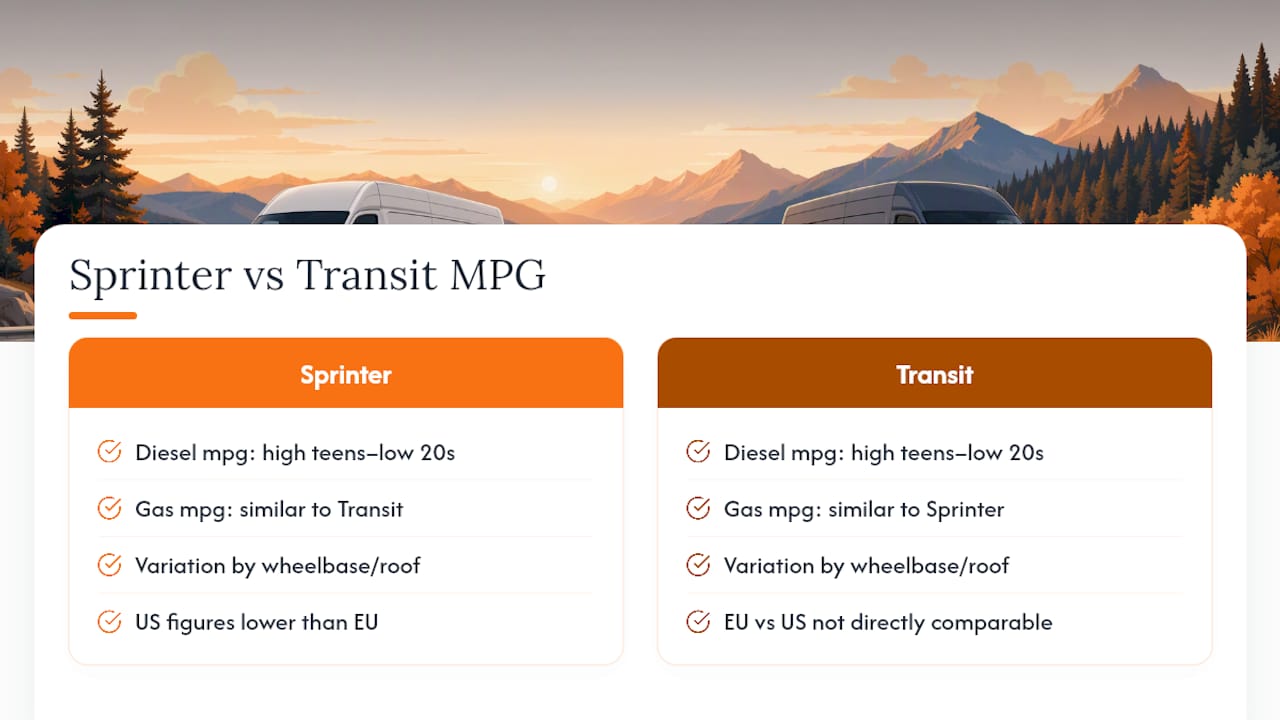
The Sprinter competes most directly with the Ford Transit in the full-size van segment, and the fuel economy gap between them is smaller than brand loyalists on either side tend to claim. Ford’s Transit, when equipped with its diesel engine option, posts real-world mpg figures in a broadly similar band to the Sprinter, generally landing in the high teens to low 20s depending on wheelbase and roof height, mirroring the same configuration-driven spread Sprinter owners report.
Gas-powered versions of both vans trade highway efficiency for simpler maintenance and broader fuel availability, and neither brand’s gas engine meaningfully outperforms the other in typical mixed driving. Where the two vans diverge more is in how weight and aerodynamics interact with each model’s specific body design, meaning a direct wheelbase-to-wheelbase, roof-to-roof comparison matters far more than a blanket “Sprinter versus Transit” mpg claim.
One nuance worth flagging: European-market MPG figures for Sprinter-based vans sometimes look considerably higher than what US drivers report, because European test cycles and often-lighter European trim levels don’t map cleanly onto US-market Sprinters, a point The Vansmith raises directly. Don’t let an EU brochure number set your expectations for a US rental. For box-truck or cutaway comparisons specifically, payload and body style shift the math further still, which is worth reviewing separately if you’re weighing a cutaway configuration against a standard cargo or passenger Sprinter.
What the Numbers Actually Tell Renters
Most advice on Sprinter mpg treats it like a single fixed number you can look up once and move on. That’s the wrong instinct. The honest answer is a range shaped by wheelbase, roof height, drivetrain, and how much weight you’re hauling, and treating it otherwise sets unrealistic expectations for a rental trip.
The conventional approach leans too hard on either owner logs or lab-style tests alone. Fuelly’s scale is valuable but blends too many configurations together to be precise for your exact build. MotorTrend’s yearlong test is precise but describes one AWD vehicle, not the fleet. The smarter move combines both: use owner logs to find your configuration’s typical band, then use controlled tests to sanity-check that band against real driving conditions.
For renters specifically, the priority should be matching seating capacity and expected load to a realistic mpg band before booking, not chasing the highest number on a spec sheet. A 15-passenger van loaded for a wedding party will not match a lightly loaded 12-seater’s mpg, and planning fuel stops around that reality beats hoping for the best.
— Gabriel
Ready to match your trip to the right Sprinter configuration? Book a 12- or 15-passenger Sprinter van nationwide and plan your fuel stops with real-world mpg in mind, not guesswork.
Sources
- 2024 Mercedes-Benz Sprinter 2500 AWD yearlong review — MotorTrend
- Actual MPG from Mercedes-Benz Sprinter 2500 owners — Fuelly
- 2024 Mercedes-Benz Sprinter MPG & Gas Mileage Data — Edmunds
- Mercedes Sprinter MPG: Real-World Fuel Economy — The Vansmith
- What MPG does a Sprinter get? Real world guide — OzkCustoms
Recommended
Keep reading
How Much Is a Sprinter Van Rental? 2026 Pricing Guide
Real Mercedes-Benz Sprinter van rental prices in 2026 — daily rates, mileage, insurance, delivery fees, and how to lower your total.
How to Start a Sprinter Van Rental Business (2026 Playbook)
Step-by-step guide to launching a Sprinter van rental business — licensing, DOT/FMCSA rules, insurance, fleet financing, and marketing.
Mercedes Sprinter Van Rental in Orlando, FL — Where to Rent
Compare Mercedes-Benz Sprinter van rental options in Orlando, FL — MCO airport delivery, theme park runs, and 12 & 15-passenger pricing.