September 21, 2026 · 12 min read
Fleet Managers: Prepare 12–15 Passenger Sprinter Vans for Winter
Fleet Managers: Prepare 12–15 Passenger Sprinter Vans for Winter
Yes, you can operate a passenger van safely in winter, but the margin for error is smaller than in a car. Priority one is correct winter tires at the right cold pressure for your actual load. Priority two is driving conservatively: longer following distances, lower speeds, and smooth inputs. A fully loaded 15-passenger van carries extra rollover risk, so treat it with more caution than a car or a lightly loaded 12-passenger van.
TL;DR:
- Proper winter tires with the three-peak mountain snowflake symbol are essential, and tire pressure must be adjusted for load to avoid increased braking distances.
- Fully loaded 15-passenger vans carry a higher rollover risk, especially in winter, requiring reduced loads, shorter routes, and mandatory seat belt use.
- Routine pre-trip inspections should include battery testing, coolant levels, lighting, seals, and an emergency kit, with photographic records recommended before multi-day trips.
- Driving techniques should prioritize increased following distances, slow speeds, gentle inputs, and avoiding cruise control on icy roads to mitigate handling issues.
- Matching all tires in brand, type, and load index significantly enhances stability and safety in winter conditions, and chain regulations vary by route and region.
Table of Contents
- How Do You Prepare a Passenger Van for Winter Driving?
- What Tires and Pressures Work Best for Loaded Vans?
- How Should You Drive a Van in Snow and Ice?
- Why Does Passenger Loading Matter So Much for 12–15 Seat Vans?
- What Winter Maintenance Keeps a Van Running Reliably?
- What Do You Do If Your Van Gets Stuck or Skids?
- What Sprinter Operators Should Know Before a Winter Trip
- What Most Winter Van Guides Get Wrong
- Book a Winter-Ready Sprinter Van for Your Next Group Trip
- Primary Sources and Further Reading
- Sources
- FAQ
How Do You Prepare a Passenger Van for Winter Driving?
A pre-trip walkaround catches most of the problems that turn into roadside emergencies. Run through it every time you take a 12 or 15-passenger van out in winter conditions, not just at the start of the season.
Start with the tires. Check tread depth, look for uneven wear that signals alignment issues, and confirm all four tires match in brand and type. Mismatched tires on a heavy van create uneven traction exactly when you need it most.
Next, the battery. Cold weather cuts cranking amps significantly, and a battery that struggled in October can fail outright in January. Slow cranking, dim interior lights, or a dashboard warning are all signs to test or replace it before a trip, not during one.
Round out the checklist with these items:
- Confirm coolant is mixed for your climate’s lowest expected temperature and top off winter-rated washer fluid.
- Inspect wipers, headlights, taillights, mirrors, and defroster function; replace wiper blades that streak or skip.
- Check door and window seals for cracking, which lets in cold air and fogs windows faster.
- Assemble an emergency kit: shovel, traction mats, blankets, a flashlight, jumper cables, a tow strap, and a phone charger, all recommended in AutoTrader’s winter van care guide.
- Verify the spare tire holds proper pressure and has usable tread.
- Keep the owner’s manual and tire placard in the glove box; you’ll need both for load-specific pressure settings.
Pro Tip: Photograph your completed checklist with a timestamp before every multi-day trip. If a passenger or client questions vehicle condition later, you have a record, not just a memory.
What Tires and Pressures Work Best for Loaded Vans?
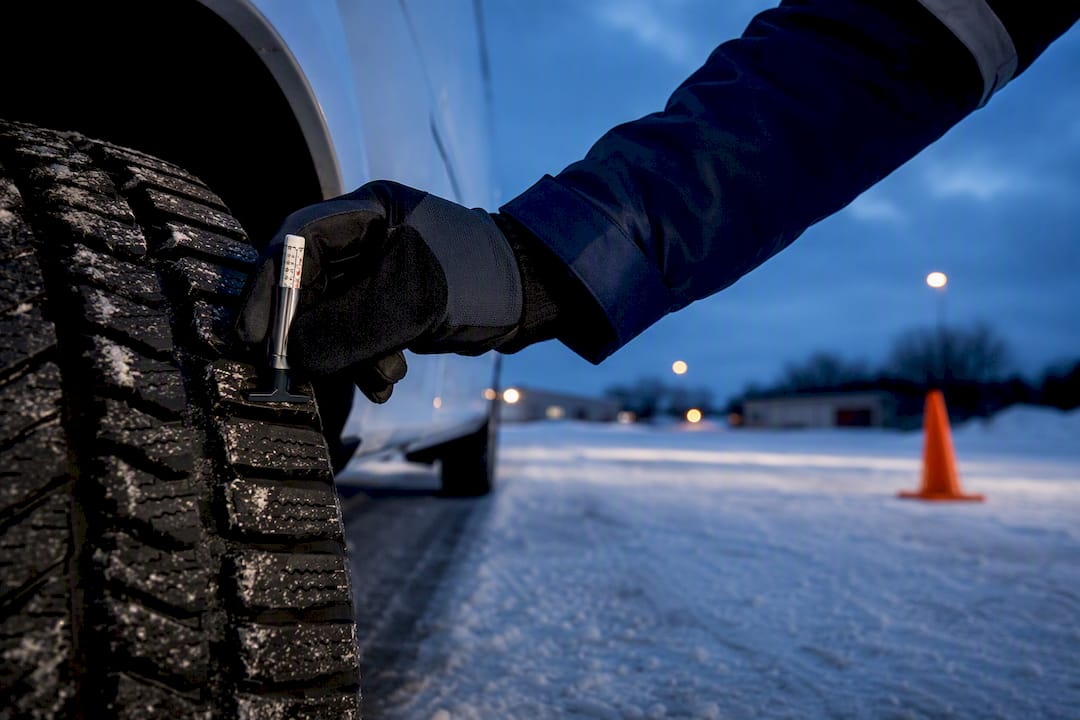
Tire choice matters more on a van than a sedan because the added weight of ten or fourteen passengers plus luggage changes how rubber behaves on ice. Look for the three-peak mountain snowflake symbol (3PMSF) rather than a basic “M+S” (mud and snow) rating. M+S tires meet a looser tread-void standard and aren’t tested for severe snow performance the way 3PMSF tires are. Four identical 3PMSF tires, matched in size and load index, give the most predictable handling, a point echoed in guidance on winter tires and chains for heavy vans.
Pressure is where most drivers make a costly mistake. Lowering tire pressure to “add grip” is a passenger-car myth that backfires badly on a heavy van. It deforms the tire’s casing, generates excess heat, and actually increases braking distance, according to Continental’s research on braking dynamics. Use the cold inflation numbers on your door placard, adjusted for the day’s actual passenger and cargo load, and check the owner’s manual if your van has separate ratings for full and partial loads.
A few more specifics worth checking before departure:
- Confirm your tires carry a load index rated for van duty (often marked “C” or “XL” on the sidewall), not a passenger-car rating.
- Check the spare’s age. Rubber degrades over time even if the tread looks fine; five to six years is a reasonable replacement window.
- Carry chains appropriate for your route. Metal chains handle sustained climbs and severe ice better, while textile or composite chains work as lighter emergency backup on mixed roads.
- Practice fitting chains in your driveway before you need them in a whiteout.
Statistic to remember: stopping distances on snow and ice can be much longer than on dry pavement, according to Consumer Reports. That number should shape every following-distance and speed decision you make in a van full of passengers.
Check chain and studded-tire regulations for every state or province on your route before departure. Requirements shift by elevation and season, and rules that apply in one mountain pass may not apply thirty miles down the highway.
How Should You Drive a Van in Snow and Ice?
Vans respond to winter roads differently than sedans do. The wheelbase is longer, the center of gravity sits higher, and the weight distribution shifts constantly as passengers move. Smooth, separated inputs matter more here than in almost any other vehicle class.
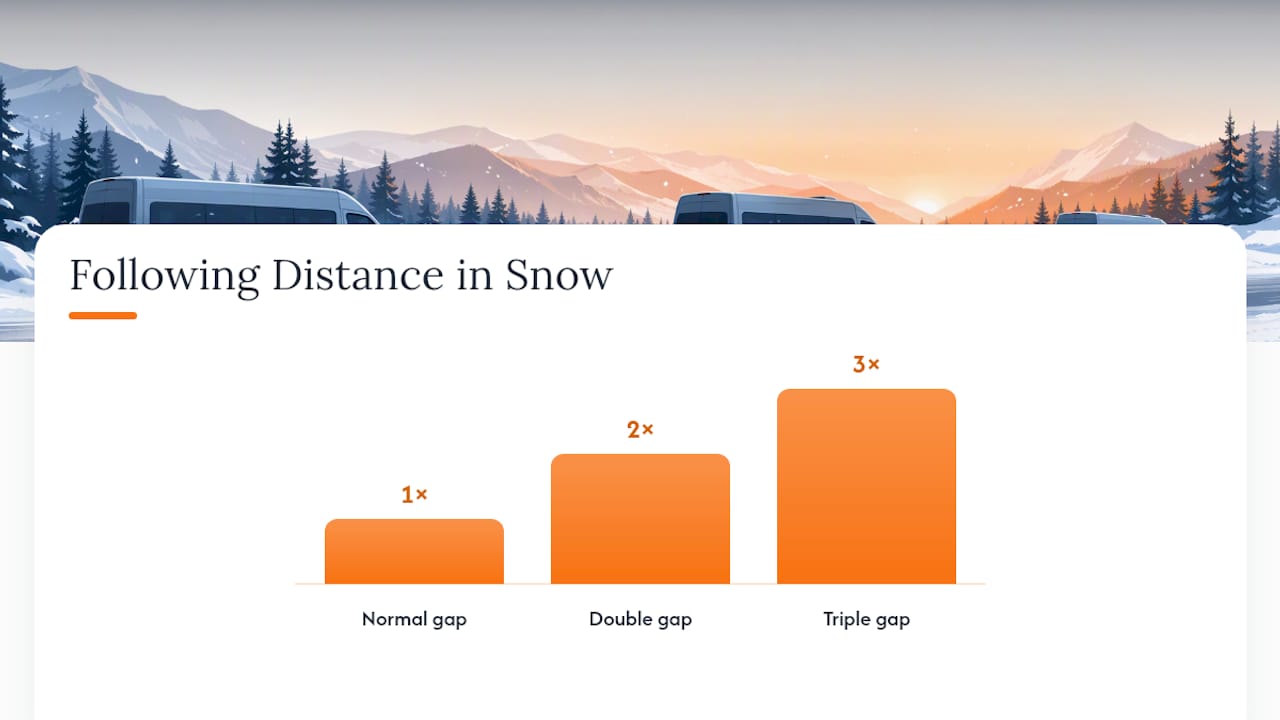
- Increase following distance well beyond the usual rule. Given how dramatically stopping distances stretch on snow and ice, doubling or tripling your normal gap gives you room to react without emergency braking.
- Slow down before the posted limit says you have to. Speed limits assume dry pavement. On snow or slush, a loaded van needs meaningfully lower speeds to keep its tires tracking, especially through curves.
- Separate your inputs. Accelerate, brake, and steer one at a time rather than blending them. Vans lose traction fast when a driver brakes mid-turn or accelerates while still steering out of a curve, a habit flagged in van-specific snow driving guidance.
- Start in second gear on slick surfaces if your transmission allows manual gear selection, to reduce wheelspin from a standing start.
- Recognize skid types and respond correctly. For understeer (front tires lose grip, van keeps going straight), ease off the accelerator and look where you want to go. For oversteer (rear end swings out), steer gently into the skid and avoid sudden braking.
- Trust ABS, but don’t outsmart it. If the pedal pulses, keep steady pressure and steer; pumping the brakes yourself defeats the system.
- Treat traction control and stability aids as a safety net, not a license to drive faster. They reduce wheelspin and correct minor slides, but they can’t create traction that isn’t there.
Pro Tip: Avoid cruise control entirely in slick or sub-freezing conditions. Consumer Reports notes it removes your ability to ease off the throttle instantly when a wheel starts to slip, which is often the first and only warning you get.
For a deeper technical breakdown of how braking distance changes with speed and surface, this stopping-distance resource is worth bookmarking for driver training sessions.
Why Does Passenger Loading Matter So Much for 12–15 Seat Vans?
Payload isn’t a formality. Subtract your van’s curb weight from its Gross Vehicle Weight Rating (GVWR), and what’s left is what you can legally and safely carry in passengers plus luggage. Fill that number with ten adults averaging 180 pounds each plus a duffel bag apiece, and a van that looked roomy on paper can sit close to its limit before you’ve loaded a single suitcase in the back. Real-world capacity examples for Sprinter van luggage loads show how quickly cargo space fills on a full-passenger run.
Load seats front to back, not back to front, and skip the roof rack in winter. Weight up high raises the center of gravity exactly where you can least afford it.
Fifteen-passenger vans deserve extra caution. According to NHTSA guidance, these vans have a higher center of gravity than cars and require trained drivers and consistent seat belt use. Rollover risk climbs further under load. Fully loaded 15-passenger vans can carry significantly higher rollover risk than when driven by just a single driver, according to an Actsafe safety infosheet.
That risk profile should drive practical decisions:
- Avoid full-GVWR loading in winter conditions; leave a buffer.
- Keep long, high-speed segments short or reroute through lower-speed roads when ice is a factor.
- Enforce seat belts for every occupant, every time, no exceptions.
- Switch to two smaller vans or a 12-passenger configuration rather than max out a 15-passenger van in a storm.
What Winter Maintenance Keeps a Van Running Reliably?
Winter maintenance isn’t a one-time event. It’s a recurring routine, especially for vans logging long miles on salted highways.
Test battery and charging-system output regularly; cold weather exposes weak batteries fast, and a jump-start on a highway shoulder with fourteen passengers aboard is a situation worth avoiding entirely. Inspect brakes for slush buildup and check rotors and pads for wear, since wet braking systems that don’t dry properly corrode faster. Confirm coolant concentration matches your climate and check that your oil viscosity is rated for cold starts.
- Clean headlights and taillights regularly; road grime and salt film cut visibility fast.
- Test defroster and heater output on both windshield and rear glass.
- Rinse the undercarriage after storms and apply cavity wax to slow salt corrosion, a step detailed in corrosion-prevention guidance for winter vans.
- Run a documented weekly inspection during multi-day trips, not just before departure.
Pro Tip: Keep a simple maintenance log in the glovebox. A driver switching vehicles mid-trip should be able to see, in thirty seconds, what was checked and when.
What Do You Do If Your Van Gets Stuck or Skids?
- Secure occupants first. Turn on hazard lights immediately and confirm nobody needs urgent medical attention.
- In a skid, steer into it and ease off the gas. Never slam the brakes; if ABS engages, hold steady pressure and keep steering toward your intended path.
- If stuck, dig out methodically. Clear snow from all four wheels and the undercarriage, place traction mats or even carpet scraps under the drive wheels, and rock the van gently between forward and reverse rather than flooring the accelerator.
- Call for tow or roadside assistance with specifics. Give dispatch your exact location, van type, passenger count, and whether anyone requires medical help.
- Decide wait or evacuate based on visibility and traffic risk. If you’re safely off the roadway, staying inside with hazards on and the dome light visible is usually safer than standing outside in a storm. Keep passengers warm with blankets from your emergency kit and run the engine intermittently, not continuously, to conserve fuel and avoid exhaust buildup.
What Sprinter Operators Should Know Before a Winter Trip
Sprinter 12 and 15-passenger layouts each handle luggage differently in winter, when everyone’s carrying bulkier coats and gear. The 12-passenger configuration leaves more rear cargo room per person, while the 15-passenger interior layout requires tighter luggage planning to avoid crowding the rear seats.
Before you drive off the lot, confirm a short list with the rental provider:
- Winter-rated tires are mounted, not just all-season tires labeled for cold weather.
- Chains are available or permitted for your route, and the spare tire is in usable condition.
- Optional driver services are available if your group prefers an experienced winter driver over self-driving.
- The rental agreement states the van’s exact GVWR and tire pressure specs. Don’t rely on general knowledge; check the specific vehicle’s placard, as guidance varies by model year.
What Most Winter Van Guides Get Wrong
Most winter driving advice is written for sedans and then loosely applied to vans, and that gap is where trouble starts. A 15-passenger van doesn’t handle like a bigger car. It handles like a different category of vehicle entirely, with a higher center of gravity, weight that shifts with every passenger’s movement, and stopping distances that punish aggressive inputs far more severely than a compact car would.
The conventional advice, “slow down and leave more space,” isn’t wrong, but it’s incomplete for fleet decision-makers. The real judgment call is knowing when the smarter move is not to drive the 15-passenger van at all. Splitting a group into two smaller vans, or delaying departure by a few hours until plows clear a route, isn’t overcautious. Given the rollover math on fully loaded vans, it’s the responsible default in marginal conditions.
What gets underrated is documentation. A tire check or a maintenance log feels like paperwork until the day it’s the only thing standing between your operation and a liability question after an incident. Build the habit before you need it, not after.
— Gabriel
Book a Winter-Ready Sprinter Van for Your Next Group Trip
Sprinter Van Rentals gives you a faster path to a winter-ready vehicle than sourcing and inspecting a van on your own, with 12 and 15-passenger Sprinter configurations available in more than 260 U.S. cities.
Before you confirm a reservation, run through a short winter-readiness list with your booking agent: winter-rated tires mounted and matched, spare tire condition verified, chain availability confirmed for mountain or high-snowfall routes, and optional add-ons like insurance or a professional driver locked in if your group prefers not to self-drive through unfamiliar winter roads. You can also review available fleet configurations to compare 12 and 15-passenger layouts against your group size and luggage needs before you book. If your trip involves a mountain pass, an overnight storm forecast, or a group larger than a car can safely hold, reach out to plan a customized winter itinerary and confirm availability for your dates.
Primary Sources and Further Reading
- NHTSA: 15-passenger van safety
- Actsafe: 15-passenger van safety infosheet (PDF)
Sources
- 15-passenger van safety — NHTSA
- Braking distance and tire effects — Continental Tires
- Winter van driving and care tips — AutoTrader
FAQ
Which Vans Are Best for Winter Driving?
Vans with matched 3PMSF winter tires, a manageable payload relative to GVWR, and available all-wheel or rear-wheel drive tend to perform most predictably in snow. For groups, a well-maintained 12-passenger Sprinter with proper winter tires generally handles more predictably in adverse weather than a fully loaded 15-passenger van, given the rollover risks NHTSA outlines for larger passenger vans.
Which Minivans Are Best for Driving in the Snow?
Minivans with standard all-wheel drive and dedicated winter tires generally handle snow better than rear-wheel-drive-only vans, since AWD improves initial traction on acceleration. Keep in mind that AWD does not shorten stopping distances on ice, so tire quality and driving technique still matter more than drivetrain alone.
Is a Van Good to Drive in Snow?
A van can be driven safely in snow when it’s equipped with proper winter tires, loaded within its rated payload, and driven with increased following distance and reduced speed. The bigger risk factor isn’t the vehicle type itself but overloading, especially in 15-passenger configurations where rollover risk rises sharply under full load, per Actsafe’s safety data.
How Cold Is Too Cold for Driving a Car or Van?
There’s no universal cutoff temperature that makes driving unsafe on its own; road surface condition and visibility matter more than the thermometer reading. Extreme cold can still stress a weak battery to failure and stiffen rubber components, so a thorough pre-trip check matters more as temperatures drop toward zero and below.
Recommended
Keep reading
How Much Is a Sprinter Van Rental? 2026 Pricing Guide
Real Mercedes-Benz Sprinter van rental prices in 2026 — daily rates, mileage, insurance, delivery fees, and how to lower your total.
How to Start a Sprinter Van Rental Business (2026 Playbook)
Step-by-step guide to launching a Sprinter van rental business — licensing, DOT/FMCSA rules, insurance, fleet financing, and marketing.
Mercedes Sprinter Van Rental in Orlando, FL — Where to Rent
Compare Mercedes-Benz Sprinter van rental options in Orlando, FL — MCO airport delivery, theme park runs, and 12 & 15-passenger pricing.