September 19, 2026 · 9 min read
Stop Stranding Guests: Wedding Shuttle Timeline Template & Sprinter Tips
Stop Stranding Guests: Wedding Shuttle Timeline Template & Sprinter Tips

A wedding shuttle timeline works when it’s built around staggered arrival waves, 15 to 20 minute travel buffers on every leg, and at least two to three return runs at night. Plan for 10 to 25 minutes of boarding time per load, run two arrival shuttles instead of one, and publish the finished schedule on your wedding website and on-site signage. Assign one person as shuttle captain to own it from booking through last call.
TL;DR:
- Most wedding shuttle plans fail when couples rely on a single run instead of multiple staggered arrival waves and return trips, especially for larger guest lists.
- Planning for two to three departure waves and at least two to three return runs, spaced about 20 minutes apart, ensures smoother guest flow and covers diverse guest departure needs.
- Booking shuttles 6 to 9 months in advance and confirming vehicle capacity, driver details, and routes reduces last-minute chaos and ensures availability during peak season.
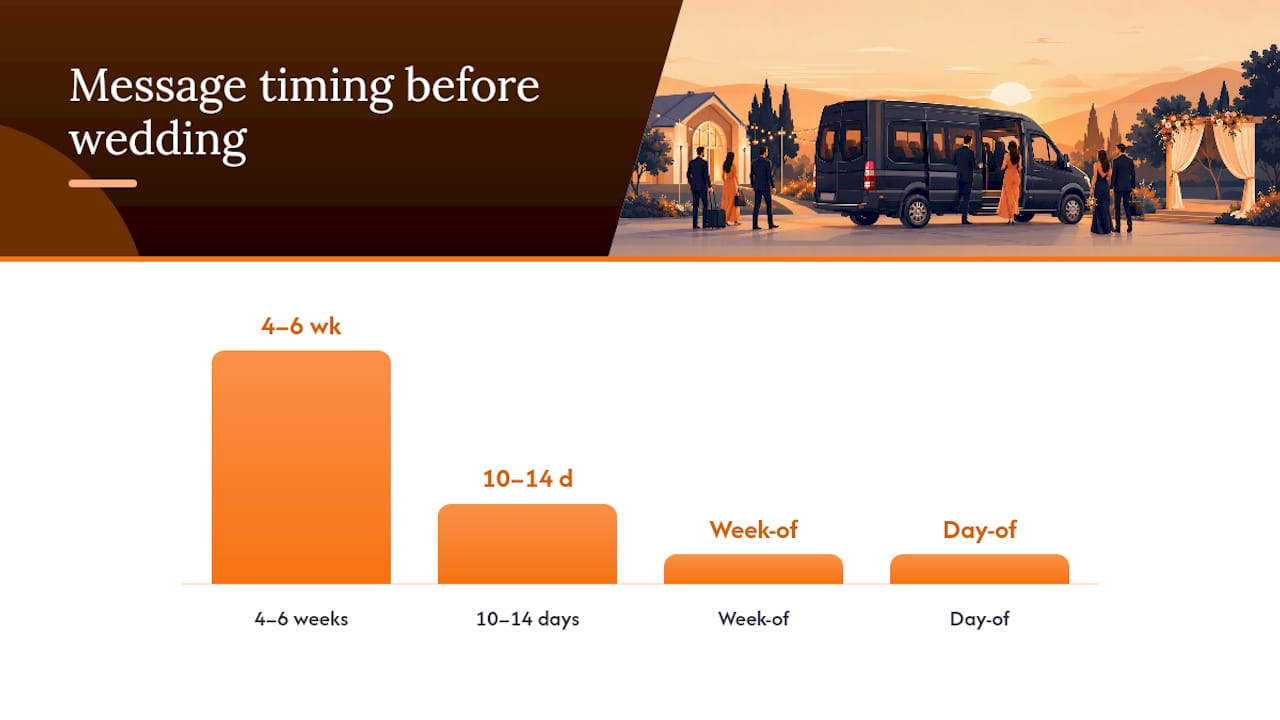
- A layout for schedule communication includes detailed updates at 4-6 weeks, 10-14 days, a week before, and printed signage on the day, to build guest trust and prevent missed shuttles.
- Using roughly 60% of out-of-town guests for shuttle calculations and avoiding one-shuttle nights significantly decreases transportation failures.
Table of Contents
- Sample Wedding Transportation Timeline Templates You Can Copy
- How Many Shuttles Do You Actually Need?
- Building the Minute-by-Minute Transportation Schedule
- When and How to Tell Guests About the Shuttle Schedule
- When to Book Shuttles and What to Confirm Before the Big Day
- What a Van Provider Wants Couples to Know
- Why Most Shuttle Plans Fail Before They Even Start
- Get a Straightforward Shuttle Quote From Sprinter Van Rentals
- Sources
- FAQ
Sample Wedding Transportation Timeline Templates You Can Copy
The right template depends on your venue setup. Here are three starting points, based on the arrangements most couples actually book.
1. Same-venue, short travel (ceremony and reception at one location)
- 4:00 PM: First shuttle departs hotel, arrives 30 to 40 minutes before ceremony
- 4:20 PM: Second shuttle departs, catching stragglers about 20 minutes later
- 10:30 PM: Early return run for families and older guests
- 11:00 PM: Main return run at reception close
- 11:20 PM: Final “tail” run for the last stretch of guests
2. Separate ceremony and reception, 20 to 30 minutes apart
Guests need staggered departures from the ceremony site, and the couple’s vehicle should be booked through the full photo window rather than straight to the reception door. Otherwise, you risk stranding the couple mid-portraits with no ride.
- Guest shuttle 1 departs ceremony 15 minutes after recessional
- Guest shuttle 2 departs 20 minutes later for stragglers and photo-line guests
- Couple and wedding party depart separately, routed through the photo session
- Vendor van (florist, DJ gear) departs early to beat guest traffic into the reception
3. Destination wedding or hotel block
- Airport to hotel: two to three waves spaced by flight arrival clusters
- Hotel to venue: same two-wave arrival system as the single-venue template
- Venue to hotel: early, main, and tail return runs, same as above
Scale each template by travel time and headcount. A 10-minute hop between ceremony and reception needs less buff than a 25-minute drive through weekend traffic. If your guest list runs past 80 out-of-town attendees, add a third arrival wave rather than stretching boarding windows past 25 minutes.
How Many Shuttles Do You Actually Need?
Start with a simple assumption: a significant share of out-of-town guests will use the shuttle instead of driving or ride-sharing. For planning purposes, size conservatively to avoid scrambling to add a run the week of the wedding.
Run the math against your fleet options:
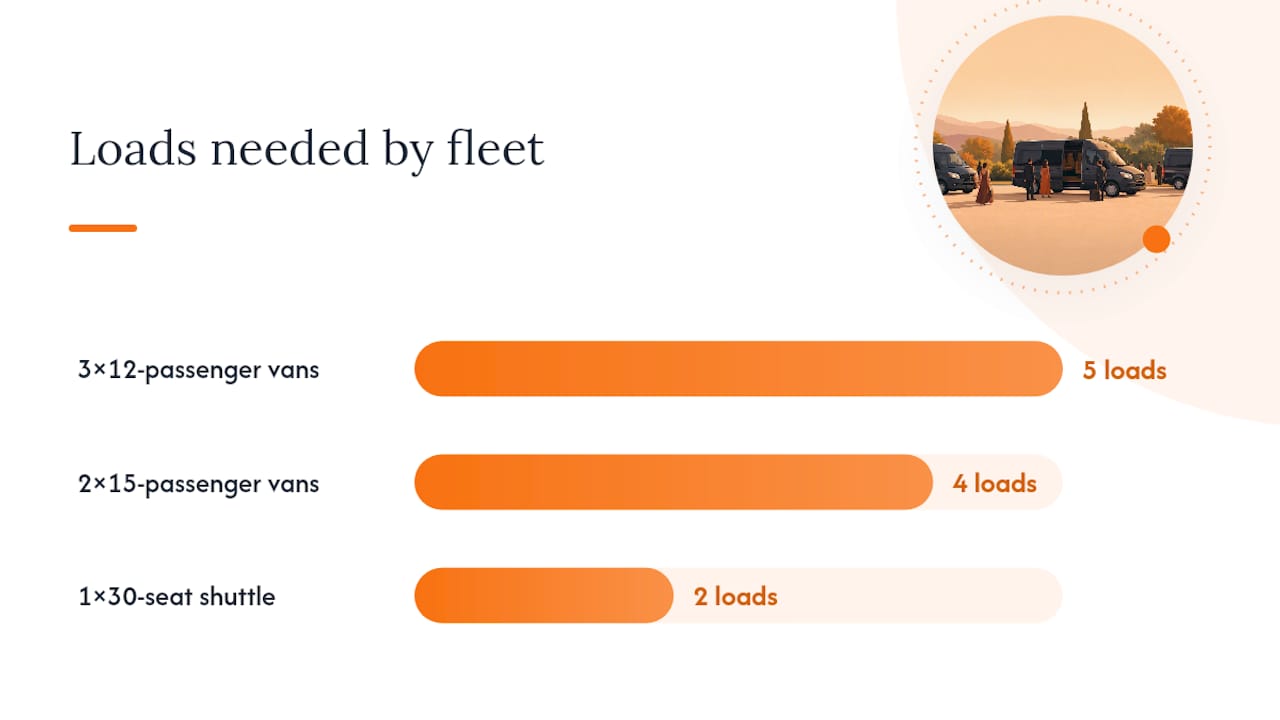
- 100 out-of-town guests at 60% usage = 60 riders needing transport
- Three 12-passenger vans need 5 total loads to move 60 people once
- Two 15-passenger vans need 4 total loads
- One 30-seat shuttle needs 2 loads, but only if your pickup point has room for a bus that size
Continuous loops work best when your hotel-to-venue distance is short and predictable, under 10 minutes each way. Scheduled waves work better for longer drives, because a loop that takes 25 minutes each direction burns driver hours fast and can tip into overtime charges by 10 PM.
Pro Tip: Skip the single late-night shuttle. Two scheduled returns plus one tail run, spaced about 20 minutes apart, catches early-leaving families, the main crowd at reception close, and the diehards who stay until the lights come up. Practitioner guidance consistently flags the one-shuttle plan as the single most common transportation failure at weddings.
Building the Minute-by-Minute Transportation Schedule
Work backward from your ceremony start time. Everything else, guest arrival, wedding party staging, vendor deliveries, gets scheduled around that fixed point.
- Set guest arrival window 30 to 45 minutes before ceremony start
- Schedule the first shuttle to arrive 30 to 40 minutes ahead, with a second wave roughly 20 minutes behind it
- Sequence wedding party and family vehicles separately from the general guest shuttle
- Book the couple’s transportation through the photo block, not to a fixed drop-off time
- Add 15 to 20 minute buffers between every location change to absorb traffic and loading delays
- Note vendor arrival windows on the same master document so nobody double-books a loading zone
A sample annotated schedule might read: 3:15 PM florist arrives, 3:40 PM first guest shuttle departs hotel, 4:00 PM ceremony guests seated, 4:30 PM ceremony starts, 5:15 PM couple departs through photos, 6:00 PM reception shuttle wave one arrives. Every line item should have a named vehicle attached to it, not just a time.
When and How to Tell Guests About the Shuttle Schedule
Guests only use the shuttle if they trust it’ll show up when promised, and that trust starts with clear, repeated communication. Every notice needs five things: the pickup point description, exact departure times, arrival windows, the last-call time, and what to do if someone misses the shuttle entirely.
Timing the message matters as much as the content. A staged communication plan works better than one big email:
- 4 to 6 weeks out: a simple overview noting shuttle service exists and where to check for details
- 10 to 14 days out: the full schedule with exact times and pickup locations
- Week-of: a reminder email or text with the same details, shortened
- Day-of: printed signage at the hotel lobby and reception entrance
Publish the schedule in at least three places: your wedding website, a printed welcome packet, and venue signage. A one-page printable schedule at the hotel front desk cuts down on last-minute guest texts more than any single email will. A short MC announcement at the reception (“last shuttle leaves at 11:20, don’t miss it”) works as a friendly, firm nudge that guests actually remember.
When to Book Shuttles and What to Confirm Before the Big Day
Book your primary transportation vendor 6 to 9 months before your wedding date, earlier if you’re marrying during peak season, since fleet availability tightens fast in the months leading into summer and fall weekends. Confirm vehicle types, hours, and overtime rates in writing before you sign.
In the week before the wedding, walk the actual routes at the times you’ll be running shuttles, not just on a map.
- Confirm driver contact numbers and vehicle plate or ID with your shuttle captain
- Print manifests and route sheets for every driver
- Identify alternate load zones in case the primary pickup spot is blocked
- Line up one backup vehicle on standby
- Set up a simple phone tree for handling missed shuttles or last-minute changes
What a Van Provider Wants Couples to Know
A 12- or 15-passenger van fits tight hotel driveways and handles luggage better than a full coach, which makes it the practical call for wedding parties, smaller guest blocks, or venues with limited parking. Larger coach buses only make sense once your out-of-town count climbs well past what two or three vans can comfortably cover.
Before booking any vendor, ask these questions directly:
- What’s the actual luggage capacity, not just seat count?
- What’s the driver’s staging plan between runs?
- Where exactly will loading and unloading happen at each stop?
- What are restroom or comfort expectations on longer routes?
Drivers work best with a printed manifest, a clear on-site contact, and visible signage at every pickup point.
Why Most Shuttle Plans Fail Before They Even Start
The mistakes I see repeated most often aren’t complicated: one shuttle run instead of three, vans sized to the RSVP count instead of realistic usage, and a schedule that lives only in the planner’s inbox. None of that requires a bigger budget to fix, just earlier decisions.
Assign a shuttle captain the same week you book your vendor. That single decision prevents more wedding-day chaos than any amount of extra buffer time.
— Gabriel
Get a Straightforward Shuttle Quote From Sprinter Van Rentals
Couples can find a straightforward way to book wedding shuttles without agency markups or vague availability promises. A 12-passenger van fits tight hotel driveways for shorter guest blocks, while a 15-passenger option covers larger wedding parties or hotel-to-venue runs without adding a second vehicle. Both vehicle sizes work well for the wave system outlined above: two arrival shuttles, staggered returns, and enough seating to avoid a scramble on the night.
Before requesting a quote, have your date, estimated out-of-town guest count, exact pickup points, and total service hours ready. That’s enough for Sprinter Van Rentals to price out the right vehicle count and shift length for your timeline. Couples weighing party-bus-style comfort against straight passenger capacity can compare options on the Sprinter party bus page, and for load coordination alongside other event vendors, an event logistics partner can help align shuttle pickup points with staging and delivery schedules. Start your quote request now on the Sprinter Van Rentals booking page.
Sources
- Wedding Transportation and Logistics Guide | Plan A Wedding
- The Wedding Transportation Timeline That Prevents the Classic Disasters
- Wedding Transportation Planning Guide Template | ROT
- How To Communicate Wedding Shuttle Schedules Clearly To Out-Of-Town Guests
FAQ
What Is the 30 to 5 Minute Rule for Weddings?
There isn’t a standard “30 to 5” rule in wedding transportation planning; the widely used guidance instead calls for shuttles to arrive 30 to 40 minutes before the ceremony, with buffers of 15 to 20 minutes added to each travel segment to absorb delays.
How Many Shuttles Do I Need for My Wedding?
Plan around 50 to 70% of out-of-town guests using shuttle service, sizing conservatively near 60% for your headcount math. Most weddings need at least two arrival waves and two to three staggered return runs rather than one shuttle covering the whole night, since a single-run plan is the most common transportation failure couples run into.
What Is the 50/30/20 Rule for Wedding Budgeting?
The 50/30/20 rule isn’t a formal wedding transportation standard, and definitions of it vary depending on the source. For shuttle planning specifically, the more reliable guidance is booking your vendor 6 to 9 months ahead and confirming vehicle count against realistic guest usage rather than following a fixed budget split.
What Is a Typical Timeline for a Wedding Ceremony?
Ceremonies themselves typically run 20 to 40 minutes, but the transportation timeline around them needs to start earlier: guest arrival windows open 30 to 45 minutes before the ceremony, with the first shuttle landing 30 to 40 minutes ahead of start time.
How Far in Advance Should I Book Wedding Shuttles?
Book primary shuttle transportation 6 to 9 months before your date, earlier for peak-season weekends when fleet availability tightens fastest. Sprinter Van Rentals lets couples request quotes once they know their date, guest count, and pickup points, without waiting on a lengthy vendor back-and-forth.
Recommended
Keep reading
How Much Is a Sprinter Van Rental? 2026 Pricing Guide
Real Mercedes-Benz Sprinter van rental prices in 2026 — daily rates, mileage, insurance, delivery fees, and how to lower your total.
How to Start a Sprinter Van Rental Business (2026 Playbook)
Step-by-step guide to launching a Sprinter van rental business — licensing, DOT/FMCSA rules, insurance, fleet financing, and marketing.
Mercedes Sprinter Van Rental in Orlando, FL — Where to Rent
Compare Mercedes-Benz Sprinter van rental options in Orlando, FL — MCO airport delivery, theme park runs, and 12 & 15-passenger pricing.