September 5, 2026 · 9 min read
125 Mile Caps Add Costs: Van Rental Mileage Limits for Group Renters
125 Mile Caps Add Costs: Van Rental Mileage Limits for Group Renters

Most van rentals do carry mileage limits, but the exact rule depends on the vehicle class and the company you book with. Standard passenger vans and cargo vans often ship with a daily or per-booking mileage allowance, while some larger providers offer unlimited miles on the same vehicle type. Before you assume either way, check the mileage terms printed directly on your reservation confirmation or quote.
TL;DR:
- Large passenger vans and specialty vehicles are more likely to have mileage allowances rather than unlimited miles, especially for longer rentals or one-way trips.
- Overage charges are calculated by multiplying extra miles driven beyond the allowance by a set per-mile rate, which can significantly increase the final cost.
- Comparing your planned route’s total mileage against the rental allowance beforehand prevents unexpected fees and helps determine if an unlimited plan offers better value.
- Unlimited mileage often excludes cross-border travel, one-way drop-offs, tolls, and fuel surcharges, which can still incur additional costs.
- Always verify the specific mileage terms listed for your chosen vehicle at booking, as policies vary widely between providers and vehicle classes.
Table of Contents
- Understanding Van Rental Mileage Policies: Unlimited vs. Allowance
- Which Vans and Bookings Usually Come With Mileage Caps?
- What Do Mileage Allowances and Overage Fees Actually Cost?
- How Can You Avoid Excess Mileage Charges?
- What “Unlimited Mileage” Doesn’t Always Include
- When Is Unlimited Mileage Actually Worth the Extra Cost?
- How Sprinter Van Rentals Handles Mileage Terms
- Where to Check Your Exact Mileage Allowance and Book
- Why Renters Get Burned by Mileage Assumptions
- Sources
Understanding Van Rental Mileage Policies: Unlimited vs. Allowance
An unlimited mileage policy means you can drive as far as you want during the rental period without paying per mile. A mileage allowance caps your driving, either per day or across the entire booking, and charges you once you cross that line.
The math behind overage charges is straightforward. The rental company multiplies the miles you drove beyond your allowance by a set per-mile rate, then adds that total to your final bill. A renter who logs 550 miles against a 400-mile allowance at $0.25 per mile owes an extra $37.50, on top of the base rental price.
Several things can quietly change which label applies to your booking. Promotional rates, one-way rentals, business-use bookings, and specialty vehicles all tend to carry different mileage terms than a standard weekend rental of the same van. Enterprise’s own policy notes that unlimited mileage covers most car classes, but larger or specialty vehicles, including large passenger and cargo vans, may run on a limited-mileage structure with an incremental per-mile charge instead.
Which Vans and Bookings Usually Come With Mileage Caps?
Large passenger vans, cargo vans, and specialty vehicles are the categories most likely to carry a mileage allowance rather than unlimited miles. Standard sedans and smaller SUVs get unlimited mileage far more consistently across the industry, but vans see more variation because of higher operating costs and heavier use in commercial bookings.
Rental duration shifts the terms too. Short-term hires, a day or a weekend, more often run on a daily allowance, while longer bookings sometimes convert to unlimited mileage or a much higher cap once you pass a certain number of days.
The booking type matters as much as the vehicle. One-way rentals, weekend specials, and promotional rates frequently attach their own mileage rules, separate from the company’s standard policy for that same van. Hertz, for example, lists no mileage limits on its 15-passenger van rentals, which shows how much this varies from one provider to the next even within the same vehicle class.
What Do Mileage Allowances and Overage Fees Actually Cost?
Published rates from rental companies and independent guides give a workable range for planning. Daily allowances often vary widely, and overage rates differ by company, region, and vehicle class, so exact figures depend on your rental contract.
CVS Van Hire documents a 125-mile daily allowance for short-term hires, with that allowance accumulating across the full rental period rather than resetting each day. Arnold Clark uses a 250-mile daily allowance for hires up to three days, then switches to unlimited mileage for rentals of four days or longer, capped at 2,500 miles per 28-day period.
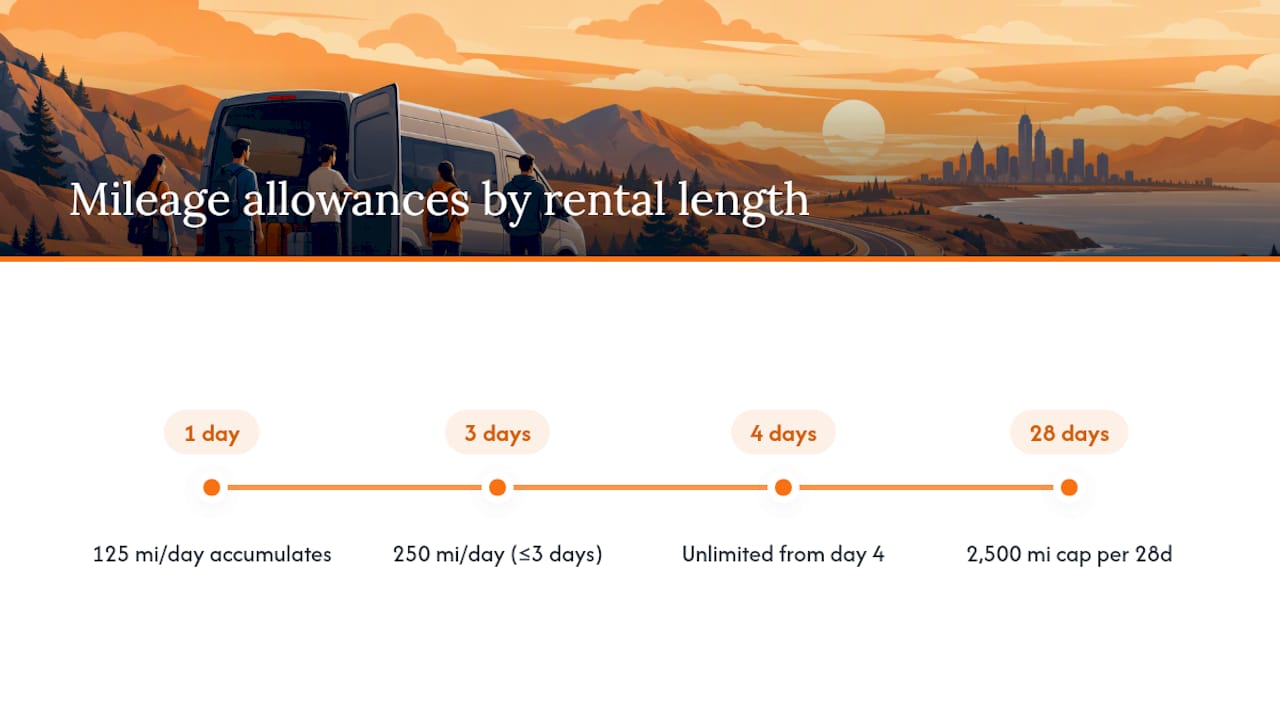
Here’s how those numbers play out on a five-day trip:
Pro Tip: Add up your planned route mileage before you book, then compare it against the daily allowance multiplied by your rental length. A booking that looks cheap upfront can lose that advantage fast once overage fees kick in.
Rates and currencies vary by country and company, so treat these as U.S.-market planning figures rather than fixed universal numbers. For a fuller breakdown of what a van rental actually costs before mileage fees enter the picture, this pricing guide walks through typical rate structures.
How Can You Avoid Excess Mileage Charges?
A little planning before you book saves real money once you’re on the road. Work through these steps in order:
- Map your full route first. Use a mapping tool to total your expected miles, including detours, before comparing that number to any allowance.
- Compare unlimited against your daily rate. If your trip miles exceed the allowance by even a modest margin, unlimited mileage often costs less than paying overage fees.
- Check weekly and promotional rates. Longer rentals sometimes include higher caps or unlimited mileage that a short-term booking won’t offer.
- Confirm the allowance on your contract at pickup. Don’t rely on the quote page alone; read the printed terms before you sign.
- Photograph the odometer reading. This protects you if there’s ever a dispute about total miles driven.
- Ask about cross-border restrictions. Some allowances that look unlimited domestically still apply extra fees or bans once you cross a state or national border.
Pro Tip: Call the location directly if your itinerary includes multiple stops or an unclear return route. Staff can often tell you whether your specific trip pattern qualifies for a better mileage rate than what’s listed online.
What “Unlimited Mileage” Doesn’t Always Include
Unlimited mileage usually refers only to distance driven, and it doesn’t automatically cover everything else in your trip. Cross-border travel, one-way drop fees, and certain toll or fuel surcharges often apply separately, even when the mileage itself carries no cap.
Some companies also build in long-term limits that only show up once a rental stretches past a certain point. Arnold Clark’s structure is a clear example: renters get unlimited mileage after four days, but that unlimited status is capped at 2,500 miles across any 28-day window. A booking that looks fully open-ended on paper can still carry a ceiling once you read the fine print.
Campervan and road-trip focused providers, like KuKu Campers, tend to advertise unlimited mileage more consistently because their business model depends on long-distance sightseeing. Group passenger van rentals don’t follow that pattern as reliably, so verify the exact exclusions and ask staff at pickup before you assume your booking works the same way.

When Is Unlimited Mileage Actually Worth the Extra Cost?
A quick rule of thumb settles most of these decisions: multiply your rental’s daily allowance by the number of days you’re booking, then compare that total against your realistic trip mileage. If your estimate comes in close to or over that number, unlimited mileage almost always pays for itself.
Certain trips benefit more than others:
- Cross-country or multi-state trips where daily mileage adds up fast and unpredictably.
- Multi-stop itineraries with uncertain routing, since detours and rerouting eat into a fixed allowance quickly.
- Group trips with shared driving duties, where total mileage is harder to predict in advance.
Skip the upgrade for short city trips or predictable round-trip routes that fall well under your included allowance. Paying extra for unlimited mileage on a 60-mile weekend errand adds cost without any real benefit.
How Sprinter Van Rentals Handles Mileage Terms
Mileage terms are often listed alongside vehicle details for bookings on nationwide Sprinter van fleets, covering various passenger capacities. This usually means the allowance or unlimited status is shown before committing to a reservation rather than being discovered only in a contract at pickup.
Mileage information typically appears on the vehicle selection screen during the booking process, alongside pricing and vehicle specifications, enabling groups to compare options before choosing a van. For renters weighing a multi-day trip against a shorter one, it’s worth reviewing how long-term rental terms affect mileage caps, since duration often changes the math.
Where to Check Your Exact Mileage Allowance and Book
Reading about typical mileage policies only gets you so far. Every provider sets its own numbers, and the only way to know your real allowance is to check the specific booking page for the van you’re reserving.
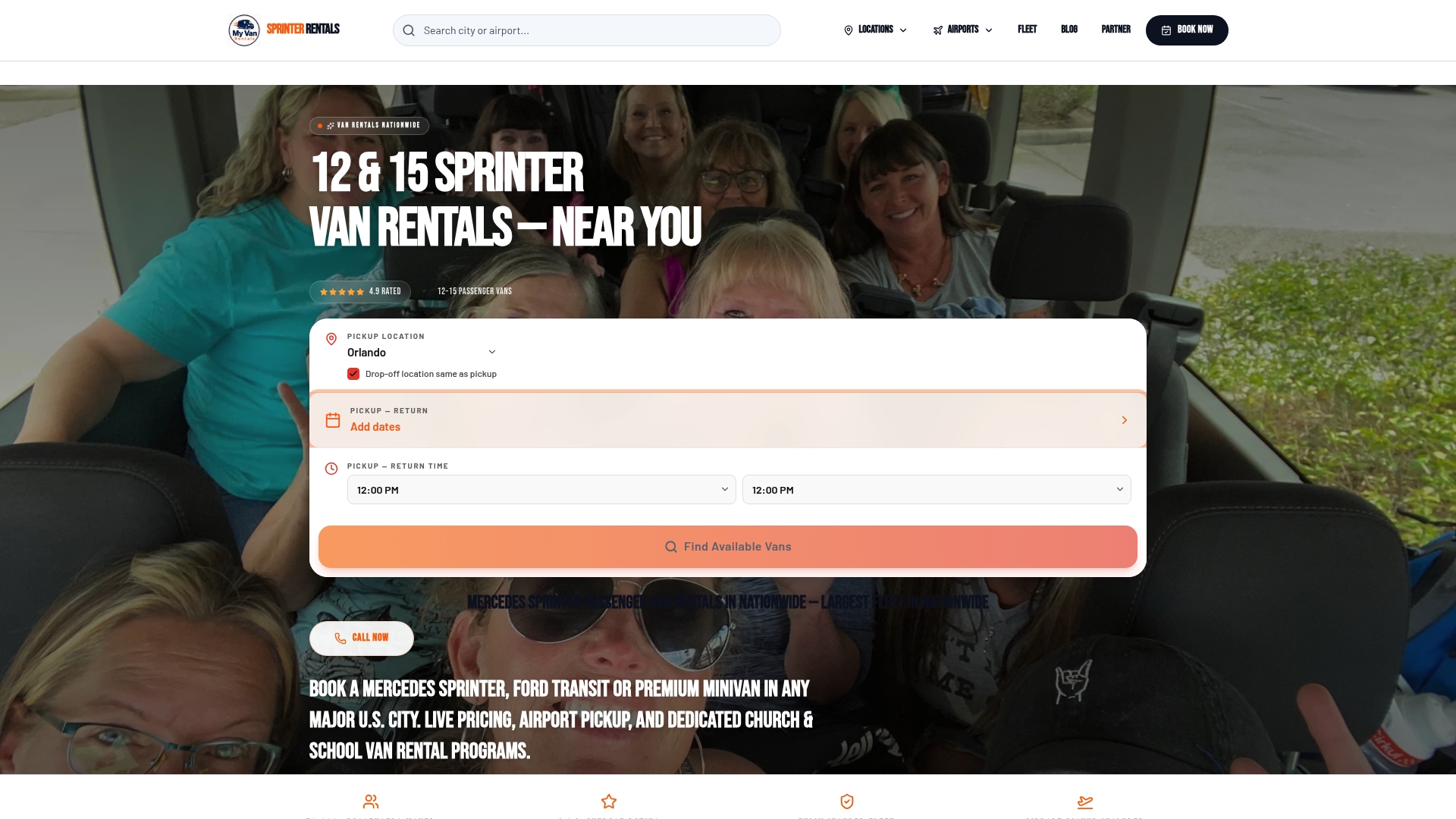
Some rental platforms show mileage terms directly on vehicle listings before payment, so renters can understand what extra miles might cost on longer trips. Whether you need a 12-passenger Sprinter for a family road trip or a full 15-passenger configuration for a sports team, you can compare the mileage allowance against your route mileage before you commit. Head to Sprinter Van Rentals to view live pricing, confirm the mileage terms for your dates, and get a quote for your specific trip.
Why Renters Get Burned by Mileage Assumptions
The biggest mistake I see renters make isn’t picking the wrong van. It’s assuming “van rental” means one consistent mileage policy across every company and every vehicle class, the way it might for a compact sedan. That assumption doesn’t hold. A 15-passenger van from one provider might come with genuinely unlimited miles, while the same vehicle class from another company runs on a 200-mile daily cap with real overage fees attached.
What gets underestimated most is how much rental duration bends the rules. A three-day booking and a five-day booking on paper look like the same policy, but cross a threshold like four days and some companies flip the entire structure from capped to unlimited, sometimes with a longer-term ceiling hiding behind it. Nobody reads that far into the terms until the invoice arrives.
My honest take: don’t trust the word “unlimited” until you’ve read what it excludes. Cross-border rules, one-way fees, and rolling monthly caps all hide behind that word more often than renters expect. The renters who avoid surprise charges aren’t the ones who found the cheapest quote. They’re the ones who read the mileage line item before they signed anything.
— Gabriel
Sources
- Unlimited Mileage Car Rental Policy - Enterprise Rent-A-Car
- 15-Passenger Van rentals | Vehicles - Hertz
- Van Hire Mileage Limit: Short-Term Hire | CVS Van Hire
- Terms of Hire | Arnold Clark Rental
- Unlimited Mileage Campervan Rental Colorado | KuKu Campers
Recommended
Keep reading
How Much Is a Sprinter Van Rental? 2026 Pricing Guide
Real Mercedes-Benz Sprinter van rental prices in 2026 — daily rates, mileage, insurance, delivery fees, and how to lower your total.
How to Start a Sprinter Van Rental Business (2026 Playbook)
Step-by-step guide to launching a Sprinter van rental business — licensing, DOT/FMCSA rules, insurance, fleet financing, and marketing.
Mercedes Sprinter Van Rental in Orlando, FL — Where to Rent
Compare Mercedes-Benz Sprinter van rental options in Orlando, FL — MCO airport delivery, theme park runs, and 12 & 15-passenger pricing.