August 27, 2026 · 9 min read
Do You Need a Deposit for a Van Rental?
Do You Need a Deposit for a Van Rental?

Yes, most van rentals require a deposit, either as a credit card authorization hold or a security payment collected at pickup. Amounts typically run from $150 for smaller vans to $2,500 for large 12 or 15-passenger models, depending on vehicle size, payment method, and rental length. Bring a major credit card and confirm the exact policy before you book to avoid surprises at the counter.
TL;DR:
- Larger vans typically require refundable security deposits starting at $150, but some models and payment methods can demand up to $2,500.
- An authorization hold is a temporary freeze on funds, which can take anywhere from a day to over two weeks to release fully.
- Payment with a credit card usually results in lower deposits and faster releases compared to debit cards or cash payments, which often involve higher holds.
- Confirm your specific vehicle’s deposit amount and policy before pickup, especially for large models, cross-border rentals, or if paying with a debit or cash.
- Using a premium credit card, providing proof of insurance, or purchasing a damage waiver can help reduce or eliminate the deposit requirements.
Table of Contents
- What a Van Rental Deposit Actually Covers
- How Much Is a Van Rental Deposit, Really?
- Authorization Hold or Actual Charge: What’s the Difference?
- Credit Card, Debit Card, or Cash: Which Pays Off?
- Smart Ways to Lower or Skip the Deposit
- Your Pickup and Return Checklist
- How Sprinter Van Rentals Handles Group Van Deposits
- What Group Renters Consistently Get Wrong
- Book Your Sprinter Van With Deposit Terms You Can Plan Around
- Sources
What a Van Rental Deposit Actually Covers
A van rental deposit protects the rental company against costs that show up after you drive off the lot. Understanding the terminology matters because operators use three distinct terms that get lumped together in casual conversation: a reservation deposit, a refundable security deposit, and an authorization hold.
A reservation deposit locks in your booking and is often nonrefundable if you cancel late. A security deposit is held during the rental and released afterward, assuming nothing goes wrong. An authorization hold is a temporary freeze on funds, distinct from either. Some operators charge a separate reservation deposit plus a security hold at pickup, according to rental policy pages from providers like VTI Van Rentals.
The deposit typically covers:
- Vehicle damage beyond normal wear
- Refueling charges if the tank isn’t returned full
- Cleaning fees for excessive mess
- Unpaid tolls or traffic tickets incurred during the rental
- Late return penalties
- Missing equipment (child seats, dollies, straps)
Fuel and cleaning charges get disputed most often. Keep your gas station receipt and take timestamped photos of the van’s interior and exterior at drop-off.
How Much Is a Van Rental Deposit, Really?
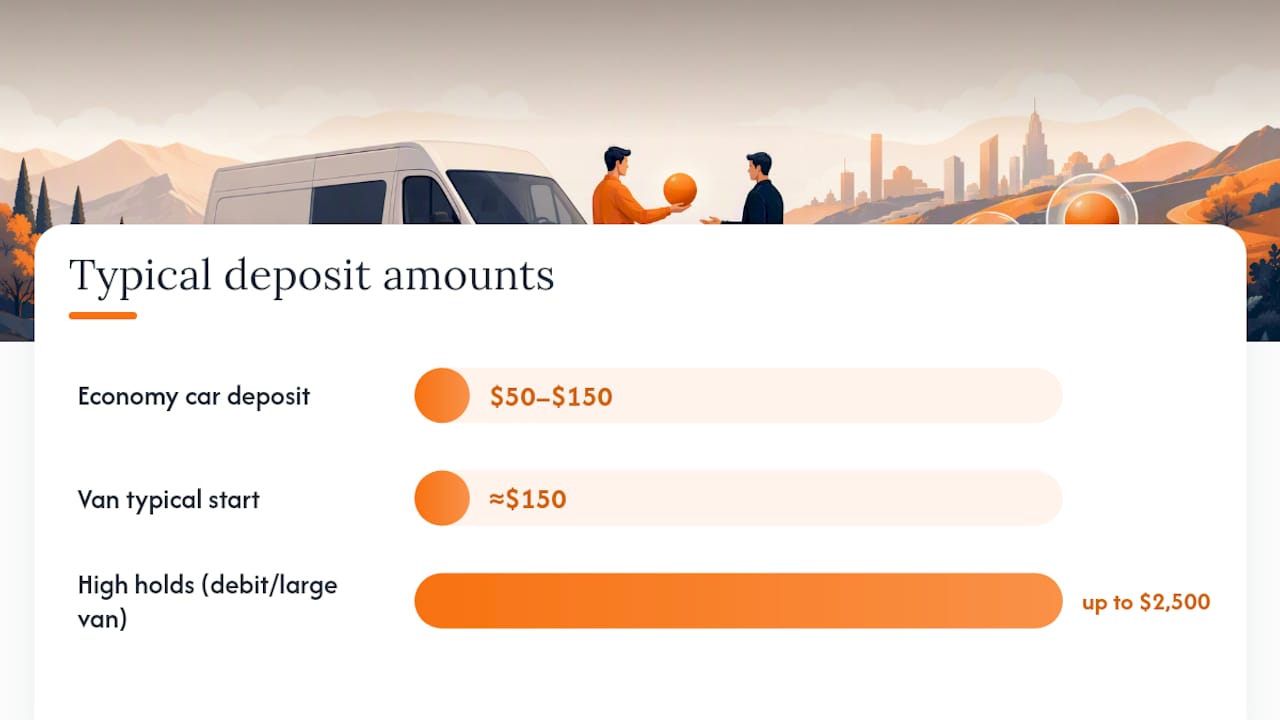
Deposit size scales with risk, and vans carry more of it than sedans. Economy cars often see deposits in the $50 to $150 range. Standard cars land somewhat higher. Vans, especially 12 and 15-passenger models, routinely start at $150 and climb well beyond that.
Several factors push the number up:
- Vehicle classification: larger vans cost more to repair and often fall under commercial-class rules, which is why Enterprise’s France-market van rental page lists a fixed €500 deposit for vans in that market.
- Rental duration: longer rentals often mean higher holds.
- One-way or cross-border trips: added logistics and risk usually raise the deposit.
- Driver age and record: younger or higher-risk drivers frequently pay more.
- Payment method: debit and cash renters almost always face steeper deposits than credit card users.
Deposit snapshot: Some van rental operators set refundable security deposits starting around $150, but certain large vans or debit-card bookings can require holds up to $2,500. That’s a sixteen-fold spread, which is exactly why confirming your specific vehicle’s policy before pickup day matters more than trusting a generic online estimate.
Group and 12 to 15-passenger van rentals trend toward the higher end of these bands because repair costs run higher and insurers apply stricter commercial-class terms to bigger vehicles.
Authorization Hold or Actual Charge: What’s the Difference?
An authorization hold is not a charge. It’s a temporary freeze that reduces your available credit without moving any money, placed the moment you pick up the van as a placeholder against potential fees.
Release timing varies more than most renters expect:
- Some holds disappear within a day or two of return, once the rental company confirms no damage or extra charges.
- Others take longer. Bank processing can stretch 7 to 14 days or more, according to Nomora’s breakdown of how rental deposits work.
- If extra fees apply (unpaid tolls, damage, a late return), the rental company converts part or all of the hold into an actual charge, and you’ll see a separate line item on your statement.
Even after the rental company releases its hold, your bank’s own internal process can keep the freeze visible on your account for a few extra days. That’s a bank quirk, not a sign the rental company did anything wrong.
Pro Tip: If a hold is still showing after two weeks, contact the rental company first and ask for written confirmation the deposit was released on their end. Then take that confirmation to your card issuer. Having a paper trail speeds up resolution considerably.
Credit Card, Debit Card, or Cash: Which Pays Off?
Payment method changes your deposit experience more than almost any other factor. Rental companies treat a major credit card as the gold standard because it demonstrates access to credit and gives them a straightforward way to place a hold without moving actual cash.
Debit card renters often face higher deposit minimums compared to credit card users.
- Additional identification requirements, sometimes including proof of address
- A pay stub or secondary ID in some cases
- Occasional background or credit checks before the keys change hands
Policy pages for van rental operators commonly spell out these debit-specific requirements because debit transactions carry more risk for the company. There’s no credit line behind them.
Cash rentals exist but are far less common for vans, particularly for group and 15-passenger models. When available, expect a higher deposit than either card option and more paperwork to prove identity and residence. If you’re planning to pay cash, call ahead. Don’t assume every location accepts it.

Smart Ways to Lower or Skip the Deposit
You have more leverage here than most renters realize. A few tactics genuinely move the needle:
- Use a premium credit card. Some cards include built-in rental coverage, which can reduce what the company asks for upfront. Check your card’s benefits guide before you book.
- Show proof of primary insurance. If your personal auto policy or a third-party plan covers rental vehicles, present it at pickup. It often lowers the deposit the company requires. Sprinter Van Rentals’ liability insurance options can also factor into this equation.
- Buy the rental company’s damage waiver. It costs more per day but frequently reduces or eliminates the security deposit. Weigh the daily cost against your risk tolerance and trip length.
Pro Tip: “No deposit” offers sound appealing, but read the cancellation and damage clauses closely. Some operators recover that risk through nonrefundable prepayment instead.
Your Pickup and Return Checklist
Preparation at the counter saves headaches at drop-off. Before you leave with the keys:
- Present the same card used for the online authorization. A mismatch can delay pickup.
- Bring IDs for every listed additional driver.
- Walk the vehicle with staff and take timestamped photos of every panel, plus the interior and fuel gauge.
- Get written confirmation of the fuel level and any pre-existing damage.
At return, the company reconciles your final invoice against the hold. If everything matches, the hold releases; if not, they convert the difference into a charge. Bank release windows still apply even after the company processes the release. If a hold lingers past two weeks, escalate with the rental company first, then your card issuer, and keep every email and receipt along the way.
How Sprinter Van Rentals Handles Group Van Deposits
Sprinter Van Rentals works with a nationwide network covering 260+ U.S. cities, and deposit terms follow the same logic outlined above: vehicle size, insurance coverage, and payment method all factor into what you’ll be asked to hold at pickup. For 12 and 15-passenger Sprinter vans, expect deposit expectations on the higher end given the vehicle class, similar to industry norms for large group vehicles.
Before booking, review the fleet options to match vehicle size to your group’s actual needs, since oversizing your van often means an unnecessarily high deposit. If your trip crosses into Mexico, check the insurance requirements for cross-border travel well ahead of time. International trips almost always carry different deposit and coverage rules than domestic rentals.
At pickup, bring your booking confirmation, the credit card used for reservation, valid ID for every driver, and any proof of insurance you plan to use to offset the deposit.
What Group Renters Consistently Get Wrong
Most advice about van rental deposits treats every vehicle the same way, and that’s the biggest blind spot in this whole topic. A deposit guide written for a compact sedan renter doesn’t translate cleanly to someone booking a 15-passenger van for a church retreat or a sports team. The stakes are different. The repair costs are different. The insurance math is different.
Here’s what the research actually supports: group and large-van renters should treat the deposit conversation as part of vehicle selection, not an afterthought at checkout. If you’re comparing a 12-passenger against a 15-passenger van for a trip where either would technically fit, the smaller van will almost always carry a lighter deposit and lower daily insurance costs. That’s a decision worth making before you fall in love with the extra legroom.
The other overlooked point: debit card renters get treated as a completely different risk category, and most people don’t find out until they’re standing at the counter with a declined reservation. If your group is pooling funds and someone volunteers their debit card, ask about the policy days in advance, not the morning of pickup.
— Gabriel
Book Your Sprinter Van With Deposit Terms You Can Plan Around
Sprinter Van Rentals gives group travelers a clearer starting point than piecing together policies from a dozen local van companies. Because Sprinter Van Rentals works with a nationwide fleet of 12 and 15-passenger Sprinter vans, insurance and deposit terms stay consistent whether you’re booking in Denver or Dallas, so you’re not relearning a new company’s rules for every trip.
That consistency matters most for group organizers coordinating weddings, sports teams, or corporate travel, where a surprise deposit policy can derail a tight schedule. Sprinter Van Rentals also offers liability insurance options and driver add-ons through its Sprinter Van Driver program, both of which can factor into lowering what you’re asked to hold at pickup. If your group needs a hands-off option entirely, a chauffeured booking through Sprinter Van Rentals’ transportation service shifts liability off your personal card altogether.
Start by browsing the 12 and 15-passenger van rental options nationwide and requesting a quote for your dates. You’ll know your deposit terms before you commit.
Sources
- Terms & Conditions – AVH Van Rental
- Car Rental Security Deposits: How They Work (2026 Guide) — Nomora
Recommended
Keep reading
How Much Is a Sprinter Van Rental? 2026 Pricing Guide
Real Mercedes-Benz Sprinter van rental prices in 2026 — daily rates, mileage, insurance, delivery fees, and how to lower your total.
How to Start a Sprinter Van Rental Business (2026 Playbook)
Step-by-step guide to launching a Sprinter van rental business — licensing, DOT/FMCSA rules, insurance, fleet financing, and marketing.
Mercedes Sprinter Van Rental in Orlando, FL — Where to Rent
Compare Mercedes-Benz Sprinter van rental options in Orlando, FL — MCO airport delivery, theme park runs, and 12 & 15-passenger pricing.