September 2, 2026 · 14 min read
What Operators Recommend for Group Van Rental Delivery: 12 or 15 Seats
What Operators Recommend for Group Van Rental Delivery: 12 or 15 Seats

For group airport transfers, event shuttles, and team travel, book a 12- or 15-passenger Sprinter, chauffeured when punctuality and parking matter, self-drive when you need flexibility. Airport runs, weddings, sports tournaments, and church trips all fit this format. Confirm your final headcount and luggage load, then request a quote so the operator can lock the right configuration.
TL;DR:
- Choose a 12-passenger van for more comfort and luggage space if the group size is near 12, but consider a 15-passenger van for larger, more straightforward groups up to 15.
- Book at least 24 to 72 hours in advance with precise headcount, luggage details, and confirmation of vehicle configuration to avoid last-minute issues.
- Budget between $175 and $350 per hour for chauffeured services or about $585 for one-way airport transfers, ensuring quotes include all fees like gratuity, tolls, and parking.
- For airport pickups, provide flight details and confirm meet-and-greet locations; build in extra buffer time for delays and assign a primary contact for communication.
- Verify vehicle condition, seatbelts, safety features, fuel level, and documentation during handoff to prevent disputes and ensure a smooth trip.
Table of Contents
- How Do You Choose Between a 12- and 15-Passenger Sprinter Van Rental?
- What’s the Booking Process and Timeline for a Group Van?
- How Much Should You Budget for a Van Rental Delivery Service?
- What Should You Know About Airport Pickup Logistics?
- What Safety and Insurance Details Should You Verify?
- How Do You Load Luggage and Seats Efficiently?
- What Are the Delivery Options and Fees for Getting the Van to You?
- Are There Geographic Restrictions on Where You Can Drive a Delivery Van?
- What Documentation and License Requirements Apply to Delivery Vans?
- What Should You Check When the Van Is Delivered?
- What Do Experienced Group Organizers Wish They’d Known Sooner?
- How Sprinter Van Rentals Makes Van Rental Delivery Simple for Groups
- Sources
How Do You Choose Between a 12- and 15-Passenger Sprinter Van Rental?
The headcount decision is really a comfort-versus-capacity tradeoff. A 12-passenger Sprinter gives every rider more legroom and a bigger buffer for bags, coolers, or equipment cases. A 15-passenger configuration packs in more bodies but leaves less room per person once luggage enters the equation.
Seating in these vans typically runs 10 to 15 passengers depending on interior layout, and executive configurations often trim seat count on purpose to add legroom, tables, or mood lighting. That matters for corporate groups who want the ride itself to feel like part of the event.
A few practical rules help narrow the choice:
- Sports teams and gear-heavy groups: count duffel bags, stick bags, or instrument cases separately from headcount, since bulky items eat seats fast.
- Urban pickups: a 12-passenger van maneuvers hotel loops and city curbs more easily than a 15-passenger van.
- Large-venue staging: weddings and conferences with a dedicated loading zone can comfortably handle the 15-passenger footprint.
- Groups near 15: 10 to 15 riders benefit from a single van for simplicity, but past that threshold, two vans or a charter bus usually work better than overloading one Sprinter.
- When unsure, size up. Reserving one seat more than you expect avoids an on-site denial if a “plus-one” shows up.
Executive and limo configurations trade a few seats for legroom, USB charging, and mood lighting, which fits corporate clients better than youth sports trips. You can compare seating and luggage layouts directly on the fleet configuration page before you commit to a headcount.
What’s the Booking Process and Timeline for a Group Van?
Booking a Sprinter isn’t complicated, but skipping a step tends to cause the exact chaos you’re trying to avoid on travel day. Follow this sequence:
- Lock in your headcount and luggage estimate first. This determines whether you need 12 or 15 seats, and whether you need a trailer or second vehicle.
- Book with adequate lead time. Standard airport and event runs typically need 24 to 72 hours notice; same-day bookings are possible but risky for time-sensitive transfers.
- Provide the essentials up front: exact passenger count, flight numbers if it’s an airport run, precise pickup and drop-off addresses, and any accessibility needs.
- Get written confirmation of the hourly or flat rate, the driver’s name and contact number, the exact vehicle configuration, and the cancellation policy.
- Reconfirm 24 to 48 hours before pickup, especially if headcount could shift.
Most operators will accommodate a modest headcount reduction close to departure, but adding riders last minute is harder; the van you reserved may already be maxed on seatbelts. If your event date is fluid, ask about change fees before you sign anything, not after.
How Much Should You Budget for a Van Rental Delivery Service?
Pricing usually falls into three models: hourly with a minimum, a flat one-way airport rate, or a full-day charter rate. Which one saves you money depends entirely on your itinerary shape.
Chauffeured Sprinter service commonly runs $175 to $350 per hour depending on vehicle class and market, while dedicated airport transfers sometimes start around $585 one-way for larger runs. Hourly pricing tends to favor multi-stop event days; flat rates tend to favor a single point-to-point airport trip.
By the numbers: A $175 one-way airport transfer split across 10 passengers works out to about $17.50 per person, often cheaper than 10 separate rideshare fares once you account for luggage handling and coordination.
Before comparing quotes side by side, check what’s actually included:
- Driver gratuity (sometimes bundled, sometimes added separately)
- Airport parking or waiting fees
- Tolls along the route
- Overtime charges if the event runs long
- Fuel surcharges on longer trips
Two quotes that look similar on the surface can differ by $100 or more once these add-ons surface. Ask each operator to itemize the base rate before you compare, and check a current pricing guide if you want typical ranges by trip type.
What Should You Know About Airport Pickup Logistics?
Airport transfers are where most group van bookings succeed or fail, and the difference usually comes down to communication before the trip, not anything that happens at the curb.
Give the operator your flight number, always. Operators monitor flight arrival times and adjust pickup timing automatically, which means a delayed flight doesn’t leave your group standing at baggage claim wondering where the van went. Confirm the exact meet-and-greet location in writing, whether that’s a specific terminal door, a designated rideshare zone, or a cell-phone lot where the driver waits for your call.
A few operational habits reduce day-of stress:
- Build in a 15 to 30 minute buffer after the scheduled landing time for deplaning and baggage claim.
- Ask whether the driver tracks your flight automatically or needs a text when you land.
- Confirm whether luggage handling is included or if your group loads the van itself.
- For groups splitting across multiple flights, ask about a dedicated transfer instead of a shared multi-stop run.
Pro Tip: Assign one person in your group as the “driver contact” who keeps their phone on and handles all communication with the chauffeur. Splitting that responsibility across five group texts is how pickups get missed.
Dedicated transfers cost more than shared shuttle runs but eliminate the risk of your group waiting while the van drops off strangers first. For a large team or wedding party, that reliability is usually worth the premium.
What Safety and Insurance Details Should You Verify?
Chauffeured and self-drive rentals shift responsibility in very different directions, and knowing which one you’re booking changes what you need to check.
With chauffeured service, the operator handles licensing, insurance, and vehicle maintenance. You should still verify the driver’s license type and commercial insurance proof before departure, along with recent vehicle inspection records. Reputable operators provide the driver’s name and direct contact number ahead of pickup, not just a dispatch line.
Self-drive rentals put more on your shoulders. Age minimums, license class, and liability rules vary by state and by rental company, so confirm these before assuming a standard driver’s license covers a 15-passenger van. Ask specifically about:
- Minimum driver age (often 25, though this varies)
- Whether supplemental liability insurance is recommended for a vehicle this size
- Fuel policy: full-to-full is standard, but confirm the refueling location requirement
- Mileage caps and the per-mile overage rate
- Damage liability limits and the deposit hold amount
If your group includes teen drivers or you’re unsure who’s driving, chauffeured service removes the question entirely. You can compare both paths on the driver options page.
How Do You Load Luggage and Seats Efficiently?
Loading a 12- or 15-passenger van for a group trip goes faster when someone has a plan before the van shows up. Plan roughly one standard suitcase and one carry-on per person; oversized items like hockey bags, golf clubs, or cellos need to be flagged ahead of time so the driver can plan the stow layout.
- Board back-to-front so nobody climbs over seated passengers.
- Assign seats in advance for large groups to avoid a scramble at the curb.
- Flag any mobility needs when booking so the driver can plan boarding time and seat placement.
- Designate one trip leader who carries the driver’s contact number and a backup plan if timing slips.
Pro Tip: Load bulky gear first, then luggage, then people. Reversing that order means unloading half the van to fit one hockey bag that didn’t fit.
What Are the Delivery Options and Fees for Getting the Van to You?
Not every group wants to pick up a Sprinter at a rental counter, and most operators, including Sprinter Van Rentals, offer door-to-door delivery as an alternative. Delivery means the van arrives already fueled, cleaned, and configured at a home, hotel, church, office, or venue you specify, and the driver either hands off the keys for self-drive or stays on as chauffeur.
Delivery fees typically scale with distance from the operator’s nearest depot and with how early or late in the day the delivery happens. A daytime delivery within a normal service radius often carries a modest flat fee or none at all when bundled into an event package; early-morning, late-night, or long-distance delivery tends to add a surcharge. Ask for this fee in writing alongside your rate confirmation, not as a surprise line item on the final invoice.
Business delivery works the same way as residential delivery, but corporate clients should confirm loading dock access, parking restrictions, or building security requirements ahead of time. Church groups and event venues should do the same, since a delivery driver circling a packed parking lot on a Saturday morning wastes everyone’s buffer time.
A few questions worth asking before you book delivery:
- Is there a minimum booking size or rental length to qualify for free delivery?
- Does the delivery fee cover return pickup too, or is that billed separately?
- What happens if your delivery address changes after booking?
- Is a contact person required to be on-site to receive the van?
Delivery adds convenience, especially for groups without an easy way to reach a rental counter, but it works best when the address and access details are locked in early.
Are There Geographic Restrictions on Where You Can Drive a Delivery Van?
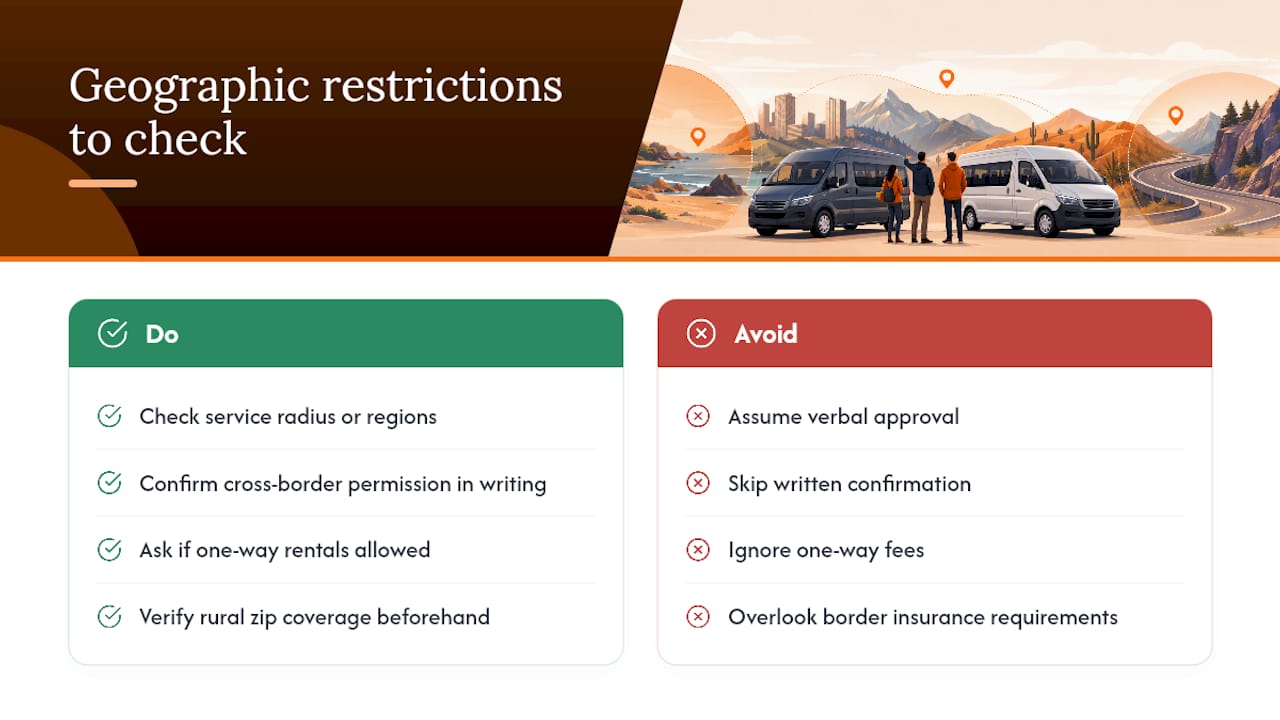
Most van rental companies define a service radius or a list of approved travel regions, and delivery rentals are no exception. A van delivered to your driveway or venue usually comes with either an unrestricted mileage allowance within a defined multi-state region or a capped radius tied to specific drop-off and return points.
Interstate travel is common with these rentals, but crossing certain borders, particularly international ones, usually requires advance written permission and sometimes additional insurance coverage. If your group is planning a trip that crosses into Canada or Mexico, confirm this explicitly before booking; most standard agreements exclude it by default.
One-way rentals, where you pick up in one city and drop off in another, are typically available only through select markets and carry a separate one-way fee. If your itinerary has your group flying into one airport and driving to a destination in another state before returning home, ask directly whether the van can be dropped at a different location than where it was delivered.
Rural or remote delivery addresses sometimes fall outside a company’s standard service area even when the destination is within the same state. It’s worth checking coverage for your specific pickup and delivery zip codes before finalizing dates, particularly for church retreats, sports tournaments in smaller towns, or family reunions at lake houses and rural venues.
Confirm any regional restriction in writing alongside your rate quote, since a verbal “that should be fine” from a booking agent isn’t something you can rely on if a border checkpoint or toll authority disagrees.
What Documentation and License Requirements Apply to Delivery Vans?
Delivery rentals require the same core documentation as counter pickups, plus a few delivery-specific details. Expect to provide a valid driver’s license, a credit card in the renter’s name for the security deposit, and proof of insurance if you’re waiving the company’s optional coverage.
Age requirements for self-drive 15-passenger vans commonly start at 25, though this varies by company and by state, and some insurers apply a young-driver surcharge below that threshold regardless of the base rental terms. If your group’s designated driver is under 25, confirm this before you build your travel plan around them.
For chauffeured delivery, the renter typically isn’t driving at all, so the documentation burden shifts to the organizer confirming logistics rather than proving a license. You’ll still need to provide a primary contact name, phone number, and the exact delivery address, plus written authorization if someone other than the account holder will be receiving the vehicle on-site.
Corporate and church groups booking delivery under an organizational account should confirm whether the company requires a formal authorization letter naming which employees or members are approved to sign for the vehicle. This detail gets missed often, and it can delay a delivery on the morning of an event if the person on-site isn’t the one who booked the reservation.
Keep a printed or digital copy of your confirmation, insurance card, and the driver’s license of anyone authorized to drive, since a delivery driver handing off keys will typically ask to see all three before completing the handoff.
What Should You Check When the Van Is Delivered?
A delivered van should arrive in verifiably good condition, and a quick walkthrough at handoff protects you from disputes over damage later. Before the delivery driver leaves, walk the exterior with them and note any existing scratches, dents, or windshield chips, ideally with photos timestamped on your phone.
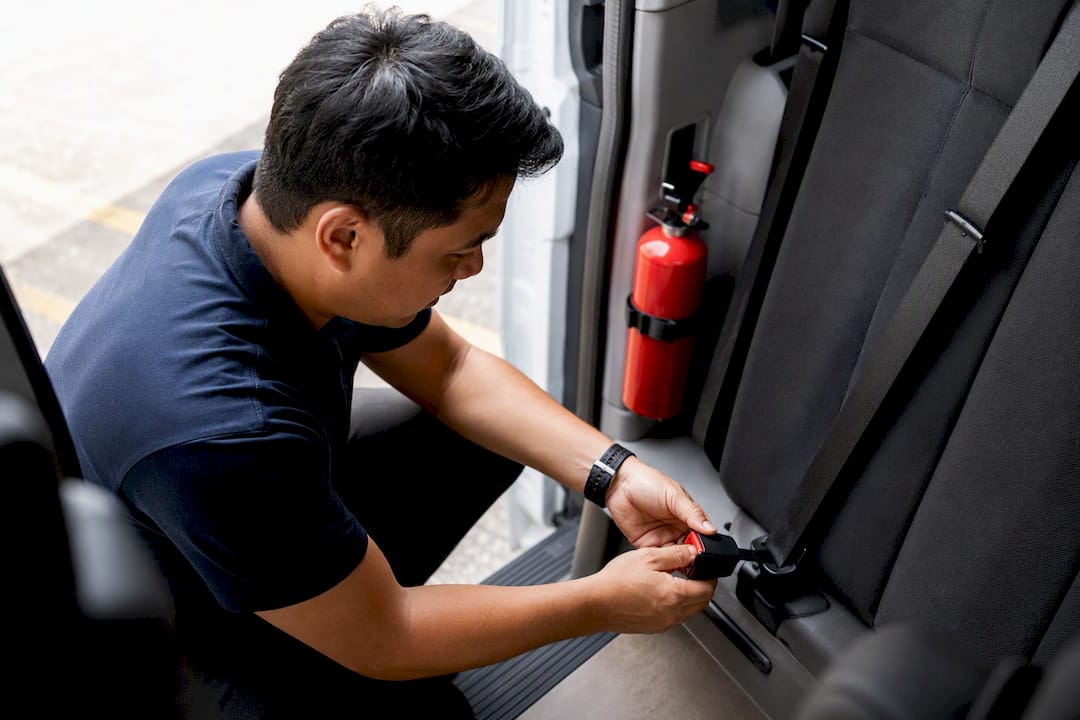
Inside the van, confirm the safety basics: working seatbelts at every seat position, a visible fire extinguisher, functioning interior lighting, and an accessible first-aid kit if your organization requires one for events. Check that the number of working seatbelts matches your booked seat count exactly, since a broken buckle on a 15-passenger van means you’re effectively down to 14 usable seats.
Test the essentials that affect comfort on a longer transfer: air conditioning across all zones, the sliding door mechanism, and any onboard charging ports if your group needs them. For chauffeured delivery, ask the driver directly about the vehicle’s last inspection date and mileage; a legitimate operator has this on hand without hesitation.
Confirm the fuel level at handoff and get it noted in writing, since a full-to-full policy only works fairly if both parties agree on the starting level. Take a photo of the dashboard fuel gauge and odometer before the driver leaves, and keep it alongside your booking confirmation. This single habit resolves more post-rental disputes than any other single step in the process.
What Do Experienced Group Organizers Wish They’d Known Sooner?
The biggest mistake I see organizers make isn’t picking the wrong van size. It’s confirming logistics too late. Venue pickup zones, parking restrictions, and loading dock access should get nailed down when you book, not the week before your event.
Headcount is the other recurring headache. Groups drift up or down between booking and departure, and the smart move is reconfirming your exact number 24 to 48 hours out, not assuming the number you gave three weeks ago still holds. That single phone call prevents most of the “we have three extra people” scrambles that happen curbside.
Fleet specs matter more than people expect. A 15-passenger van isn’t automatically better than a 12-passenger one once luggage enters the math, and reviewing actual seating and cargo layouts before you book beats guessing based on the seat number alone.
— Gabriel
How Sprinter Van Rentals Makes Van Rental Delivery Simple for Groups
Sprinter Van Rentals is built specifically around the group transportation problem this article just walked through: matching the right seat count, the right driver setup, and the right delivery logistics to your actual trip, without the guesswork of comparing five separate quotes yourself.
The fleet covers both 12- and 15-passenger Sprinter configurations, with a chauffeur add-on for groups who want to skip the parking and navigation headaches entirely, plus executive and limo van configurations for corporate clients and wedding parties who want a premium ride. Coverage spans 260-plus U.S. cities, so airport transfers, church retreats, and multi-city sports travel all run through the same booking system.
Getting started is straightforward: check available 12- and 15-passenger configurations for your city, request a quote with your headcount and luggage details, and add a driver or supplemental insurance if your group needs it. For a larger event where you’re weighing a van against a full charter bus, Reliant Transportation offers useful background on scaling group transport past the single-vehicle threshold.
Ready to lock in your dates? Request a quote today and confirm your configuration before your travel window fills up.
Sources
- Complete Guide to Sprinter Van Service: Premium Group Transportation Solutions
- Sprinter Van Rental Orlando: The 2026 Chauffeured-Only Insider Booking Guide - Orlux Rides
- When a 15 Passenger Van Rental Is the Best Travel Choice in 2026
- Renting A 15-Passenger Van: Ultimate Guide For Group Trips | ShunRent
Recommended
Keep reading
How Much Is a Sprinter Van Rental? 2026 Pricing Guide
Real Mercedes-Benz Sprinter van rental prices in 2026 — daily rates, mileage, insurance, delivery fees, and how to lower your total.
How to Start a Sprinter Van Rental Business (2026 Playbook)
Step-by-step guide to launching a Sprinter van rental business — licensing, DOT/FMCSA rules, insurance, fleet financing, and marketing.
Mercedes Sprinter Van Rental in Orlando, FL — Where to Rent
Compare Mercedes-Benz Sprinter van rental options in Orlando, FL — MCO airport delivery, theme park runs, and 12 & 15-passenger pricing.