September 9, 2026 · 11 min read
Ask Rental Fleets for 3 Van Height Clearance Specs Before You Drive
Ask Rental Fleets for 3 Van Height Clearance Specs Before You Drive

Most cargo and passenger vans range from roughly 6.8 feet for low-roof models to heights exceeding 9 feet for high-roof builds when roof accessories are included. That’s a three-foot swing, which is exactly why guessing gets people stuck. The rule that matters most: know your van’s measured, finished height, then keep at least 6 to 12 inches of margin under any posted clearance sign before you commit to a route.
TL;DR:
- Always measure your van’s finished height, including accessories, and keep a 6 to 12-inch safety margin under posted clearance signs.
- Be aware that internal height can decrease by 2 to 4 inches after insulation, ceiling panels, and flooring are installed.
- Clearance signs vary widely by region and structure, making route-specific checks essential to avoid low clearance incidents.
- Snow, ice buildup, and loaded roof equipment can add several inches to your van’s height, requiring re-measurement before routes.
- Fleet operators document vehicle heights and modifications carefully, and rental drivers should confirm exact dimensions and accessories before trips.
Table of Contents
- Van Height Clearance by Roof Type: Low, Medium, and High
- How to Measure Your Van’s Total Height (Step by Step)
- Common Clearance Limits and When You Need a Permit
- Safety Checklist Before You Drive
- If You Hit a Low Clearance: What to Do Immediately
- How Clearance Rules Change From Region to Region
- Weather and Cargo Load Can Change Your Effective Height
- Commercial Vans vs. Personal Vans: Different Clearance Stakes
- What Rental Fleets Get Right About Clearance
- Check Your Finished Height Before You Book
- Where to Verify Clearance Rules and Van Specs
- Sources
Van Height Clearance by Roof Type: Low, Medium, and High
The term most manufacturers and DOT documents actually use is “vertical clearance,” and it covers everything from the vehicle’s exterior height to the posted limit on a structure. Van height clearance breaks down into three rough categories, and the difference between them isn’t cosmetic. It’s the line between fitting under a parking garage and peeling your roof off.
- Low roof: Exterior height typically runs 6.8 to 7.5 feet (82 to 90 inches). Interior standing room is usually limited, often under 5 feet, so these are built for cargo hauling, not walking upright inside.
- Medium roof: Exterior height generally sits between 8 and 8.5 feet (96 to 102 inches), with interior standing height often in the 6-foot range depending on the platform.
- High roof: Exterior height commonly lands between 8.75 and 9.5 feet, according to Vanetics’ wheelbase and roof height guide, once factory roof accessories are factored in. Interior standing room after finishing often reaches 76 to 81 inches, where most conversion vans and tall passenger models land.
None of these numbers are fixed by law. They shift based on wheelbase, model year, and whether the manufacturer counts the roof rib or the actual peak. Conversion work changes things further. Insulation, ceiling panels, and subfloor typically shave 2 to 4 inches off raw interior height once a shell becomes a livable or workable space. If you’re comparing a full-size cargo van in high-roof trim against a passenger version of the same platform, expect the exterior number to be close, but the interior story to differ once flooring and headliners go in.
How to Measure Your Van’s Total Height (Step by Step)
A sticker on the door jamb tells you what the factory built. It doesn’t tell you what’s on your van right now. Roof racks, rooftop AC units, ladders, and solar panels get added after the fact, and none of them show up on the original spec sheet.
- Park on level ground. A slope throws off even a careful measurement.
- Use a tape measure, a height pole, or a laser measure to find the highest solid point on the vehicle, including any fixed accessory.
- Add clearance for temporary cargo that sits above the roofline, like ladders or roof-mounted bike racks.
- Round up, never down. If your reading lands at 9 feet 4.5 inches, treat it as 9 feet 5 inches.
- Re-measure any time you add or remove a roof accessory, install a conversion, or swap tires and suspension components that change ride height.
Pro Tip: Write your finished height on a laminated card and tape it to the dashboard where you can see it while driving. Rental fleets and professional drivers do this because stress and unfamiliar roads are exactly when people forget a number they knew perfectly well in the driveway.
If you rent rather than own, ask for the finished height in writing before you leave the lot, not after you’re staring at a garage entrance.
Common Clearance Limits and When You Need a Permit
Clearance signs aren’t uniform, and that inconsistency is where most incidents happen. Drivers assume a highway number applies everywhere. It doesn’t.
- Parking garages, drive-thrus, and older overpasses commonly post clearances between 7 and 9 feet, according to building-code references that cite minimums like the 98-inch vertical clearance standard used in many parking-structure codes. Plenty of high-roof vans exceed that without even trying.
- Major highways and interstates are typically engineered for 14 to 16 feet of vertical clearance, but that number falls off fast once you leave the interstate system.
- Local bridges and tunnels can sit far below that. Municipal crossings in dense cities sometimes post clearances as low as 12 feet 1 inch, and older structures may be lower still.
Highway design assumes 14 to 16 feet. Local structures routinely post 7 to 13 feet 6 inches. That difference is where most van height clearance problems actually happen.
Several states use 13 feet 6 inches as a common threshold for vehicles that don’t need special permits, a figure confirmed in Massachusetts commercial vehicle permit guidance. Go above that on certain routes and you may need a permit or an escort, a pattern Virginia’s DOT also documents for specific bridges and tunnels. If your van’s finished height is anywhere near 13 feet 6 inches, which is rare for standard passenger and cargo vans but common for van-based box trucks, check state rules before you plan a route through unfamiliar territory.
Safety Checklist Before You Drive
Route planning for van height clearance takes five minutes and saves you a five-figure repair bill.
- Confirm your measured height, plus accessories, against your safety margin of 6 to 12 inches.
- Read posted clearance signs at every garage, drive-thru, and low structure, even ones you’ve used before.
- Switch your GPS to commercial-vehicle or truck routing where the app supports it, since passenger-car routing ignores height entirely.
- Keep a laminated clearance card on the dash, and update it the moment you add or remove equipment.
- Call ahead to venues or garages when a route looks tight, especially for underground parking with no posted sign visible from the street.
Pro Tip: Standard consumer GPS apps route by distance and traffic, not height. If you’re driving anything above a low-roof van regularly, a routing app or setting built for trucks and commercial vehicles is worth the switch, even for personal use.
Avoid underground garages entirely when signage is missing or faded. A blank wall where a clearance sign should be isn’t a good sign. It’s a guess you shouldn’t make.
If You Hit a Low Clearance: What to Do Immediately
Stop before the obstruction, not underneath it. If your van is already partially under a structure and you’re unsure of the clearance, get out and look rather than inch forward hoping for the best. Never try to force passage by flooring it. That turns a scrape into a structural problem.
If contact happens, stop the vehicle immediately, secure the scene, and photograph the damage to both the vehicle and the structure. Notify the property owner or the relevant agency, and contact your insurer before moving the van if there’s any chance of structural damage to the roof or frame. If your route triggers a permit requirement, your state DOT’s freight or oversize-vehicle office is the right place to start, not a general customer service line.
How Clearance Rules Change From Region to Region
Vertical clearance regulation is a patchwork, not a single national standard. Federal highway design guidance sets a consistent target for interstates, but once you’re off that system, every state and city writes its own rules.
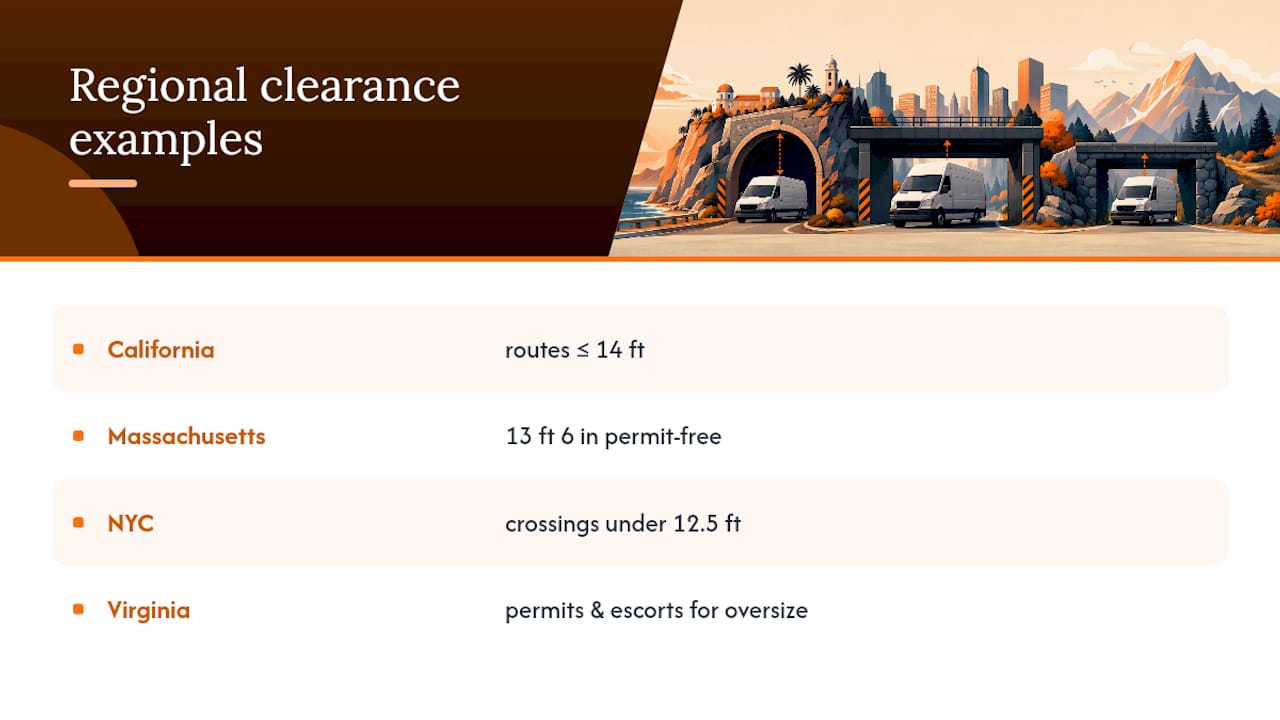
California’s DOT maintains a searchable list of state routes and structures with clearances at or below 14 feet, along with short-term restriction notices for construction or resurfacing work. Massachusetts leans on a 13-foot-6-inch threshold for permit-free travel on many routes. Virginia issues permits and escorts for oversized loads on specific bridges and tunnels where the standard limit doesn’t apply. New York City’s tunnel and bridge network includes crossings under 12.5 feet, numbers that would shock a driver used to interstate clearances.
The pattern holds internationally too: clearance signage, measurement units, and permit processes vary by country, and older infrastructure in any region tends to run lower than newer construction. A structure built decades ago rarely got redesigned just because vehicles got taller.
The practical takeaway is that no single number works everywhere. A van that clears every garage in one city might not clear the tunnel entrance three states over. Treat every unfamiliar route as a fresh check, not an assumption carried over from your last trip.
Weather and Cargo Load Can Change Your Effective Height
Snow and ice buildup on a roof rack, ladder rack, or rooftop AC unit adds height you didn’t account for during your last measurement. A few inches of packed snow on a roof-mounted cargo box is enough to turn a comfortable clearance into a tight squeeze, and it’s easy to miss because the snow accumulated gradually over a drive, not all at once.

Cargo loading works differently but creates the same risk. Items strapped to a roof rack, extension ladders lashed on top, or aftermarket cargo boxes all raise your effective height above what the manufacturer listed. Tire chains and heavier snow tires can also shift ride height slightly, though the effect is smaller than most people expect.
The fix isn’t complicated: re-measure after loading anything onto the roof, and check again after a snowstorm before heading anywhere with tight overhead structures. If you regularly drive in regions with heavy snowfall, build a seasonal buffer into your clearance card rather than relying on a number you measured back in July.
Commercial Vans vs. Personal Vans: Different Clearance Stakes
A personal van owner driving to a grocery store faces a different risk profile than a business running a fleet of high-roof cargo vans through downtown deliveries every day. Commercial operators typically face repeated exposure to the same low-clearance structures, which raises the stakes for getting it wrong even once.
Fleet vehicles also tend to carry more accessories: rooftop racks, ladder mounts, signage, and sometimes reinforced roofs for equipment storage. Each addition changes the finished height, and a fleet manager overseeing a dozen vehicles needs a system for tracking those changes across every van, not just one. Personal van owners usually deal with a single, more stable configuration, which makes it easier to memorize a height and stick with it.
Commercial vans also face more frequent permit questions, since business routes often include industrial areas, loading docks, and older urban infrastructure where clearance rules get stricter. A personal van owner heading to a mall garage faces a simpler decision tree than a delivery driver navigating a city’s full network of tunnels, low bridges, and permit-restricted corridors.
What Rental Fleets Get Right About Clearance
Fleet operators that manage this well don’t rely on memory. They keep finished-height spec sheets for every vehicle configuration, run pre-trip briefings for drivers unfamiliar with a specific van, and log every modification the moment it happens, from a new roof rack to a swapped-in ladder mount. That habit turns a guess into a documented fact.
If you’re renting, ask for three things: the finished exterior height in writing, a confirmed list of any roof accessories already installed, and a quick pre-trip briefing if you’re not familiar with the vehicle. It takes two minutes and removes almost all the guesswork.
— Gabriel
Check Your Finished Height Before You Book
Some van rental companies list finished exterior heights and available roof configurations for their vehicles, helping customers avoid estimating before trips with tight overhead limits. Listings may reflect actual builds rather than just factory baselines, and pre-trip spec confirmation might be available for groups planning routes through parking garages, tunnels, or older city streets.
If your trip involves urban venues, underground event parking, or bridges with posted restrictions, check the Sprinter high roof spec page for exact interior and exterior dimensions before you reserve. For groups that want a driver who already knows the vehicle’s finished height and handles route planning directly, the Sprinter Van Driver option adds that layer without extra guesswork on your end. Ready to lock in a vehicle for your dates? Visit the Sprinter Van Rentals fleet page to check availability and confirm specs for your route.
Where to Verify Clearance Rules and Van Specs
For federal design standards, check the Federal Highway Administration. For local bridge and tunnel limits, consult your state DOT or city transit authority, such as the MTA’s commercial vehicle pages. For exact vehicle dimensions, review the Sprinter Van High Roof guide.
Sources
- Federal Highway Administration — design standards
- California Department of Transportation — legal truck access / height
Recommended
Keep reading
How Much Is a Sprinter Van Rental? 2026 Pricing Guide
Real Mercedes-Benz Sprinter van rental prices in 2026 — daily rates, mileage, insurance, delivery fees, and how to lower your total.
How to Start a Sprinter Van Rental Business (2026 Playbook)
Step-by-step guide to launching a Sprinter van rental business — licensing, DOT/FMCSA rules, insurance, fleet financing, and marketing.
Mercedes Sprinter Van Rental in Orlando, FL — Where to Rent
Compare Mercedes-Benz Sprinter van rental options in Orlando, FL — MCO airport delivery, theme park runs, and 12 & 15-passenger pricing.