August 31, 2026 · 10 min read
Administrators: School Trip Van Rules and 4 Step Pre Trip Checklist
Administrators: School Trip Van Rules and 4 Step Pre Trip Checklist

Short answer: schools face a federal ban on purchasing or leasing new 15-passenger vans for K-12 transport, plus wide variation in state and district rules layered on top. Before you book a van for a school trip, confirm your state and district policy, verify the driver’s qualifications and training records, and require a documented pre-trip inspection and signed trip permit.
TL;DR:
- Schools must verify their state and district policies, as many have stricter rules than federal regulations, especially regarding passenger limits and vehicle use.
- Drivers require specific training on rollover prevention, defensive driving, fatigue management, and pre-trip inspections, with records stored centrally for quick verification.
- Vehicle capacity is determined by manufacturer certification, not perceived seating, and vans missing seat belts or with incorrect configurations are prohibited for pupil transportation.
- Pre-trip inspections must include exterior, interior, brake checks, and post-trip visual scans, with documentation stored to support safety and liability claims.
- All trip documentation, including permits, insurance, driver records, and emergency forms, should be collected, verified, and retained for standard liability periods.
Table of Contents
- Understanding School Trip Van Rules at the Federal Level
- Why State and District Rules Vary So Widely
- Driver Qualifications and Training Records You Should Require
- Confirming Vehicle Capacity, Restraints, and Prohibited Configurations
- The Pre-Trip Inspection Checklist Every Trip Needs on File
- Building Your Trip Permit and Vendor Documentation Timeline
- In-Trip Rules That Keep Everyone Accountable
- What to Keep on File After Every Trip
- What Running a Fleet Teaches You About Compliance
- How Sprinter Van Rentals Supports School Trip Compliance
- Where to Verify the Rules Yourself
- Sources
Understanding School Trip Van Rules at the Federal Level
The federal baseline starts with one clear restriction: NHTSA prohibits schools from purchasing or leasing new 15-passenger vans for transporting K-12 students unless that van meets school-bus safety standards, including strengthened rollover protection, seating, and fuel-system requirements. This rule targets new vehicle sales and leases specifically, so it doesn’t automatically outlaw every 15-passenger van already in a fleet. But most states have added their own restrictions on top, which is where a lot of administrators get tripped up.
FMCSA guidance adds a second layer. If a trip crosses state lines or the vehicle is operated for hire by a third-party carrier, FMCSA’s education-related transportation rules may apply, triggering commercial driver requirements and vehicle inspection standards that don’t kick in for a purely local, school-operated trip.
A few carve-outs matter here:
- Private schools and nonprofit operations sometimes fall under different exemptions than public districts, depending on state statute.
- College and university programs often operate under separate transportation policies than K-12 systems.
- School-sponsored trips using a school-owned van are treated differently from trips booked through a commercial, for-hire operator.
None of these exemptions eliminate your responsibility to check state law. They just change which rulebook applies.
Why State and District Rules Vary So Widely
Federal rules set the floor, not the ceiling. Ohio’s education department requires that vehicles originally designed for more than 12 passengers not be used for pupil transportation at all, a tighter standard than the federal 15-passenger threshold. Ohio also mandates twice-yearly mechanic inspections for any alternative vehicle and bans loading or unloading students directly on a roadway.
Pennsylvania takes a similar but distinct approach. The Commonwealth generally prohibits 11 to 15 passenger vans for student transportation unless a vehicle is grandfathered under older rules. That single-passenger difference between Ohio’s 12-seat cutoff and Pennsylvania’s 11-seat cutoff shows exactly why a policy written for one district can’t be assumed to work in another.
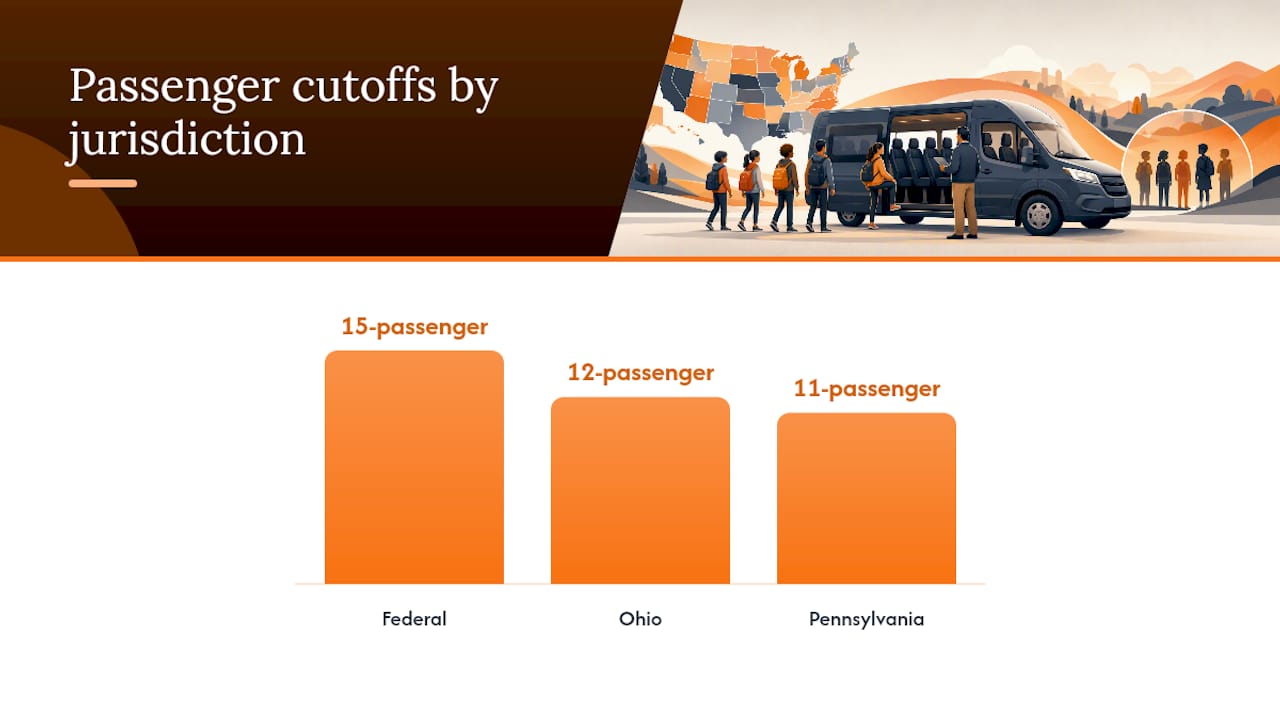
Districts add their own procedural layer on top of state law. Some, like DCPS, require multi-stage permit approval with defined submission windows and restrict trips to an approved-vendor list.
Before you book anything, work through this checklist:
- Pull your state department of education’s transportation code or FAQ page directly.
- Check your district’s field-trip policy for permit deadlines and vendor restrictions.
- Call your transportation office to confirm whether recent policy updates exist that haven’t hit the website yet.
- Request a written confirmation, not just a verbal answer, for anything involving liability.
Driver Qualifications and Training Records You Should Require
Whether a driver needs a commercial driver’s license with a passenger endorsement depends on vehicle seating capacity and how the trip is structured. A van designed to carry 16 or more passengers, including the driver, generally pushes into CDL territory. Vans at or under that threshold often don’t require a CDL, but your state or district may still impose stricter internal standards.
Regardless of licensing category, require these training elements before any driver gets behind the wheel of a school-affiliated van:
- Defensive driving certification specific to passenger vans, not just a general car course.
- Rollover dynamics training, since top-heavy vans handle differently than sedans or minivans.
- Fatigue management guidance, since safety researchers recommend limiting drivers to roughly eight hours behind the wheel per day on longer trips.
- Documented pre-trip inspection procedure training, so the driver knows what to check and how to report defects.
Also pull a motor vehicle record and DUI history check on every driver, and set a minimum age and experience threshold rather than relying on a general “licensed adult” standard.
Pro Tip: Store training certificates and MVR checks in a centralized digital folder tied to each driver’s name, not scattered across individual trip files. When an insurer or superintendent asks for proof six months later, you want a five-minute answer, not a scavenger hunt.
Confirming Vehicle Capacity, Restraints, and Prohibited Configurations
Seating capacity isn’t determined by how many people can physically fit. It’s determined by the manufacturer’s original design certification, which you can confirm through the FMVSS compliance label mounted on the vehicle’s door frame. That label tells you the “originally designed” passenger count, the exact language Ohio’s guidance uses to define which vans are off-limits for pupil transportation.
Seat belts and child restraints carry their own layer of statutory requirements. Ohio’s code sets specific child restraint and seat-belt expectations that apply regardless of vehicle type, and most states have comparable statutes worth pulling before finalizing a vendor contract.
Watch for these common prohibitions:
- New 15-passenger vans purchased or leased specifically for K-12 transport, per federal restriction.
- Loading or unloading students directly on a roadway shoulder instead of a driveway or designated safe zone.
- Vans lacking functioning seat belts at every seating position students will occupy.
- Missing or outdated vehicle identification and emergency contact signage required by some district policies.
If you’re evaluating vehicle options, understanding how seating configurations differ across 12- and 15-passenger layouts helps you match the right vehicle to your headcount without guessing.
The Pre-Trip Inspection Checklist Every Trip Needs on File
A pre-trip inspection isn’t a courtesy. It’s the document that protects your district if something goes wrong. Standard forms modeled on Ohio’s motor van pre-trip inspection process walk through key categories, and skipping any one of them leaves a gap in your paper trail.
- Exterior walk-around: tire tread and pressure, headlights and turn signals, fluid leaks under the vehicle, mirror condition, window integrity, and visible body damage.
- Interior systems: seat belt function at every position, horn, dashboard gauges, HVAC operation, door locks, and a stocked emergency kit with a working fire extinguisher.
- Brake verification: a three-step brake check confirming pedal resistance, parking brake hold, and low-speed stopping response before the van ever leaves the lot.
- Post-trip visual seat check, confirming no student or belongings were left behind, a step that’s easy to skip when everyone’s tired at the end of a long day.
Statistic to keep in mind: districts that build this exact four-part sequence into their standard inspection form create a paper trail that both insurers and state auditors recognize on sight, which matters more than most administrators realize until they’re asked to produce one.
Attach the completed inspection form directly to the trip permit packet rather than filing it separately. If a defect surfaces mid-trip, route it through a written defect-report workflow so the issue and its resolution are both on record.
Building Your Trip Permit and Vendor Documentation Timeline
Permit timelines vary by district, but a common pattern requires submission 10 to 14 business days before departure for standard trips, with some districts running longer multi-stage flows. DCPS, for example, uses staged windows that require submission well in advance depending on trip type and distance.
Before signing off on any vendor, collect these documents:
- Current certificate of insurance naming the district as an additional insured where required.
- Vehicle maintenance and inspection records for the specific van being assigned.
- Driver motor vehicle record and proof of completed training modules.
- A written contingency plan covering driver illness or vehicle breakdown.
Build in a buffer for procurement delays. A vendor that can’t produce documentation within 48 hours of a request is a vendor you probably shouldn’t be booking, regardless of price.
In-Trip Rules That Keep Everyone Accountable
Once the van is loaded and moving, the rules that matter shift from paperwork to real-time discipline. Load heavier cargo low and toward the center of the vehicle to reduce rollover risk, since a top-heavy load shifts a van’s center of gravity in ways that make emergency maneuvers riskier.
- Require a visual seat-belt check by the chaperone before the van moves, every single time, not just at departure.
- Never permit loading or unloading directly on a roadway shoulder; use a driveway, parking lot, or designated pickup zone instead.
- Assign one chaperone per van as the designated headcount and seat-belt monitor for the full trip.
- Cap driving stretches and build in rest breaks, consistent with fatigue management guidance from safety researchers on longer routes.
Pro Tip: Assign the seat-belt check to the same chaperone for the entire trip rather than rotating it. Consistency in who’s responsible for that one task cuts down on the “I thought someone else checked” gap that causes most in-trip compliance failures.
What to Keep on File After Every Trip
Good documentation doesn’t just satisfy an audit. It’s often the deciding factor in a negligent-entrustment claim, where courts look closely at whether training and screening records existed before assigning fault.
Keep these records centralized and retained for at least the district’s standard liability window:
- Signed trip permit and completed pre-trip inspection form.
- Driver training certificates and MVR checks.
- Vendor insurance certificate valid for the trip date.
- Parental permission slips and emergency contact forms.
A single missing document rarely sinks a defense on its own, but a pattern of missing documents tells its own story.
What Running a Fleet Teaches You About Compliance
Operationally, the schools that struggle least with this aren’t the ones with the most paperwork. They’re the ones where inspection and training records are already built into how the fleet runs, not bolted on before a trip. Keeping one inspection copy with the driver and one in fleet records, a practice common among well-run commercial operators, tends to prevent the “who has proof” disputes that surface after an incident. Vetted driver programs with documented MVR checks make school approval processes faster because the paperwork already exists instead of getting assembled under deadline pressure.
— Gabriel
How Sprinter Van Rentals Supports School Trip Compliance
Sprinter Van Rentals gives school transportation coordinators a documentation head start most vendors can’t match. Every rental in the fleet comes with maintenance records and insurance certificates ready to hand over for your trip permit packet, and 12-passenger options are available for districts where 15-passenger vans are restricted or banned outright.
Driver hire is available too, so you’re not stuck vetting an unfamiliar name against your district’s training requirements the week before a trip. Check the driver options if your policy requires a professionally screened operator rather than a staff volunteer. None of this replaces confirming your own state and district rules first, but it does mean the vendor-side paperwork won’t be the reason your permit gets delayed. Get a quote through Sprinter Van Rentals and see which vehicle size and driver setup fits your trip before your submission deadline hits.
Where to Verify the Rules Yourself
Confirm every policy above against the primary source before finalizing a trip:
- NHTSA School Bus Regulations FAQs and FMCSA education-related transportation guidance.
- Your state department of education’s pupil transportation code, plus your specific district’s field-trip policy PDF and required pre-trip inspection form.
This article is general information, not a substitute for advice from a qualified lawyer. Consult a qualified legal professional about your own circumstances before acting on anything here.
Sources
- School Bus Regulations FAQs
- Use of Vehicles Other Than School Buses for Pupil Transportation
- Education-related transportation — FMCSA
Recommended
Keep reading
How Much Is a Sprinter Van Rental? 2026 Pricing Guide
Real Mercedes-Benz Sprinter van rental prices in 2026 — daily rates, mileage, insurance, delivery fees, and how to lower your total.
How to Start a Sprinter Van Rental Business (2026 Playbook)
Step-by-step guide to launching a Sprinter van rental business — licensing, DOT/FMCSA rules, insurance, fleet financing, and marketing.
Mercedes Sprinter Van Rental in Orlando, FL — Where to Rent
Compare Mercedes-Benz Sprinter van rental options in Orlando, FL — MCO airport delivery, theme park runs, and 12 & 15-passenger pricing.