September 20, 2026 · 14 min read
5 Pickup Checks to Verify Car Seats in Sprinter 12/15 Passenger Vans
5 Pickup Checks to Verify Car Seats in Sprinter 12/15 Passenger Vans
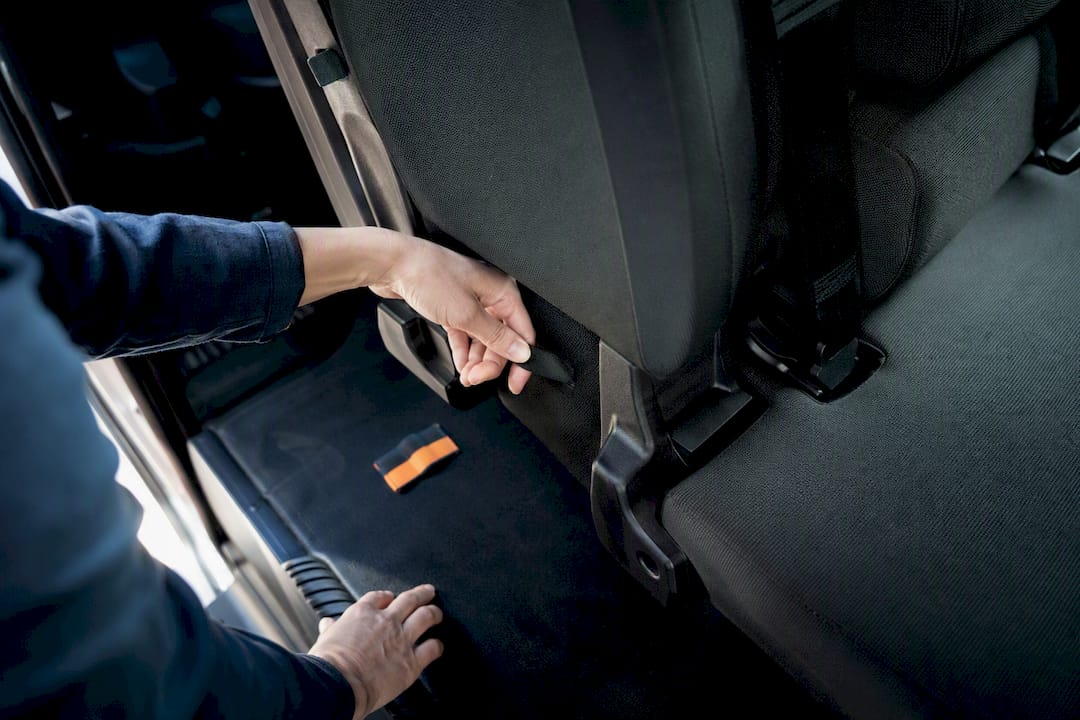
Yes, you can use a child car seat in a 12- or 15-passenger rental van, but compatibility depends on the row and the specific vehicle. Every child under 13 belongs in the rear seats, and not every row has LATCH or a top-tether anchor. Before you drive off the lot, check the owner’s manual for anchor points, photograph the seatback labels, and line up a certified Child Passenger Safety Technician if you have any doubt about the installation.
TL;DR:
- Most rental vans may lack LATCH or top-tether anchors in certain rows, so verify anchor points and seat compatibility at pickup with photos and manual checks.
- The safest seat position is typically the center of the second row, but anchor availability varies by vehicle make, model, and trim, requiring individual verification.
- Children under 13 must always ride in rear seats, and rear-facing seats should never be placed in front of an active front passenger airbag unless airbags are deactivated and confirmed off.
- Confirm with rental agencies beforehand which rows have LATCH or ISOFIX, and request manual and anchor photos to ensure the seat will fit safely in the specific van.
- Renting a car seat provides convenience but requires checking manufacture and expiration dates, and ensuring it’s never been in a crash, with a preference for seats with recent safety standards.
Table of Contents
- Which Seats Are Safest in a 12- or 15-Passenger Rental Van?
- What to Check for Rental Van Car Seat Compatibility
- How to Install a Car Seat in a Rental Van Step by Step
- Safety Rules, Airbags, and Getting a Professional Check
- Renting a Car Seat vs. Bringing Your Own
- Car Seat Laws for Rental Vehicles by Jurisdiction
- How to Talk to a Rental Agency About Car Seats
- Keeping a Rental Car Seat Clean and Sanitary
- Traveling and Storing Your Own Car Seat Safely
- What Booking a Sprinter Van Taught Us About Family Travel
- Book a Passenger Van That Fits Your Family’s Car Seats
- Sources
- FAQ
Which Seats Are Safest in a 12- or 15-Passenger Rental Van?
The middle of the second row is generally the safest spot for a car seat in a large passenger van, since center positions tend to have more crush space around them and less exposure if the van rolls. That advantage matters more in a 12- or 15-passenger van than in a sedan or minivan, because these vehicles sit higher, have a longer wheelbase, and behave differently in an evasive maneuver.
The rule that outranks everything else is simple: children under 13 should always ride in the rear seats, and a rear-facing seat should never sit in front of an active passenger airbag, according to Johns Hopkins Medicine. That guidance doesn’t change just because the vehicle is bigger.
What does change from van to van is the hardware. Design differences across makes and trims mean the row that works perfectly in one 15-passenger van might have no anchors at all in another. Before you assume anything, walk the van and check:
- Whether the second row has a true center seating position or a split bench
- Which rows include LATCH or ISOFIX anchors versus seat belt only
- Whether third-row and rear-most seats have top-tether points
- If any rear-facing seat placement would land in front of a live airbag
Manufacturer fitment tables, like those in Nissan’s passenger van child restraint guidance, spell out exactly which seating positions accept which restraint categories. Treat that document as more reliable than a guess based on how the seat looks.
What to Check for Rental Van Car Seat Compatibility
Most surprises with car seats and rental vans happen because nobody asked the right questions before the trip started. Fixing that takes two short conversations: one when you book, one when you pick up the keys.
When you book, ask the rental agency:
- Which rows have LATCH or ISOFIX anchors, and how many per row
- Whether those rows also have top-tether anchor points for forward-facing seats
- What type of seat belt is installed at each position (lap-only versus lap-and-shoulder)
- Whether headrests are removable or adjustable enough to fit a booster properly
At pickup, before you load a single bag, do this:
- Locate the LATCH bars in the seat crease of each candidate row
- Look for the ISOFIX or IUF label stitched into the seatback, per suitability tables like Kia’s owner’s manual guidance
- Find and test the top-tether anchor, usually on the seatback or ceiling
- Pull the owner’s manual or check the console sticker for a seating position chart
- Photograph every anchor point and seatback label before you install anything
Interior layouts vary enough between vans that checking the manual for each specific vehicle beats relying on what worked in a different rental last time. If a row doesn’t check out, don’t force it. Some rental providers cannot legally install or certify a seat for you, so postponing the installation until you’ve confirmed compatibility, or arranging a rented seat at your destination, is often the safer call.
Pro Tip: Save the anchor photos to your phone before you leave the lot. If a CPST or a second driver needs to redo the installation later in the trip, those photos save you from re-searching a strange van’s seatbacks in a parking lot.
How to Install a Car Seat in a Rental Van Step by Step
Once you know which row has usable anchors, the installation itself follows the same logic in a Sprinter-style van as it does in a sedan. The steps just need to happen in order.
- Pick the safest available seating position first, ideally the center of the second row if anchors are present there
- Adjust the vehicle seat itself (recline, position) before placing the car seat, since large vans often have adjustable captain’s chairs
- If LATCH or ISOFIX anchors are within the seat’s weight limit, connect both lower anchors and pull the strap tight
- If no LATCH is available at that position, route the vehicle seat belt through the correct belt path and buckle it, following the car seat’s own instructions exactly
- For any forward-facing seat, attach and tighten the top tether to its anchor point, whether LATCH or belt-installed
Tightness is the detail most parents get wrong. After installing, grab the seat at the belt path and pull firmly. If it moves more than one inch in any direction, it isn’t tight enough. Tighten in stages, and have a second person kneel on or compress the seat cushion while you pull the strap, since rental van upholstery often has more give than a personal vehicle.
Rear-facing seats need the correct recline angle, and manufacturers commonly recommend a rolled towel or a foam noodle under the base to hit that angle when the van’s seat cushion doesn’t provide it naturally. This kind of tightening and angle check follows the same technique described in OEM installation guidance: tighten the lap portion first, then the shoulder portion, and always finish with the movement test. For boosters, adjust the vehicle headrest so it sits at or above the top of your child’s ears, not behind their neck.
Safety Rules, Airbags, and Getting a Professional Check
Two rules from national safety authorities apply no matter which van you’re driving. Children under 13 stay in the rear seats, full stop, and a rear-facing car seat never goes in front of an active front passenger airbag. If the manufacturer allows airbag deactivation and the dashboard indicator confirms it’s off, that position may become usable, but skip it entirely if you’re not certain.
- Rental staff typically cannot install or certify a car seat installation for you, for liability reasons
- A certified Child Passenger Safety Technician, findable through NHTSA’s CPST locator, can verify or fix an installation before you drive
- Some van manuals include specific notes on reducing airbag risk at front ISOFIX positions, including moving the seat back or adjusting the backrest, per Renault’s owner guidance
- If no row checks out safely, your options are reassigning who sits where, renting an approved seat at your destination, or rescheduling until you can confirm a safe setup
None of these steps take more than a few minutes, and skipping them is the only real risk here.
Renting a Car Seat vs. Bringing Your Own
Bringing your own seat means you already know its history, its fit, and its quirks. You’ve installed it before, so you’re not learning the anchor points and the seat at the same time. The tradeoff is logistics: hauling a bulky seat through an airport or fitting it into luggage space alongside a group’s bags.
Renting a seat at your destination solves the bulk problem but shifts the burden to trust. Reputable providers offer clean, current seats with manuals included, and pricing commonly falls in the single-digit to low-double-digit dollar range per day in many markets. Before accepting a rented seat, ask for:
- The manufacture date and expiration date stamped on the seat
- Written confirmation it has never been in a crash
- The printed manual, since most rental services provide one but won’t install the seat for you
Pro Tip: Photograph the serial number and manufacture date sticker the moment the rented seat arrives. It’s your only proof if a question comes up later about the seat’s age or history.
Car Seat Laws for Rental Vehicles by Jurisdiction
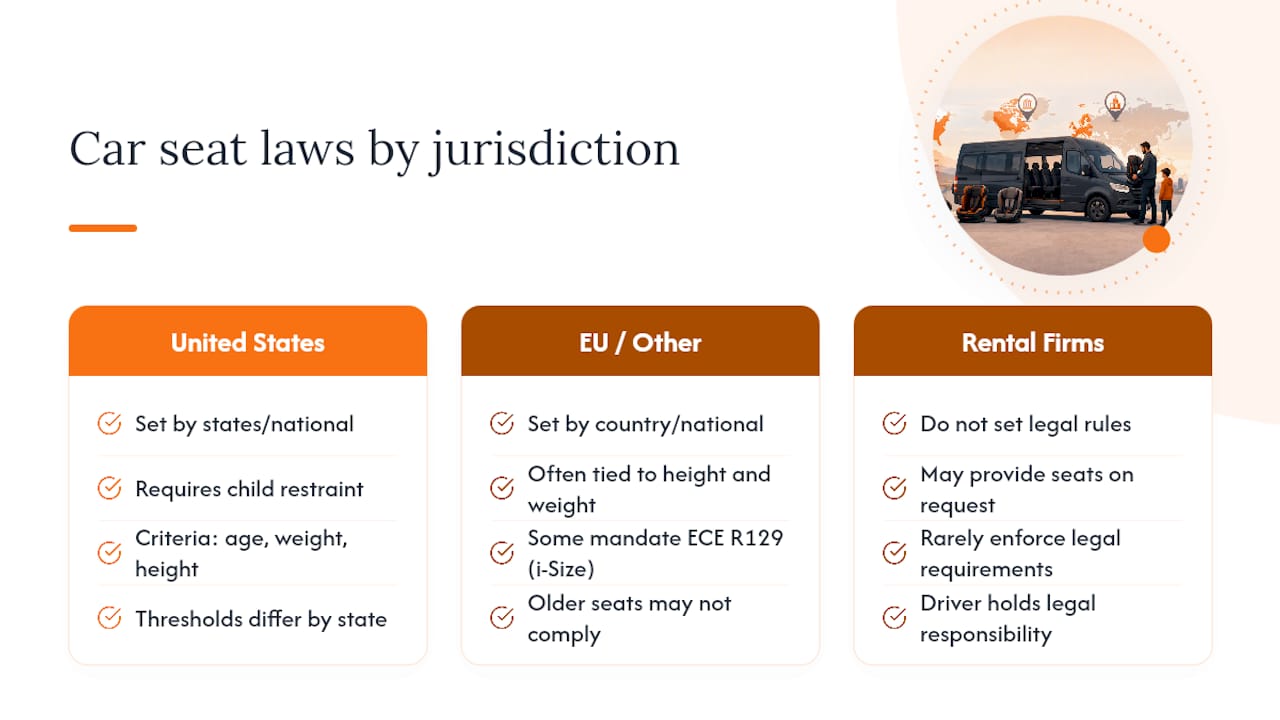
Car seat laws are set at the state or national level, not by the rental company, and they don’t loosen just because you’re driving a larger vehicle. In the United States, every state requires some form of child restraint by age, weight, or height, but the exact thresholds (the age a child can move to a booster, the age they can use a seat belt alone) differ from state to state. A seat that satisfies the law in the state where you rented the van might not satisfy the law in a state you’re driving through, so check the requirements for every state on your route, not just your starting point.
Outside the U.S., requirements shift again. Many countries in the European Union tie restraint requirements to height and weight rather than age alone, and some jurisdictions mandate specific certification standards (like ECE R129, also known as i-Size) that older seats may not meet. If you’re renting internationally, confirm that your seat, or a seat you plan to rent locally, meets the certification standard required where you’re driving, not just the standard from home.
Rental companies themselves rarely enforce car seat law beyond making sure one is in the vehicle if you’ve requested it. The legal responsibility for correct restraint use sits with the driver, which is exactly why the anchor checks and CPST verification covered earlier matter more than any paperwork the counter agent hands you.
How to Talk to a Rental Agency About Car Seats
The single biggest source of car-seat frustration at a rental counter is a mismatch between what you assumed and what the agency actually offers. Passenger van fleets vary by location, and not every branch stocks the same trim or seating configuration, so specifics matter more than general questions.
When you call or book online, ask by row number, not just “does it have car seat anchors.” Say something like: “Does the second row of the 15-passenger van have LATCH anchors, and are there top-tether points in that row?” A vague question gets a vague answer; a specific one gets you a usable one.
If you’re bringing your own seat, tell the agency at booking, not at pickup. Some locations note this in your reservation so the specific van they pull for you has been checked or has a known configuration. If you want the agency to provide a seat, confirm in writing (email or the booking confirmation) how many seats, what age range, and whether there’s a separate rental fee, since car seat availability through a vehicle rental company is inconsistent and often limited to a small number of units per location.
Finally, ask what happens if the van you’re assigned doesn’t have the anchors you need. A good agency will tell you upfront whether they can swap vehicles, rather than leaving you to discover the problem in the parking lot with a loaded van and a flight to catch.
Keeping a Rental Car Seat Clean and Sanitary
A rented or borrowed car seat has almost certainly carried other children before yours, which makes hygiene a legitimate concern, not an overreaction. Start by inspecting the fabric cover and harness for stains, odors, or visible wear before you accept the seat. A reputable rental provider should have already cleaned it between uses, but a quick visual and smell check takes seconds and confirms it.
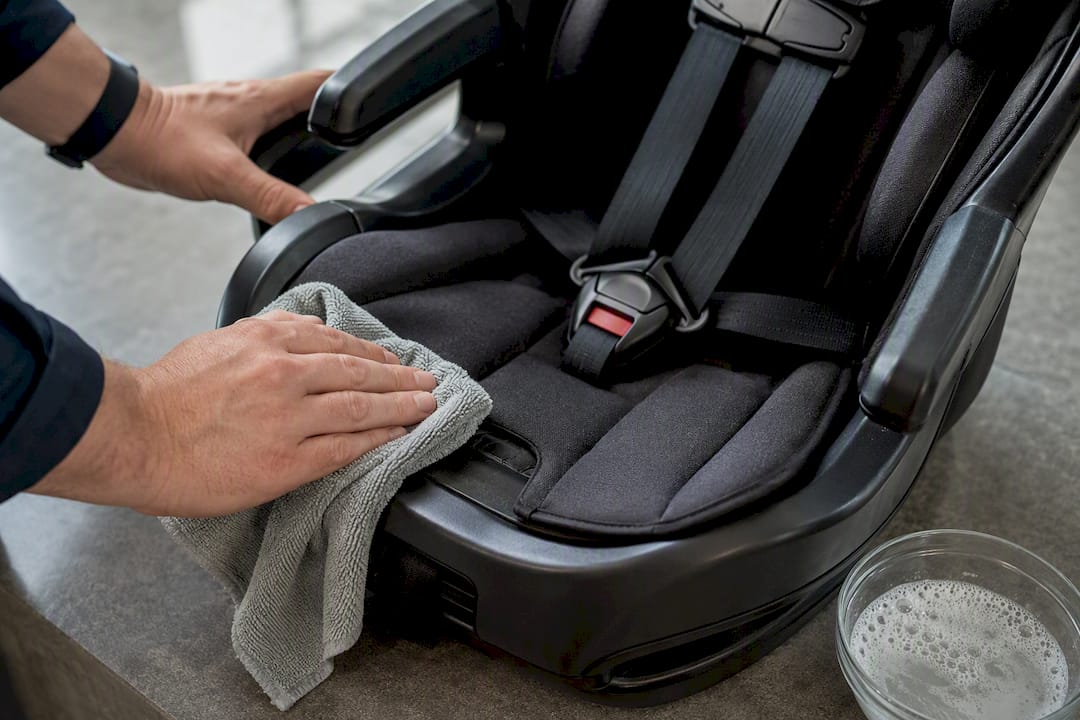
For the harness straps and hard plastic shell, a damp cloth with mild soap and water is standard, and it’s what most manufacturer manuals recommend. Skip bleach, disinfecting wipes with strong solvents, or anything not explicitly approved in the seat’s manual, since harsh chemicals can degrade the webbing fibers that keep the harness strong in a crash. If the seat’s fabric cover is machine washable, check the tag before tossing it in with regular laundry, since some covers require air drying only.
If you’re using your own seat on the trip, wipe down the buckle and harness adjuster after any airport or rest-stop use, since these are the parts small hands touch most and germs collect fastest. A packet of sanitizing wipes rated safe for use on car seat plastics is worth keeping in your travel bag for exactly this. Whatever seat you use, never spray disinfectant directly onto the harness webbing itself.
Traveling and Storing Your Own Car Seat Safely
If you’re flying to your rental van destination with your own seat, treat it the way you’d treat any piece of safety equipment, not just luggage. A dedicated car seat travel bag protects the shell and harness buckles from baggage handling damage, and it keeps grease, dirt, and jet bridge grime off a seat your child will sit in within hours of landing.
Keep the original instruction manual with you, either the physical booklet or a photo of every page, rather than trusting memory for the installation steps once you’re standing next to an unfamiliar van. Manuals are often the fastest way to confirm weight limits, harness routing, and recline angle requirements specific to your exact model.
Between uses, store the seat somewhere it won’t take on heat damage, since prolonged exposure to a hot trunk or car interior can degrade the plastic shell and harness webbing over time. If you’re switching between a rental van and another vehicle mid-trip, reinstall the seat fully each time rather than assuming last night’s installation still meets the one-inch movement test. Vibration from driving and repeated buckling can loosen even a well-installed seat over a multi-day trip.
What Booking a Sprinter Van Taught Us About Family Travel
Every Sprinter layout handles car seats a little differently, which is exactly why we point families to the seating options page before they book, not after. Knowing which row has bench seating versus captain’s chairs changes where LATCH anchors sit.
Our fleet spans multiple configurations nationwide, so families can often match a layout to their car seat needs rather than settling for whatever van shows up. A short pre-trip checklist works best: decide who sits where, confirm which rows need LATCH versus belt installation, and line up a CPST if any seat feels uncertain.
— Gabriel
Book a Passenger Van That Fits Your Family’s Car Seats
Sprinter Van Rentals gives families a way to match seating layout to car seat needs before a single bag gets loaded, something a same-day rental counter rarely allows. Because we list 12-passenger and 15-passenger configurations by row, you can check anchor-friendly seating before you commit to a reservation instead of discovering a mismatch at pickup.
Sprinter van rentals for group and family transportation are available, and the reservations team can confirm LATCH and top-tether availability for a specific van before you book. Review the fleet configuration page to compare seating rows, then reserve early since car-seat-friendly rows can be limited per vehicle. Head to Sprinter Van Rentals to check availability in your city and confirm seating details with the booking team before your travel dates lock in.
Sources
- Car safety (Johns Hopkins Medicine expert guidance)
- Car seats and booster seats (NHTSA)
- Car seats available to rent (BabyQuip)
- Nissan NV passenger van child restraint guidance (owner manual excerpts)
FAQ
Do Rental Vans Come With Car Seats?
Most passenger van rental companies do not include car seats automatically, and availability through the rental agency itself is often limited. Confirm with your specific provider at booking, and consider a dedicated car seat rental service if the agency can’t supply one.
Can Rental Staff Install My Car Seat?
Generally no. Most rental providers cannot install or certify a car seat installation for liability reasons, so verification falls to you or a certified CPST rather than the counter staff.
Which Seat Is Safest for a Car Seat in a 15-Passenger Van?
The center of the second row is generally considered the safest position when anchors are present there, since it reduces exposure in a rollover. Always confirm anchor availability at that specific position before assuming it applies to every van.
Is It Safe to Put a Rear-Facing Seat in the Front of a Van?
Not if the front passenger airbag is active. Johns Hopkins Medicine advises against it unless the manufacturer permits airbag deactivation and the dashboard confirms it’s off.
How Much Does It Cost to Rent a Sprinter Van With Compatible Seating?
Sprinter Van Rentals offers 12- and 15-passenger Sprinter rentals, with fleet pages showing seating layouts so you can confirm compatible rows before booking. Contact the reservations team to confirm LATCH and top-tether availability for your specific pickup location.
Recommended
Keep reading
How Much Is a Sprinter Van Rental? 2026 Pricing Guide
Real Mercedes-Benz Sprinter van rental prices in 2026 — daily rates, mileage, insurance, delivery fees, and how to lower your total.
How to Start a Sprinter Van Rental Business (2026 Playbook)
Step-by-step guide to launching a Sprinter van rental business — licensing, DOT/FMCSA rules, insurance, fleet financing, and marketing.
Mercedes Sprinter Van Rental in Orlando, FL — Where to Rent
Compare Mercedes-Benz Sprinter van rental options in Orlando, FL — MCO airport delivery, theme park runs, and 12 & 15-passenger pricing.