September 6, 2026 · 10 min read
Pack 7–8 Suitcases: Passenger Van Luggage Capacity for 12 Seat Vans
Pack 7–8 Suitcases: Passenger Van Luggage Capacity for 12 Seat Vans

For groups traveling with multiple checked bags, a 12-passenger van, usually a Sprinter or Transit with an extended or high-roof option, is the better call than a 15-passenger model. Cargo behind the last row in a 12-seat layout typically runs 60 to 70 cubic feet, enough for 7 to 8 large suitcases plus carry-ons. A 15-passenger van makes sense only when seating 13 to 15 people matters more than luggage room. Ask about seat removal or an extended-high-roof upgrade if you need both.
TL;DR:
- A 12-passenger van typically offers 60 to 70 cubic feet of cargo space, enough for 7 to 8 large suitcases, making it ideal for luggage-heavy trips.
- Van configurations with more seats, such as 15-passenger models, significantly reduce cargo capacity, often allowing only a few small bags behind the last row.
- Roof height, wheelbase, and the ability to remove seats can greatly increase cargo volume, with removing a row doubling or tripling available space.
- Overloading on weight, not just volume, can occur if heavy gear is stored on top or inside, so checking payload ratings is crucial for safety.
- When packing, heavy suitcases should go against the back wall, and oversized or loose items should be secured tightly to prevent shifting during the drive.
Table of Contents
- Passenger Van Luggage Capacity: 12-Passenger vs. 15-Passenger
- How Roof Height, Length, and Seating Change Cargo Room
- How to Choose the Right Van for Your Group and Luggage
- Packing and Cargo Management Tips for Passenger Vans
- What Trip Planners Get Wrong About Van Capacity
- Book the Right Sprinter Configuration for Your Trip
- Sources
Passenger Van Luggage Capacity: 12-Passenger vs. 15-Passenger
The math behind passenger van luggage capacity comes down to one trade-off: every seat you keep installed is cargo space you give up. A 12-passenger configuration leaves three fewer seats than a 15-passenger version, and that difference lands almost entirely in the trunk area behind the last row.
A 12-passenger Mercedes-Benz Sprinter commonly lists around 70 cubic feet of cargo volume with all seats in place. A comparable Ford Transit passenger van in a similar layout falls into a similar range, though the exact cargo volume varies depending on roof height and wheelbase. Fill either one with 15 seats instead of 12, and the cargo bay behind the last row shrinks to something closer to a golf bag and a few backpacks. Here’s how that translates into real luggage counts:
| Van Type | Typical Cargo (Cu Ft) | Approx. Large Suitcases | Best For |
|---|---|---|---|
| 12-passenger Sprinter | ~70 | 7 to 8 | Balanced groups with checked bags |
| 12-passenger Transit | Between 60 and 70 (depending on roof height and length) | Several | Groups needing flexible configuration |
| 15-passenger (any brand) | Minimal behind last row | A couple, plus what fits on laps | Short shuttles, minimal luggage |
Using the common conversion of about 8 cubic feet per large suitcase, a medium bag at roughly 5 cubic feet, and a cabin bag at about 1.5 cubic feet, a few patterns hold up across most rentals:
- A 12-seat van with 70 cubic feet fits roughly 7 large suitcases, or a mix of 5 large bags and several cabin bags.
- A 15-passenger van with all seats installed rarely clears more than 10 to 15 cubic feet behind the last row, enough for a handful of duffel bags, not hard-shell luggage for a full group.
- Extended-length or high-roof trims push the 12-passenger number higher, sometimes past 80 cubic feet depending on the model.
Manufacturer numbers vary by roof height, wheelbase, and whether any rows have been removed, so treat the figures above as a starting range rather than a fixed spec. Practical rental guidance consistently points the same direction: pick 12-passenger when luggage matters, save 15-passenger for trips where seating everyone is the only priority.
How Roof Height, Length, and Seating Change Cargo Room
Reading a manufacturer spec sheet gets confusing fast because two very different numbers get thrown around: cargo volume “behind the first row” and cargo volume “behind the last row.” These are not close to the same thing, and mixing them up leads to wildly inflated expectations.
The Ford Transit passenger van, for example, offers up to 461.9 cubic feet of cargo space behind the first row in its high-roof, extended-length configuration. That figure sounds enormous, and it is, but it only applies once most of the passenger seats are pulled out. With all rows installed and people sitting in them, cargo space behind the last row drops to somewhere in the 70 to 100 cubic foot range, depending on roof height and body length. Always check which measurement a listing actually references before comparing two vans side by side.
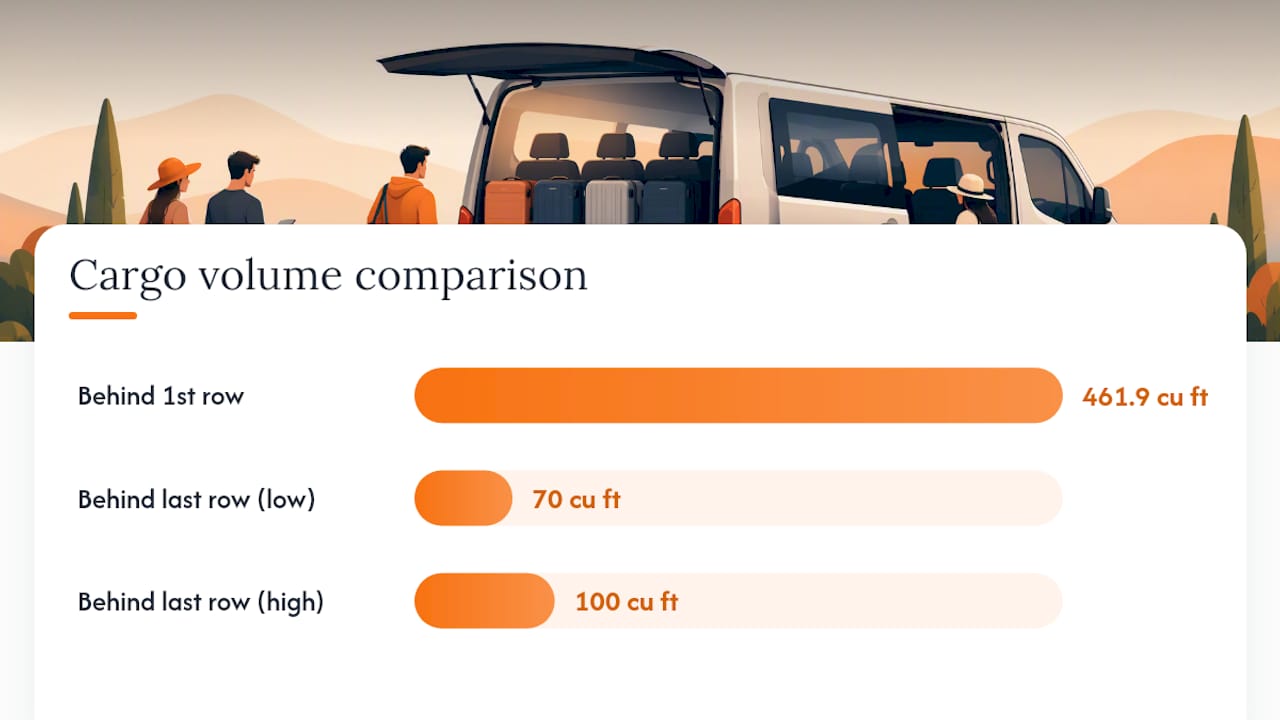
Statistic Callout: A Transit configured for maximum cargo behind the first row can hold more than six times the luggage volume of the same van loaded with passengers in every seat, which is why “cargo capacity” numbers on a spec sheet can mislead anyone shopping purely by the headline figure.
A few configuration factors matter more than most travelers expect:
- Roof height. A high-roof van doesn’t just add headroom. It adds vertical stacking room behind the last row, which matters more for bulky duffel bags than for hard-shell suitcases.
- Wheelbase and length. Extended-length models push the rear wall back several feet, directly adding to the cargo bay without touching seat count.
- Seat removal. Pulling out a bench row can turn a tight 60 to 70 cubic foot cargo area into something closer to 150 cubic feet, enough for 7 to 8 large suitcases with room to spare.
- Payload rating. Even a van with generous cubic footage has a weight ceiling. Sprinter payload figures typically fall between roughly 3,020 and 3,307 pounds depending on trim, and that number has to cover passengers, driver, and every bag loaded aboard.
That last point trips up more travelers than the cargo volume ever does. A van with plenty of open floor space can still be overloaded on a gross vehicle weight basis if a group packs heavy gear, coolers, or sports equipment on top of a full passenger count. Checking payload alongside cubic feet is the only way to know whether a van can actually carry what fits inside it.
How to Choose the Right Van for Your Group and Luggage
Matching people to seats is the easy part. Matching luggage to cargo space takes a bit more math, but the process is straightforward once you break it into steps.
-
Count your people first, then your bags. Separate luggage into large suitcases (roughly 8 cubic feet each), medium bags (about 5 cubic feet), and cabin-sized items (around 1.5 cubic feet).
-
Add trip-specific gear. Sports equipment, coolers, strollers, or musical instruments eat cargo space fast and often get left out of early estimates.
-
Apply the threshold rule. If your group needs more than 7 or 8 large suitcases for 12 or more passengers, a standard 12-passenger van will feel tight. At that point, look at seat removal, an extended-length model, or a second vehicle.
-
Call the rental company with specific questions, not general ones. Ask directly:
- What is the cargo volume behind the last row, not behind the first row?
- Is this a standard, extended, or high-roof configuration?
- Can a row of seats be removed, and does that affect the rental rate?
- What is the GVWR and payload limit once passengers and bags are combined?
- Are roof racks or trailer hitches available, and is a driver add-on offered?
-
Decide between a trailer, seat removal, or two vehicles. A trailer adds cargo room without touching seating, but it changes how the van handles and where it can park. Removing a row solves the same problem without towing anything, as long as the rental fleet allows it. Reviewing seating capacity options before booking makes this decision easier.
Pro Tip: Copy this checklist directly into your booking email: passenger count, large/medium/cabin bag counts, trip length, and whether seat removal or a trailer is an option. Rental companies respond faster and more accurately when the ask is specific instead of open ended.
Packing and Cargo Management Tips for Passenger Vans
Fitting the bags is only half the job. Loading them safely matters just as much, especially with a full passenger count and a long drive ahead.
Start with the heaviest, largest suitcases against the back wall, stacked no higher than the seatbacks in front of them. Anything stacked above headrest height turns into a hazard during hard braking, and most rental agreements prohibit blocking emergency exits or rear windows with luggage. Smaller bags and soft duffels work well tucked into footwells or narrow gaps between seats, provided they don’t restrict anyone’s legroom or exit path.
Roof boxes and trailers solve overflow problems, but each comes with trade-offs. A roof box adds height clearance concerns for parking garages and low bridges, plus a noticeable fuel economy hit at highway speed. A trailer avoids the clearance issue but requires a hitch-rated van and a driver comfortable towing.
A few practical scenarios show how this plays out:
- A sports team hauling equipment bags and coolers usually needs seat removal or a trailer, since gear bags don’t stack as efficiently as hard-shell suitcases.
- An airport-heavy group with several 28-inch suitcases per person often maxes out a 12-passenger van’s cargo bay well before hitting the passenger limit.
- A family with strollers and car seats frequently underestimates bulk. A folded stroller and infant car seat can eat the same space as two large suitcases combined.
Pro Tip: Use cargo nets or tie-down straps for anything loose in the back. A shifting cooler or duffel bag at highway speed is more than an annoyance. It’s a real safety risk for everyone in the back rows.
What Trip Planners Get Wrong About Van Capacity
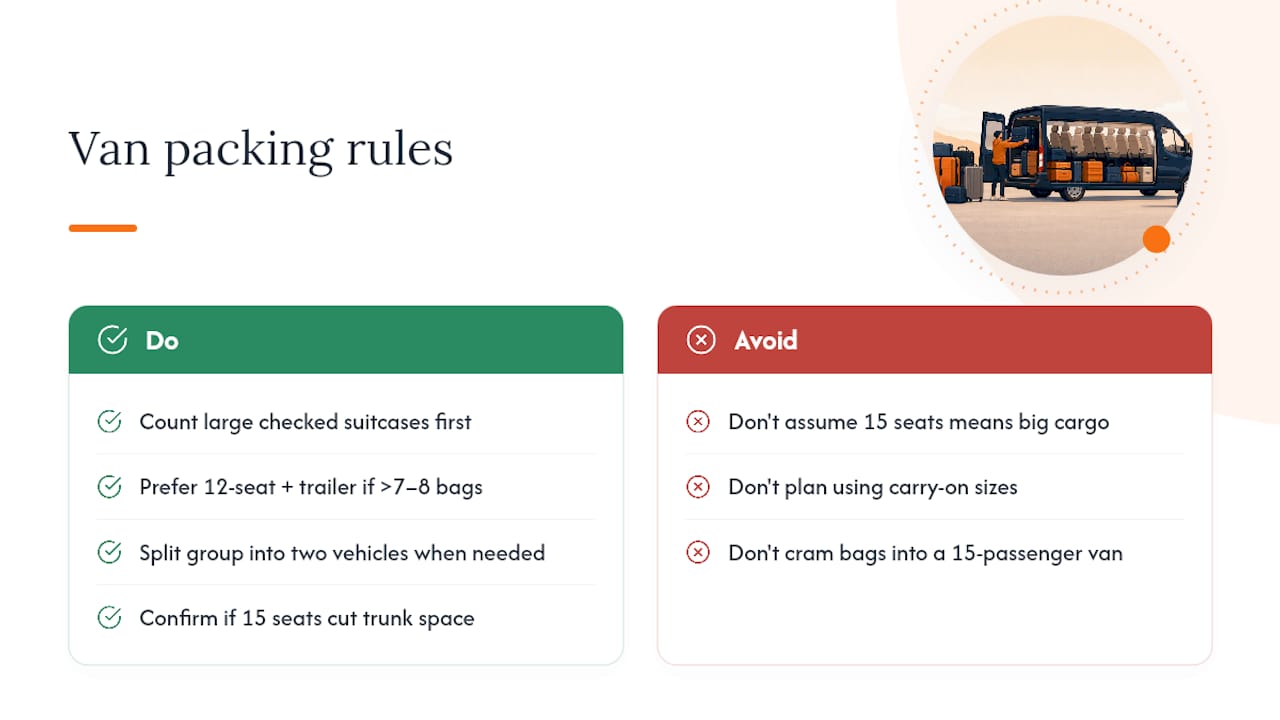
The most common mistake is assuming “15-passenger” means “big van,” full stop, without asking what that seat count does to the cargo bay. A 15-passenger van seats three more people than its 12-passenger counterpart, and those three extra seats come directly out of the trunk space. Group organizers also tend to underestimate suitcase size, picturing carry-on bags instead of the 28-inch checked luggage most travelers actually bring on multi-day trips.
A heuristic that holds up across most bookings: if your group has more than 7 or 8 large suitcases for more than 10 to 12 passengers, plan for a 12-passenger van paired with a trailer, or split into two vehicles. Trying to force that much luggage into a 15-passenger layout usually ends with bags on laps or a last-minute scramble at the pickup counter.
— Gabriel
Book the Right Sprinter Configuration for Your Trip
Some rental companies allow you to confirm cargo space and seat configuration before you pick up the keys. Its fleet includes both 12-passenger Sprinter and 15-passenger options, with configurable seating that can be adjusted to your luggage load rather than forcing your bags to fit whatever layout shows up.

When you request a quote, specify the cargo cubic feet you need behind the last row, whether you want an extended or high-roof body, and whether seat removal is available for your dates. Ask about trailer or roof-box compatibility if your group is hauling sports gear or oversized items, and mention if a driver add-on fits your trip. Start your reservation on the Sprinter Van Rentals homepage and lock in the exact configuration your group needs before availability tightens for peak travel dates.
Sources
Cargo and seating figures throughout this article come from manufacturer spec pages, including Ford’s Transit passenger van specs for behind-first-row and behind-last-row cargo volume, and Mercedes-Benz’s Sprinter passenger van page for 12-passenger cargo and payload figures. Suitcase-to-cubic-foot conversions and 15-passenger cargo limitations reference rental industry luggage guidance, while the 12-versus-15-passenger recommendation draws on practical booking comparisons from rental operators.
- 2027 Ford Transit® Vans | Pricing, Photos, Specs & More
- 2026 Passenger Van | Sprinter | Mercedes-Benz Vans
- 12 Seater Minibus Hire UK 2026 — Specs & Fares from £120
- 12 vs 15 Passenger Van Rental - Which to Book? | Airport Van Rental
Recommended
Keep reading
How Much Is a Sprinter Van Rental? 2026 Pricing Guide
Real Mercedes-Benz Sprinter van rental prices in 2026 — daily rates, mileage, insurance, delivery fees, and how to lower your total.
How to Start a Sprinter Van Rental Business (2026 Playbook)
Step-by-step guide to launching a Sprinter van rental business — licensing, DOT/FMCSA rules, insurance, fleet financing, and marketing.
Mercedes Sprinter Van Rental in Orlando, FL — Where to Rent
Compare Mercedes-Benz Sprinter van rental options in Orlando, FL — MCO airport delivery, theme park runs, and 12 & 15-passenger pricing.