September 11, 2026 · 17 min read
Stop Adding 1,500 Pounds: Plan Luxury Sprinter Features Around Payload
Stop Adding 1,500 Pounds: Plan Luxury Sprinter Features Around Payload
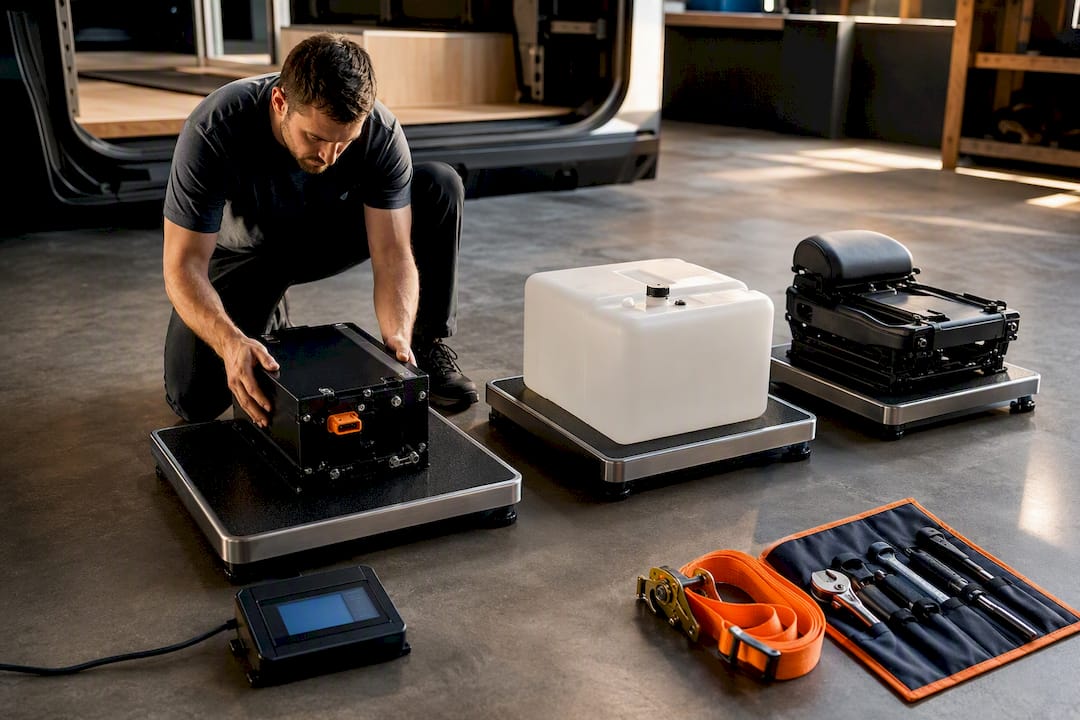
Luxury Sprinter features break down into seven categories: seating and layouts, climate control, entertainment and connectivity, onboard power, galley and bathroom fixtures, materials and finishes, and exterior mobility upgrades. Executives get the most daily value from power captain’s chairs paired with a conference layout. Families benefit most from independent rear HVAC and dedicated entertainment. Commercial operators should prioritize modular seating and luggage management.
Every choice depends on one constraint that ruins builds when ignored: payload.
TL;DR:
- Independent rear HVAC systems typically cost $4,000 to $7,000, but are essential for maintaining comfort in full-load passenger vans.
- Lithium batteries and a 2,000-watt inverter generally add $8,000 to $15,000, with proper sizing critical to support high-power features.
- Payload calculations must include the weight of additional systems like heated floors and inverters, to avoid exceeding GVWR limits.
- Factory safety features such as Active Brake Assist and Blind Spot Assist remain functional after aftermarket upgrades if properly integrated.
- Renting a luxury Sprinter for occasional use often costs less and offers all the features needed to test configurations before committing to a custom build.
Table of Contents
- What Are the Main Categories of Luxury Sprinter Features?
- How Do Seating and Layout Choices Affect Comfort?
- Why Does Independent Climate Control Matter So Much?
- What Entertainment and Connectivity Options Are Worth It?
- How Should You Size Onboard Power and Battery Systems?
- What Kitchen and Bathroom Features Make Sense in a Sprinter?
- Which Materials and Finishes Actually Hold Up?
- What Exterior and Suspension Upgrades Improve the Ride?
- How Do Payload and Chassis Choice Limit Your Build?
- What Do Luxury Sprinter Upgrades Typically Cost?
- Build Planning: What Do Experienced Upfitters Prioritize First?
- What Safety and Driver Assistance Features Come With Luxury Sprinters?
- What Interior Lighting Options Set Luxury Sprinters Apart?
- Factory Luxury Packages vs. Aftermarket Conversions: Which Is Better?
- What Maintenance and Warranty Issues Come With Luxury Features?
- Which Luxury Features Are Actually Worth It?
- Rent an Executive or Family-Ready Sprinter Today
- Sources
- FAQ
What Are the Main Categories of Luxury Sprinter Features?
Every high-end Sprinter build fits into a handful of systems, and they don’t operate independently. Add a hydronic heated floor and you’ve added weight that eats into payload. Add a 2,000-watt inverter and you’ve added an electrical load that has to be planned before the cabinetry goes in.
- Seating and layouts: captain’s chairs, lounges, conference tables, sleeper configurations
- Climate control: independent rear HVAC, heated floors, insulation
- Entertainment and connectivity: displays, premium audio, Starlink, cellular hotspots
- Onboard power: lithium batteries, inverters, solar, shore power
- Galley and bath: compressor fridges, induction cooktops, wet baths
- Materials and finishes: flooring, cabinetry, upholstery, ceiling treatments
- Exterior and mobility: air suspension, wheel and brake upgrades, awnings
Executives tend to weight seating and connectivity heaviest since the van functions as a mobile office. Families lean toward climate and entertainment. Commercial operators care most about seating flexibility and luggage handling, since their vans see different passenger loads every week.
How Do Seating and Layout Choices Affect Comfort?
Seating is where the biggest money goes, and where the biggest usability trade-offs happen. Captain’s chairs with power recline, heating, cooling, and massage function are the single most requested feature among upfitters building 2025 and 2026 model Sprinters, according to Legend Conversion’s build data. Lounges and convertible sofas trade individual seat comfort for social space and sleeping flexibility. Bench seating keeps costs down and capacity up, which matters more for commercial shuttle work than for executive transport.
- Captain’s chairs: individually adjustable, often swiveling, best for executive and small-group travel where comfort per passenger matters more than total headcount.
- Rear lounges: U-shaped or facing bench seating that converts to a bed, ideal for families on long road trips or overnight event transport.
- Conference tables: fixed seating around a table, built for mobile meetings and used heavily in executive Sprinter configurations.
- Sleeper setups: a hybrid of lounge and bed platform, common in vans built for multi-day travel rather than day trips.
Swiveling captain’s chairs add mechanical complexity and floor anchoring requirements. Heated and cooled seats draw electrical current that has to be accounted for in the power budget. Memory-position seats add cost but little functional benefit for shorter trips. Anyone comparing seating for a family versus an executive build should look closely at Sprinter interior layout options before locking in a configuration, since swapping seating after the fact usually means redoing flooring anchors too.
Why Does Independent Climate Control Matter So Much?
Independent rear HVAC shows up again and again as the upgrade that riders notice first and complain about most when it’s missing. Builders report it as one of the top requested comfort features, and for good reason: a front-only climate system leaves the back third of a 15-passenger van running 10 to 15 degrees warmer on a summer afternoon.
- Independent rear HVAC systems typically run 13,500 to 15,000 BTU cooling capacity, enough to hold cabin temperature steady even with a full passenger load.
- Hydronic heated floors cost roughly $3,000 to $5,000 installed and make the most sense for vans used in cold climates or for overnight sleeper builds.
- Acoustic window treatments and cabin insulation reduce road noise and help both heating and cooling systems work less hard, which matters for battery life on off-grid trips.
Pro Tip: Rear HVAC installations need dedicated ducting and condensate drainage, not just a bigger compressor. Budget for professional integration rather than a bolt-on unit, or you risk moisture buildup behind interior panels.
Insulation choices matter more in extreme climates. A van running mostly in temperate regions can get away with lighter insulation and a smaller HVAC unit, freeing up payload for other systems.
What Entertainment and Connectivity Options Are Worth It?
A Sprinter functioning as a mobile office or family theater needs more than a factory stereo. Premium audio systems tuned specifically to the cabin’s acoustics, not just swapped-in speakers, make the biggest audible difference. Mercedes’ own direction with the VLE concept points toward Burmester-level audio and large integrated displays becoming standard expectations rather than novelties.
- Drop-down displays running 4K or 8K resolution work well for family entertainment and passive executive viewing during transit.
- Dual-screen setups with independent content let front and rear passengers watch or work separately without headphones as the only fix.
- Conferencing hardware, including forward-facing cameras and table-mounted microphones, turns the conference layout into an actual meeting space rather than just a table with chairs around it.
Connectivity needs redundancy, not just one strong signal. Starlink satellite internet handles remote routes where cellular coverage drops out, while a 5G cellular hotspot covers everything else at lower cost. Running both, rather than picking one, keeps a van’s Wi-Fi live through tunnels, mountain passes, and rural stretches where a single system alone would fail.
How Should You Size Onboard Power and Battery Systems?
Every luxury feature that isn’t seating draws power, and running out of it mid-trip turns a luxury van into an uncomfortable one fast. Lithium batteries cost more upfront than AGM but deliver roughly double the usable capacity for the same physical size, since lithium can be discharged much deeper without damage.
- Lithium: higher energy density, longer lifespan, higher upfront cost, better for daily off-grid use.
- AGM: lower cost, heavier per amp-hour, better suited to occasional-use vans with lighter power demands.
- Inverter sizing: a continuous 2,000-watt inverter is the practical minimum for running HVAC and galley appliances together, a figure that shows up repeatedly in high-end builds like Grech Motors’ LUSSO conversion, which pairs a 300Ah lithium bank with a 2,000W inverter.
- DC-DC charging: replenishes the house battery from the alternator while driving, reducing dependence on shore power or solar alone.
A rough daily energy budget for HVAC, a compressor fridge, and two displays running eight hours easily exceeds 100 amp-hours, which is why serious off-grid builds size battery banks well beyond what a weekend camper would need. Solar helps extend range between charges but rarely replaces shore power or driving-based charging as the primary source.
What Kitchen and Bathroom Features Make Sense in a Sprinter?
Full wet baths with a porcelain toilet and shower, like the one in the Grech LUSSO build, work well for multi-day trips but consume real payload and floor space. Compact wet baths trade shower room for a smaller footprint, and portable solutions skip plumbing entirely for occasional use.
- Compressor fridges outperform thermoelectric coolers for reliability and run efficiently on a properly sized lithium system.
- Induction cooktops draw significant power but avoid the ventilation and fire-risk concerns of propane.
- Fresh and gray water tanks add weight fast. A 20-gallon tank alone weighs around 165 pounds when full.
Full bathroom builds typically run $8,000 to $15,000 depending on fixtures and plumbing complexity, while a compact wet bath can come in near half that.
Which Materials and Finishes Actually Hold Up?
Luxury feel and long-term durability don’t always point the same direction. Genuine hardwood flooring looks premium but weighs more and scratches easier than luxury vinyl plank, which now mimics wood grain closely enough that most passengers can’t tell the difference.
- Quilted leather or performance fabric upholstery resists wear better than standard leather over years of passenger turnover.
- Solid-surface cabinetry looks upscale but adds weight versus lightweight composite panels with a veneer finish.
- Fiber-optic starlight ceilings run roughly $2,500 to $5,000 installed and require occasional bulb and fiber inspection but little other upkeep.
Acoustic headliner upgrades reduce road and wind noise, which matters more on longer trips than most buyers expect until they’ve sat through one.
What Exterior and Suspension Upgrades Improve the Ride?
A fully loaded luxury Sprinter rides differently than an empty cargo van, and factory suspension often struggles once you’ve added batteries, water tanks, and cabinetry. Air-ride suspension systems, similar to the Airmatic system Mercedes is building into the VLE concept, self-level under uneven loads and smooth out the harsh bounce heavier vans develop on rough pavement.
- Air-ride and leveling systems earn their cost on vans carrying heavy power and water systems, less so on lighter passenger-only builds.
- Upgraded wheels, tires, and brakes matter once curb weight climbs past factory assumptions, since stock brakes weren’t sized for an extra 1,500 pounds of upfit.
- Awnings, roof racks, and running boards add real utility for event and outdoor use without touching ride quality.
How Do Payload and Chassis Choice Limit Your Build?
Chassis, wheelbase, and roof height decisions come before any interior selection, not after. A short-wheelbase van can’t fit a conference table and eight seats. A standard-roof van won’t let passengers stand for a wet bath transfer. Get this wrong and every luxury feature downstream becomes a compromise.
- Match wheelbase to seating count first. A 15-passenger layout generally needs the extended or long-wheelbase chassis, covered in detail on the 15-passenger Sprinter interior page.
- Choose roof height based on standing needs. High-roof configurations are close to mandatory for any van with a bathroom or standing galley.
- Calculate payload by adding curb weight, upfit weight, passenger weight, and luggage, then compare against the chassis GVWR.
- Build in a 10 to 15 percent buffer beyond that calculated load, since real-world use always runs heavier than the spec sheet suggests.
- Confirm suspension, brake ratings, and any required certifications with a qualified upfitter before finalizing the build.
Pro Tip: Weigh the empty chassis before ordering materials. Guessing at curb weight is the single most common reason builds go over GVWR halfway through installation.
What Do Luxury Sprinter Upgrades Typically Cost?
Budgets swing wildly depending on which systems you prioritize, and prioritizing wrong wastes money on features passengers barely notice.
- Power captain’s chairs run roughly $1,500 to $3,500 per seat depending on features like massage and memory position.
- Independent rear HVAC installation typically lands between $4,000 and $7,000 including ducting.
- A lithium power system with a 2,000-watt inverter often costs $8,000 to $15,000 depending on battery capacity.
- Full bathroom builds range from $8,000 to $15,000, while compact wet baths run closer to $4,000 to $6,000.
- Premium AV packages with drop-down displays and tuned audio commonly cost $5,000 to $12,000.
For daily comfort, HVAC and seating outperform “wow” items like starlight ceilings in passenger satisfaction. Businesses running occasional executive trips often find Sprinter Van Rentals a cheaper path than a six-figure custom build, especially when usage doesn’t justify full ownership costs.
Build Planning: What Do Experienced Upfitters Prioritize First?
Chassis and payload calculations always come before materials or appliances get chosen. Skipping this step is the most common reason builds run over budget or over weight limits mid-project.
- Confirm wheelbase, roof height, and GVWR before selecting any interior feature.
- Treat independent rear HVAC as close to mandatory, not optional, for any build carrying passengers regularly.
- Size electrical systems around actual daily use, not a best-case estimate, and bring in a licensed electrician for anything beyond a simple solar top-up.
- Consult a structural upfitter for seating anchors, a certified electrician for power systems, and an HVAC specialist for ducting.
What Safety and Driver Assistance Features Come With Luxury Sprinters?
Luxury doesn’t mean sacrificing the safety systems that come standard on the current Sprinter platform. The 2025 Sprinter passenger van includes Active Brake Assist, which can apply braking force automatically when it detects an imminent collision, and Blind Spot Assist, which matters enormously on a vehicle this long when merging or changing lanes.
Available all-wheel drive adds stability in poor weather, a meaningful upgrade for executive transport that can’t afford to cancel due to snow or rain. The MBUX 10.25-inch touchscreen puts navigation, climate, and vehicle settings in one interface rather than scattered across separate controls, which matters more once a build has added aftermarket entertainment and climate systems that need their own controls layered in.
Custom builds should preserve these factory systems rather than route around them. Aftermarket seating anchors, added weight from batteries and water tanks, and rewired electrical systems can all interfere with how sensors read vehicle behavior if installed carelessly. Any qualified upfitter should confirm that airbag sensors, blind spot cameras, and brake assist systems still function correctly after the interior conversion is complete. This is one area where cutting corners to save money creates real risk rather than just a lesser experience.
What Interior Lighting Options Set Luxury Sprinters Apart?
LED ambient lighting ranks among the most requested luxury features in current build data, and it’s easy to see why: lighting changes how a space feels more cheaply than almost any other upgrade. Warm white tones make a cabin feel residential rather than commercial, while cooler tones suit a working conference layout better.
Dimmable zones let front and rear passengers control their own lighting independently, useful when one group wants to work while another sleeps. Color-changing accent strips along the ceiling edge or footwell add a customizable touch that costs relatively little compared to structural upgrades. Fiber-optic starlight ceilings take lighting a step further, embedding tiny points of light into the headliner fabric to mimic a night sky, a feature that costs $2,500 to $5,000 installed but delivers a distinctive look nothing else replicates.
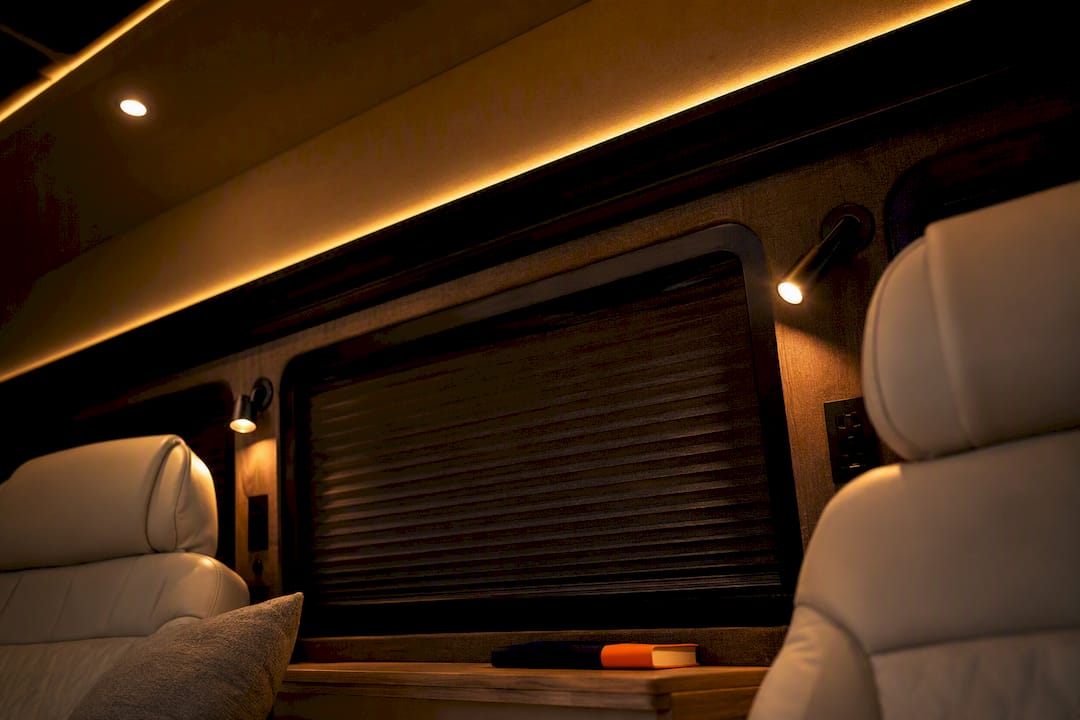
Motion-activated step lighting and entry lighting add a practical safety touch alongside the aesthetic value, especially for evening events or airport pickups where visibility matters. Task lighting near seating areas, separate from ambient lighting, lets passengers read or work without flooding the whole cabin with brightness. The best builds treat lighting as a layered system rather than one switch, combining ambient, accent, and task lighting so each zone of the van can be adjusted independently.
Factory Luxury Packages vs. Aftermarket Conversions: Which Is Better?
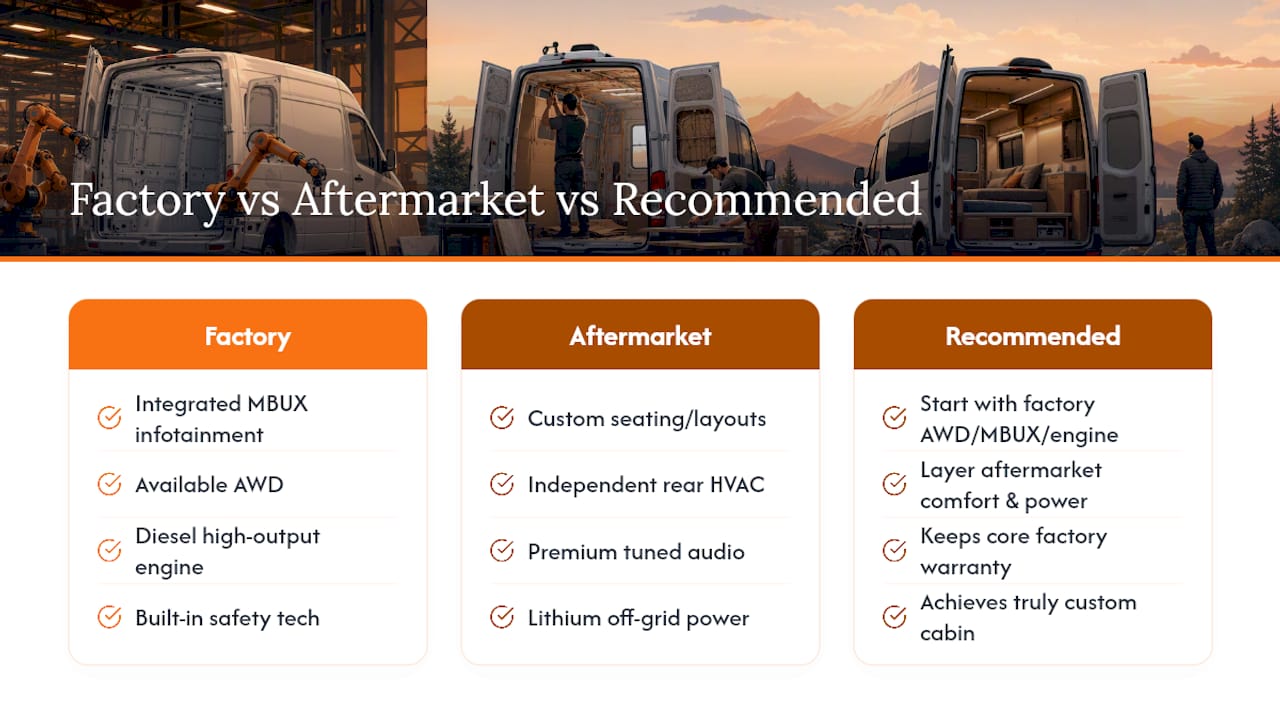
Factory packages from Mercedes-Benz deliver a strong baseline: the MBUX system, available AWD, diesel efficiency, and safety tech come integrated and warrantied from the manufacturer. What factory trims don’t offer is the deep customization that executive, family, or commercial buyers often want, like conference tables, wet baths, or lithium power systems sized for off-grid use.
Aftermarket conversions fill that gap. Upfitters like those referenced in Legend Conversion’s build data specialize in exactly the systems Mercedes doesn’t build at the factory: independent rear HVAC, custom seating layouts, and premium audio tuned to a specific cabin. The trade-off is warranty complexity and higher total cost, since aftermarket work often falls outside factory coverage.
The practical answer for most buyers is a blend. Start with a factory trim that already includes AWD, the diesel high-output engine, and MBUX, then layer aftermarket comfort and power systems on top. Mercedes’ own VLE concept suggests the company is narrowing this gap, building Burmester audio and air suspension in-house rather than leaving it entirely to upfitters. Until that trickles down to the standard Sprinter lineup, aftermarket conversion remains the only path to a truly custom cabin.
What Maintenance and Warranty Issues Come With Luxury Features?
Every system added after the factory build carries its own maintenance schedule, and mixing factory and aftermarket warranties gets complicated fast. Mercedes’ factory warranty covers the chassis, engine, and factory-installed electronics, but it generally does not extend to aftermarket HVAC, lithium battery systems, or custom seating once an upfitter has modified the vehicle.
Independent rear HVAC systems need periodic filter changes and occasional refrigerant checks, similar to home systems but harder to access in a mobile cabin. Lithium battery systems are largely maintenance-free but should have their management system checked annually to confirm cell balancing is working correctly. Hydronic heated floors need occasional fluid checks, since a slow coolant leak can go unnoticed until floor heating stops working entirely.
Upholstery and cabinetry wear differently depending on material choice. Leather needs conditioning every few months to avoid cracking, while performance fabric holds up with minimal care. Always ask an upfitter directly whether a specific system carries its own manufacturer warranty separate from the vehicle’s factory coverage. Skipping that question is how buyers end up paying full price for a failed component they assumed was still covered.
Which Luxury Features Are Actually Worth It?
Executives should spend first on power captain’s chairs and a conference layout since that combination turns transit time into productive time, which is the entire point of an executive van. Families get more daily value from independent rear HVAC and a dedicated entertainment setup than from a bathroom most trips won’t use. Commercial operators should resist the temptation to over-customize and instead prioritize modular seating that can flex between passenger counts week to week.
The build-versus-rent question deserves more attention than it gets. A six-figure custom conversion makes sense for someone using a van weekly for years. For occasional executive travel, family trips, or event transport, renting a pre-configured luxury Sprinter through Sprinter Van Rentals tests exactly which features matter before anyone commits real money to a build.
— Gabriel
Rent an Executive or Family-Ready Sprinter Today
Testing luxury features before building them into a van you own is the lowest-risk way to figure out what you actually need. Choose from 12 and 15-passenger van configurations available across many U.S. cities to experience executive seating, tuned audio, and independent climate control on your next trip instead of guessing from a spec sheet.
The fleet offers executive-style captain’s chairs, conference-style layouts for business travel, and climate systems designed to keep every row comfortable, all without the wait time or capital outlay of a custom build. Families planning a long road trip can book a 15-passenger Sprinter with the space and entertainment options that matter most for kids and luggage. Corporate travelers can reserve a Sprinter limo for airport runs or client transport without committing to ownership. Options for insurance and driver add-ons are typically included, keeping logistics simple. Check availability and pricing at Sprinter Van Rentals to configure your trip today.
Sources
For exact GVWR figures, current option availability, and factory specifications, check the manufacturer directly rather than relying on secondhand summaries. Mercedes-Benz publishes current Sprinter passenger van specs, while upfitters like Legend Conversion and Grech Motors document real-world build costs and feature popularity that OEM spec sheets don’t cover. Travel partners like Easea offer additional guidance on planning guest experience around luxury ground transport.
- 2025 Mercedes-Benz Sprinter Passenger Van Specs, Features, & Configurations | Mercedes-Benz of Houston North
- Luxury Sprinter Van Features & Upgrades: The Complete 2026 Guide | Legend Conversion
FAQ
Which Sprinter Van Is the Most Luxurious?
Custom conversions like Grech Motors’ LUSSO-ion Lounge represent the top tier, combining power recline seating, a built-in bathroom, and a 300Ah lithium battery bank with a 2,000-watt inverter. Among factory trims, the highest-spec 2025 and 2026 passenger vans with MBUX, available AWD, and the diesel high-output engine set the baseline before any aftermarket work begins.
Why Do Celebrities and Executives Use Sprinter Vans?
Sprinter vans offer more configurable interior space and practicality than a luxury SUV, while staying easier to maneuver than a full motorhome, which makes them a popular choice for executive transport and VIP travel. The high roof allows standing room, and the extended wheelbase supports conference-style seating that a sedan or SUV simply can’t fit.
What Are the Key Features of the Mercedes Sprinter?
The current Sprinter passenger van includes a 4-cylinder diesel high-output engine, 9G-TRONIC automatic transmission, available AWD, an MBUX 10.25-inch touchscreen, and safety systems including Active Brake Assist and Blind Spot Assist. A 15-passenger configuration is available for larger groups.
How Much Does a Luxury Sprinter Cost to Build?
Individual upgrades range widely: power captain’s chairs run $1,500 to $3,500 per seat, independent rear HVAC costs $4,000 to $7,000, and a full lithium power system with inverter runs $8,000 to $15,000. A complete high-end build easily reaches six figures once seating, power, bathroom, and AV systems are combined.
Is It Cheaper to Rent or Build a Luxury Sprinter?
For occasional use, renting a pre-configured luxury Sprinter through a provider like Sprinter Van Rentals almost always costs less than a custom build, which can run well into six figures before factoring in maintenance. Ownership only pencils out for businesses running the same van weekly over several years.
Recommended
Keep reading
How Much Is a Sprinter Van Rental? 2026 Pricing Guide
Real Mercedes-Benz Sprinter van rental prices in 2026 — daily rates, mileage, insurance, delivery fees, and how to lower your total.
How to Start a Sprinter Van Rental Business (2026 Playbook)
Step-by-step guide to launching a Sprinter van rental business — licensing, DOT/FMCSA rules, insurance, fleet financing, and marketing.
Mercedes Sprinter Van Rental in Orlando, FL — Where to Rent
Compare Mercedes-Benz Sprinter van rental options in Orlando, FL — MCO airport delivery, theme park runs, and 12 & 15-passenger pricing.