August 22, 2026 · 9 min read
Corporate Event Transportation: A Decision-First Guide
Corporate Event Transportation: A Decision-First Guide

For 30 or more attendees moving together on the same route, charter a motorcoach. For staggered airport arrivals spread across several flights, run a shuttle loop. For VIP transport, executive groups, or multi-stop itineraries under 15 people, book a 12 or 15 passenger Sprinter van.
Those three rules cover most corporate event transportation decisions planners face, whether you’re moving 200 conference attendees or six executives between a hotel and three client dinners.
- 30+ attendees, single route: motorcoach or minibus charter
- Staggered arrivals, multiple flights: shuttle loop with 60 to 90 minute windows
- VIPs, small groups, multi-stop days: 12 to 15 passenger Sprinter vans
Full-size motorcoaches typically seat 47 to 57 passengers, while minibuses hold 20 to 35, so the right vehicle depends on exact headcount, not just group size in general terms.
Key Takeaways
Matching vehicle type to group size and itinerary style, not just headcount, is the single decision that prevents most corporate transportation failures.
| Point | Details |
|---|---|
| Match vehicle to itinerary | Charter coaches for 30+ on one route; shuttles for staggered arrivals; Sprinter vans for VIP or multi-stop days. |
| Book early, especially in peak season | Small events need 3 to 4 weeks lead time, mid-size 6 to 8, large events 10 to 12 or more. |
| Build one manifest everyone trusts | Include names, phone numbers, flight numbers, pickup addresses, and VIP flags in a single shared document. |
| Get overtime and fees in writing | Confirm deadhead charges and overtime rates before signing to avoid invoice surprises. |
| Consider Sprinter vans for executive groups | Sprinter-Van-Rentals.com offers 12 and 15 passenger and executive Sprinter options built for VIP and multi-stop corporate itineraries. |
Where to Verify Pricing, Specs, and Best Practices
- Corporate Event Transportation: Buses, Shuttles & More
- Larry’s Limo Corporate Planning Guide
- DA Executive Service Logistics Guide
- United Motorcoach Association
- American Bus Association
- Sprinter-van-rentals for immediate quotes.
Table of Contents
- What Is Corporate Event Transportation Planning?
- Which Vehicle Fits Your Group Size and Itinerary?
- How Do You Plan the Logistics and Timeline?
- What Drives Corporate Transportation Pricing?
- How Do You Make Corporate Event Transportation More Sustainable?
- What I’ve Learned Watching Planners Get This Wrong
- Book Executive Sprinter Van Service for Your Next Corporate Event
- Sources
What Is Corporate Event Transportation Planning?
Corporate event transportation planning is the process of matching vehicle type, vendor capability, and scheduling to an event’s headcount, itinerary, and guest profile. It’s not just booking a van. It means building a manifest, setting staging plans, confirming lead times, and putting a communication system in place so nobody stands on a curb wondering where their ride is.
Here’s the checklist that actually prevents day-of chaos:
- Count heads accurately, then add 10%. Underestimating capacity is the single most common planning error, and it’s the easiest to fix with one phone call to your vendor before final booking.
- Map luggage and equipment needs. A group with laptops and a trade show backdrop needs a different cargo configuration than a group flying in with carry-ons only.
- Define your itinerary style. A single airport-to-hotel transfer needs a different vehicle than a multi-stop day with a factory tour, a lunch venue, and an evening reception.
- Flag VIP and accessibility needs early. Executives sometimes need separate vehicles or specific pickup timing; wheelchair access requires vehicles with lift capability, not a retrofit promise.
- Check staging constraints at the venue. Some hotel and convention center curbs can’t handle a 45-foot coach; ask the venue directly, not just the vendor.
When you’re vetting vendors, ask these questions directly: Do they support digital manifests? Do they track incoming flights in real time? Will you get one dedicated coordinator for the event, or a call center? What’s the cancellation window, and what counts as billable overtime? Professional corporate transportation providers typically offer 24-hour dispatch, flight monitoring, and a dedicated event coordinator — capabilities that separate corporate-grade service from a commodity rental with a driver attached.
Watch for vague cancellation language and “estimated” hourly rates that don’t specify overtime thresholds. Push vendors to put both in writing before you sign.
Pro Tip: Ask every vendor for a sample manifest template during the quote stage. If they can’t produce one, that’s a signal their operation runs on phone calls and guesswork instead of a documented system.
Which Vehicle Fits Your Group Size and Itinerary?
Vehicle selection is where most budgets go sideways. Planners either overbook capacity out of caution or underbook it to save money, and both mistakes cost more in the long run than getting the count right the first time.
Here’s how the main options break down:
- Motorcoach (47 to 57 seats): Best for large single-route transfers, like moving an entire conference from a headquarters hotel to a convention center. Limited by slow loading and curb access restrictions at smaller venues.
- Minibus (20 to 35 seats): A middle ground for mid-size groups that don’t fill a full coach. Faster to load, more flexible with parking, but still not ideal for frequent multi-stop days.
- Shuttle service: Runs fixed loops on a schedule, which makes it the strongest option for staggered airport pickups or continuous venue-to-hotel movement throughout a multi-day event.
- 12 to 15 passenger Sprinter van: Balances comfort, luggage space, and multi-stop flexibility, which makes it the go-to for executive groups, VIP arrivals, and smaller teams with a packed itinerary.
- Rideshare: Useful only as a supplement for one or two stragglers, never as the backbone of a group transport plan.
Sprinter vans in particular solve a problem larger vehicles can’t: they carry a full executive team plus luggage, but they can still navigate tight hotel driveways and make several stops in a single afternoon without the staging headaches a coach creates. That flexibility matters more than raw capacity for most executive-level itineraries.
Sizing up wrong is expensive in both directions. Right-sizing your vehicle selection avoids unnecessary cost and venue congestion — a half-empty motorcoach parked at a hotel entrance creates the same headache as an overcrowded van running two trips instead of one.
How Do You Plan the Logistics and Timeline?
Every transportation plan needs one document that everyone trusts: the manifest. A solid manifest includes passenger names, mobile numbers, flight numbers, pickup and drop addresses, vehicle assignments, VIP flags, luggage notes, and a named operations contact. Keep it in one shared file, not five email threads.

Staging matters just as much as the manifest. Confirm curb access and permit requirements with the venue directly, since some downtown locations restrict coach parking to specific loading zones at specific times.
Booking lead time scales with size and season:
| Event size | Recommended lead time |
|---|---|
| Small (under 30 guests) | 3 to 4 weeks |
| Mid-size (30 to 100 guests) | 60 to 90 minute windows |
| Large (30+ guests) | 10 to 12+ weeks |
Extend every window during peak season, particularly late spring and early fall when conference volume spikes in most major cities.
On the day itself, keep communication simple:
- Printed or digital show cards with the guest’s name and pickup time
- A live tracking link shared with attendees ahead of pickup
- One single day-of contact number, posted everywhere the manifest is shared
That last point sounds small, but it’s the difference between a guest calling the right person and a guest calling you directly while you’re trying to manage six other things at once.
What Drives Corporate Transportation Pricing?
Quotes vary wildly because the cost drivers aren’t obvious from a headline rate. Vehicle type sets the floor, but hours versus mileage, deadhead charges (what the vendor bills to get the vehicle to you and back), peak season surcharges, driver meal and overnight fees, and airport access fees all stack on top.
Ask every vendor to break out these line items before you compare quotes side by side:
- Base hourly or flat rate, and which one applies to your itinerary
- Deadhead mileage charges from the vendor’s yard to your first pickup
- Overtime threshold and rate per hour beyond the booked window
- Driver gratuity, meal, and overnight fees for multi-day events
- Airport access or parking fees, which some venues pass through directly
For large multi-day charters, budget on a per-head basis and expect that number to shrink as headcount grows, since the vehicle cost spreads across more riders. For Sprinter van bookings, the math runs the opposite direction. A smaller flat rate per van makes sense once you’re moving fewer than 15 people, especially across multiple stops where a coach would need to circle back.
The biggest hidden fee complaint planners report isn’t the base rate. It’s overtime billed at a rate that wasn’t disclosed until the invoice arrived. Get that number in writing before you sign anything.

How Do You Make Corporate Event Transportation More Sustainable?
Sustainability in group transport comes down to filling seats efficiently and choosing vehicles that match real demand instead of defaulting to the biggest option available. A half-full motorcoach burns more fuel per rider than a well-loaded Sprinter van running the same route, so right-sizing isn’t just a cost decision. It’s an emissions decision too.
A few practical levers actually move the needle:
- Consolidate pickup points. Fewer, well-chosen pickup locations reduce total miles driven compared to door-to-door service for a large group.
- Ask vendors about fleet age and fuel type. Newer diesel and hybrid vehicles generally run cleaner than older fleet vehicles, and some operators now offer electric or hybrid Sprinter vans in select markets.
- Combine trips where the itinerary allows it. A shuttle loop that serves multiple hotels in sequence produces less total mileage than separate point-to-point transfers for each property.
- Request emissions or fuel-efficiency data during vendor vetting. Corporate-grade providers increasingly track this and will share it if asked directly.
None of this requires sacrificing service quality. It requires asking one or two extra questions during the vendor selection process, which costs you nothing but a few minutes on a call you’re already having.
What I’ve Learned Watching Planners Get This Wrong
The costliest mistake I keep seeing isn’t vehicle selection. It’s skipping the transportation captain role entirely and assuming the vendor will manage on-site communication. Vendors move vehicles. They don’t chase down a VP who wandered off before pickup.
Two shortcuts pay for themselves every time: build 15 minute buffer windows into shuttle loops, and run a full operations check the day before, not the morning of.
For executive groups specifically, the math on Sprinter vans keeps holding up. A 12 or 15 passenger van solves the multi-stop, small-group problem that neither a rideshare fleet nor a coach handles well, which is exactly the gap Sprinter-van-rentals was built to fill.
— Gabriel
Book Executive Sprinter Van Service for Your Next Corporate Event
Sprinter-van-rentals is the direct fix for the gap coaches and rideshare fleets both leave open: getting a small executive group, VIPs, or a multi-stop itinerary handled in one vehicle without staging headaches or per-ride pricing chaos. A 12 or 15 passenger Sprinter van carries a full leadership team plus luggage, and it can still pull into a tight hotel driveway that a 45-foot coach never could.
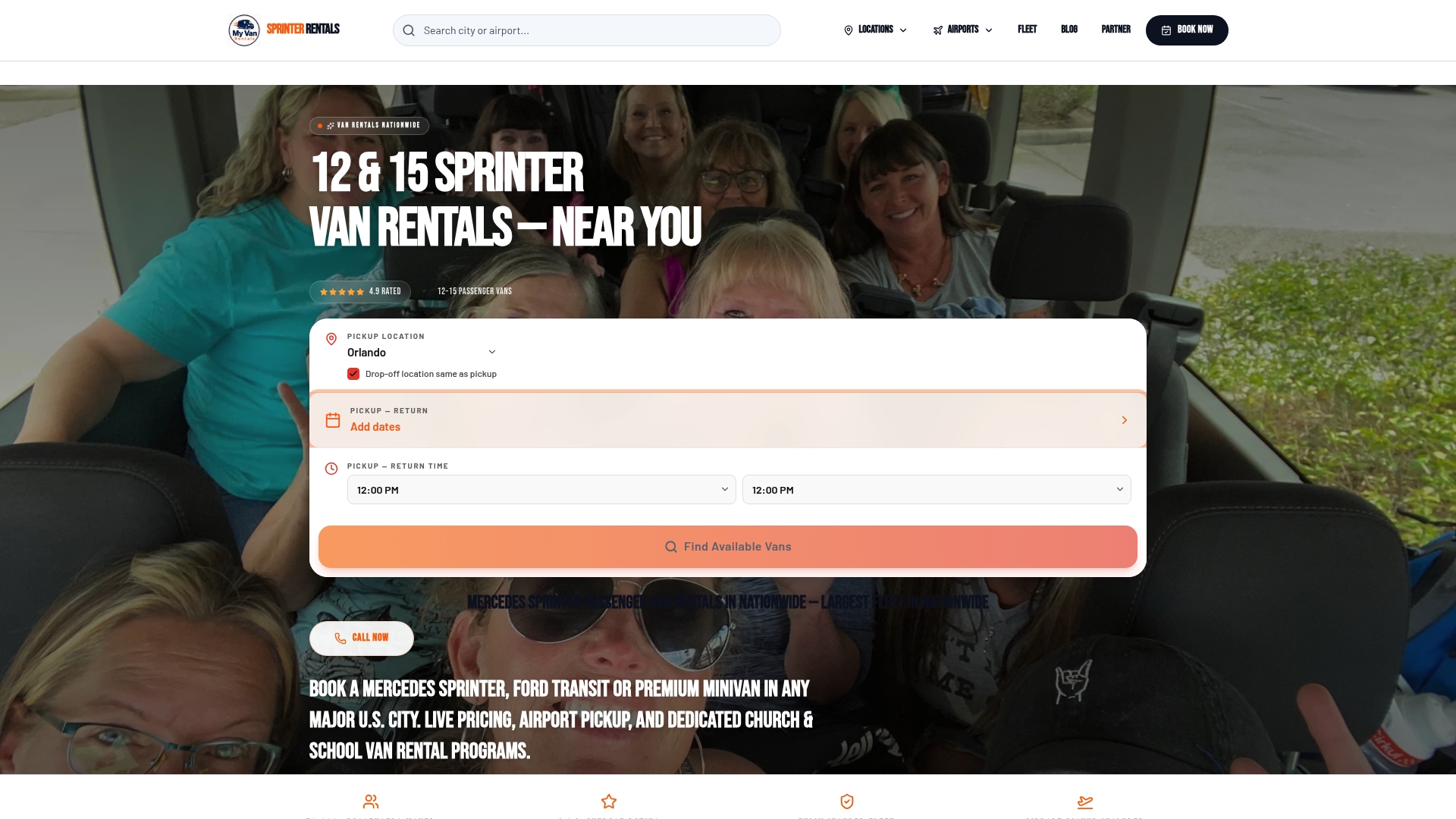
The fleet includes the Mercedes Executive Sprinter for polished client-facing arrivals, plus limo-van options for upscale evening events, with driver add-ons available so your team isn’t managing navigation between meetings. Coverage runs nationwide, which matters when your conference schedule jumps cities twice in one quarter.
Get a live quote and check availability for your event dates at Sprinter-van-rentals before you lock in a coach charter you may not actually need.
Sources
- Corporate Event Transportation: Buses, Shuttles & More
- Corporate Event Transportation Planning Guide
- Corporate Event Logistics Guide for Leaders
- Corporate Event Transportation: Plan Seamless Logistics
- United Motorcoach Association (UMA)
Recommended
Keep reading
How Much Is a Sprinter Van Rental? 2026 Pricing Guide
Real Mercedes-Benz Sprinter van rental prices in 2026 — daily rates, mileage, insurance, delivery fees, and how to lower your total.
How to Start a Sprinter Van Rental Business (2026 Playbook)
Step-by-step guide to launching a Sprinter van rental business — licensing, DOT/FMCSA rules, insurance, fleet financing, and marketing.
Mercedes Sprinter Van Rental in Orlando, FL — Where to Rent
Compare Mercedes-Benz Sprinter van rental options in Orlando, FL — MCO airport delivery, theme park runs, and 12 & 15-passenger pricing.