September 14, 2026 · 10 min read
Group Leaders: Stop the Nearly 3x Rollover Risk in 15 Passenger Vans
Group Leaders: Stop the Nearly 3x Rollover Risk in 15 Passenger Vans

Yes, 15-passenger vans can be operated safely, but only when organizations enforce a handful of non-negotiable rules. Seat belts on every occupant, correctly inflated and inspected tires, front-to-back seating, and trained drivers behind the wheel. Skip any one of those, and the risk profile changes fast. Before your next trip, walk the van, check the tires, and watch every passenger click a belt.
TL;DR:
- Ensuring every seat belt is buckled and all tires are inspected weekly with proper inflation lowers the risk of rollovers and injuries.
- Fully loaded vans with ten or more occupants have nearly three times higher rollover rates due to rear and upward weight shifts affecting stability.
- Drivers must have a clean record, van-specific training, and limitations on driving hours to prevent operator error that can lead to crashes.
- Regularly checking tire pressure before every trip and replacing tires older than six years reduces mechanical failure risks associated with rollover crashes.
- A comprehensive safety policy, including seat belt enforcement, driver qualification, maintenance documentation, and load distribution, significantly improves overall safety outcomes.
Table of Contents
- What Does a 15-Passenger Van Safety Checklist Look Like?
- Why Do 15-Passenger Vans Roll Over So Often?
- What Should Drivers Be Required to Have Before Getting Behind the Wheel?
- How Often Should You Check Tires and Suspension?
- How Should Passengers and Cargo Be Loaded?
- Which Safety Features Should You Prioritize When Choosing a Van?
- What Belongs in a Written Organizational Safety Policy?
- How Does Insurance Factor Into 15-Passenger Van Safety?
- What a Responsible Fleet Operator Actually Does
- Book a Safety-Ready 15-Passenger Van
- Sources
- FAQ
What Does a 15-Passenger Van Safety Checklist Look Like?
A written checklist turns good intentions into consistent habits. Here’s what belongs in yours before any group climbs aboard:
- Visually confirm every seat belt is buckled before the van leaves the lot, not just before highway speed.
- Check tire pressure and tread weekly, and note the tire identification number (TIN) so no tire older than six years stays in service.
- Screen drivers for a minimum experience threshold and clean driving record, then retrain them on a set schedule.
- Fill seats front-to-back and never exceed 15 total occupants including the driver.
- Ban roof cargo entirely and skip towing unless the manufacturer’s GVWR rating explicitly allows it.
For the pre-trip routine itself, follow these steps in order:
- Walk the exterior and check tire condition, lights, and mirrors.
- Confirm tire pressures against the driver-door placard, not a generic passenger-car number.
- Verify seat belts are present and functional in all 15 positions.
- Load cargo low and forward, never behind the rear axle.
- Sign and log the inspection before departure.
Pro Tip: Keep a laminated seating chart taped near the door. It sounds simple, but it stops the scramble that leads to skipped belts and back-row overcrowding.
Why Do 15-Passenger Vans Roll Over So Often?
Occupancy changes the physics of the vehicle. A 15-passenger van carrying 10 or more people has a rollover rate in single-vehicle crashes nearly three times higher than one carrying fewer than five. Weight sitting high and toward the rear pushes the center of gravity up and back, exactly the wrong direction for stability during a sudden lane change or tire blowout.
Fully loading a 15-passenger van shifts weight rearward and upward, which increases rollover propensity, according to the NTSB’s evaluation of these vehicles. That single mechanical fact explains most of what follows: tire failure, overcorrection, and roadway departure.
The numbers back this up starkly. Between 2004 and 2013, 653 people died in 15-passenger van crashes, and nearly 60% of those deaths happened in rollovers. A rear-left tire failure at highway speed, followed by a driver’s instinctive overcorrection, is a common chain of events. None of this requires a long road trip. Many incidents happen on short, local runs where drivers assume speed and distance are low enough to skip precautions.
What Should Drivers Be Required to Have Before Getting Behind the Wheel?
Driver quality matters as much as the vehicle itself. Organizations should require, at minimum:
- A verified driving record check with no major violations in the past three years.
- Completion of van-specific training covering handling, backing, and emergency maneuvers, since a fully loaded 15-passenger van handles nothing like a car or minivan.
- A night-driving policy, either restricting it outright or requiring extra experience before it’s permitted.
- A cap on driving hours, commonly no more than 10 hours in any 24-hour period, with a second driver rotating in on longer trips.
- Periodic retraining, ideally annually, to reinforce habits that fade over time.
Whether a driver needs a commercial driver’s license varies by jurisdiction and by whether the trip is for compensation, so check your state’s specific threshold rather than assuming a standard license covers every scenario. The NTSB’s research into rollover propensity notes that these vans were originally cargo-platform designs adapted for people, which means handling quirks that a car license doesn’t prepare a driver for.
How Often Should You Check Tires and Suspension?
Tire failure is the mechanical trigger behind most 15-passenger van rollovers, and it’s also the easiest problem to prevent. Check pressure before every single trip, not just weekly, and always reference the driver-door placard rather than a number you remember from your own car. Van tire pressures are often significantly higher than passenger-car pressures and may be staggered, with rear pressures set well above front.
- Inspect sidewalls for cracking and tread for uneven wear at every fuel stop on longer trips.
- Check the TIN on all five tires, including the spare, since a six-year-old spare is a liability even if it’s never been driven on.
- Schedule suspension and steering inspections on the manufacturer’s recommended interval, and keep the repair record on file.
- Require any rental or fleet vendor to share recent maintenance logs before you sign off on a booking.
Pro Tip: A worn spare is often the most overlooked risk in the whole fleet. Check it with the same rigor you check the four tires actually on the road.
How Should Passengers and Cargo Be Loaded?
Loading strategy is one of the few rollover risk factors an organization fully controls. Seat passengers front-to-back, filling the front rows before anyone sits in row four or five. This keeps weight forward and low, which counters the rearward CG shift that comes with a full van.
- Place heavy cargo forward of the rear axle and on the floor, never stacked high or pushed to the back.
- Use a trailer for excess luggage rather than cramming it behind the last row of seats.
- Never load anything on the roof, and skip towing unless the owner’s manual and GVWR rating specifically permit it.
- For youth groups or teams with a wide range of sizes, seat heavier or older passengers toward the front to keep weight distribution balanced.
Reviewing your van’s actual seating and cargo layout before a trip makes this planning far easier than guessing on the day of departure.
Which Safety Features Should You Prioritize When Choosing a Van?
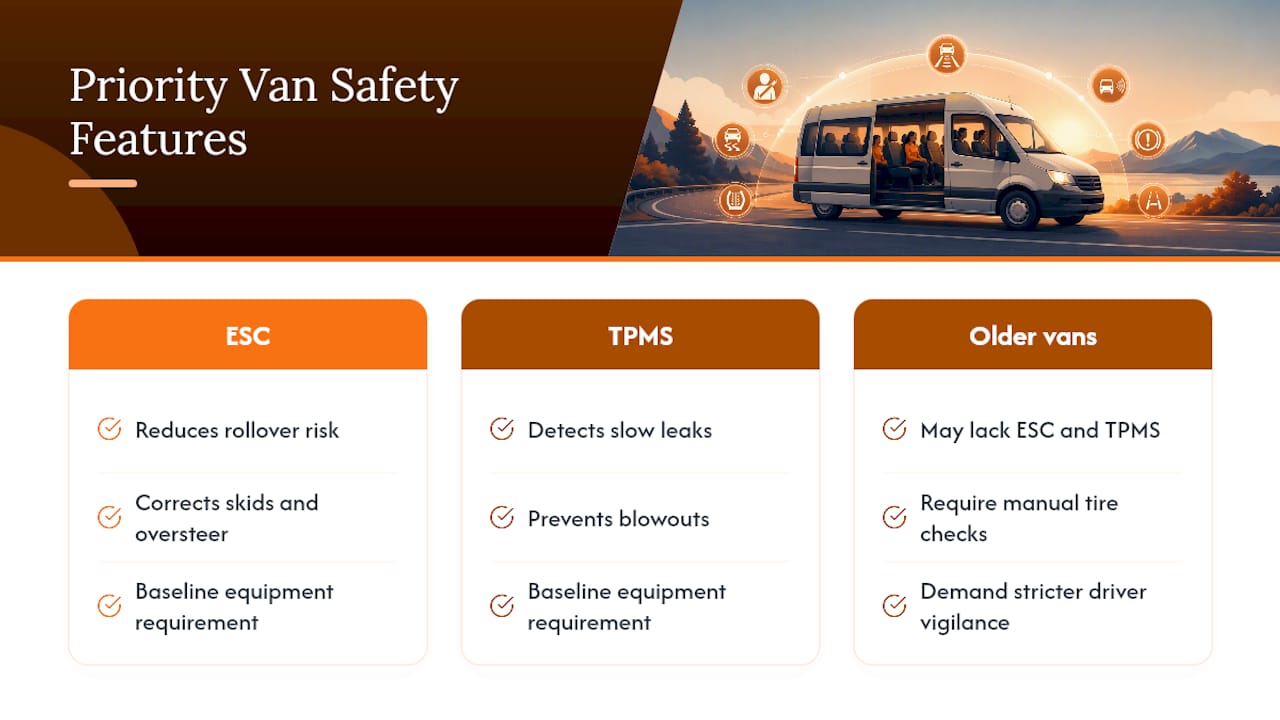
Model year matters more than most organizations realize. Electronic stability control has measurably reduced rollover risk in newer vans, correcting for skids and oversteer faster than a driver can react. Tire-pressure monitoring systems catch slow leaks before they become blowouts, closing the exact gap that caused a large share of historical rollover deaths.
When evaluating a van, whether you’re buying or renting, check the equipment list for ESC and functioning TPMS as a baseline requirement, not a bonus feature. Older units without these systems can still be driven safely, but they demand stricter manual vigilance on tire checks and driving behavior, since the vehicle itself won’t catch a mistake. Reviewing Sprinter-specific specs before committing to a vehicle gives you a clear picture of what safety tech comes standard.
What Belongs in a Written Organizational Safety Policy?
A written policy turns scattered good habits into an enforceable standard, and insurance loss-control guidance consistently points to written enforcement as more effective than relying on vehicle features alone. Your policy should include:
- A mandatory seat-belt rule with visual pre-departure checks and clear consequences for noncompliance.
- A driver qualification checklist covering experience minimums, training cadence, and maximum daily hours.
- A pre-trip inspection form with sign-off, plus a maintenance and document retention schedule.
- Firm occupancy limits, cargo placement rules, a roof-load ban, and a defined incident-reporting procedure.
| Policy Element | Minimum Standard |
|---|---|
| Seat belt enforcement | Visual check, every occupant, every departure |
| Driver experience | Clean record check, van-specific training completed |
| Max driving hours | 10 hours per 24-hour period, rotate on long trips |
| Tire inspection | Before every trip, pressure per door placard |
| Occupancy cap | Never exceed 15 total, including driver |
A pre-trip inspection template built for commercial fleets adapts well to vans and gives you a starting structure rather than building one from scratch.
How Does Insurance Factor Into 15-Passenger Van Safety?
Insurers treat 15-passenger vans as a distinct risk category, and your safety practices directly affect both your premium and your coverage in a claim dispute. Carriers frequently ask whether your organization enforces a written seat-belt policy, whether drivers pass a screening process, and whether maintenance is documented. Gaps in any of these areas can affect claim outcomes after an incident, since a documented pattern of skipped inspections or unenforced belt policies can be used to argue negligence.
Ask your insurer directly whether they offer reduced rates for organizations with a written safety policy, driver training records, and logged maintenance. Many loss-control programs reward exactly this kind of documentation, and it costs you nothing but paperwork discipline to qualify. If your organization rents vans rather than owning them, confirm whether your policy extends to rented vehicles or whether you need supplemental rental coverage, and clarify who carries liability if a vetted third-party driver is behind the wheel.
Keep your inspection logs, driver qualification records, and incident reports for at least as long as your insurer’s retention requirement, often several years. These documents matter far more after an incident than before one. An organization that can produce a signed pre-trip inspection form and a driver’s clean record check is in a dramatically stronger position than one that cannot, regardless of what actually caused the crash.

What a Responsible Fleet Operator Actually Does
A fleet that takes safety seriously keeps maintenance logs current, runs ESC-equipped vehicles, checks tire age on every unit, and offers vetted drivers as an option rather than an afterthought. Before booking any van, ask directly for maintenance records, the date of the most recent inspection, and details on driver screening if you’re adding a driver.
Working with a fleet that already meets these standards doesn’t replace your organization’s own policy. It does remove a lot of the guesswork, since you’re inheriting a maintenance discipline instead of building one from zero.
— Gabriel
Book a Safety-Ready 15-Passenger Van
This service is designed to meet the checklist above, helping to integrate vehicle safety and policy compliance. Rentals come from fleets with maintenance histories, and tire and inspection records may be requested prior to booking.
Vans are configured with front-to-back seating layouts that support the loading practices covered earlier, and you can review specific seating and legroom details before you commit to a unit. If your organization prefers not to vet a driver internally, Sprinter Van Rentals also offers a vetted driver option that shifts the qualification burden off your team entirely. With availability across 260-plus U.S. cities, you can match the same safety standard whether you’re planning a school trip across town or a multi-state church retreat.
Check current availability and vehicle specs for your dates, and request maintenance documentation before you finalize your booking.
Sources
This article draws on NHTSA’s 15-passenger van safety guidance, the NTSB’s rollover propensity evaluation, and Tennessee’s state safety report on 15-passenger van incidents, alongside U.S. DOT’s tire safety advisory.
- 15-Passenger Vans | NHTSA
- Evaluation of the Rollover Propensity of 15-passenger Vans — NTSB
- Consumer Advisory: NHTSA urges 15-passenger van users to always check tires before driving — U.S. DOT
FAQ
What Is the Largest Cause of Accidents in 15-Passenger Vans?
Tire failure combined with rollover is the leading cause, with nearly 60% of van crash fatalities between 2004 and 2013 occurring in rollover crashes, often triggered by tire blowouts and driver overcorrection.
How Hard Is It to Drive a 15-Passenger Van?
It’s noticeably harder than driving a car or minivan because of the higher center of gravity and longer stopping distance, which is why van-specific training in handling and emergency maneuvers matters before anyone drives one loaded with passengers.
Which Passenger Vans Are the Safest?
Newer model-year vans equipped with electronic stability control and tire-pressure monitoring carry meaningfully lower rollover risk than older units lacking those systems, so checking the equipment list before booking or buying matters as much as the brand.
Can I Drive a 15-Passenger Van With a Regular License in Texas?
Licensing requirements vary by state and by whether the trip involves compensation, so confirm the specific rule with your state’s transportation authority rather than assuming a standard license covers every use case.
What Safety Practices Should Every Organization Enforce?
Enforce visible seat belt checks before departure, front-to-back seating, weekly tire inspections against the door placard, and a written driver qualification and training policy, all of which address the specific failure points behind most 15-passenger van crashes.
Recommended
Keep reading
How Much Is a Sprinter Van Rental? 2026 Pricing Guide
Real Mercedes-Benz Sprinter van rental prices in 2026 — daily rates, mileage, insurance, delivery fees, and how to lower your total.
How to Start a Sprinter Van Rental Business (2026 Playbook)
Step-by-step guide to launching a Sprinter van rental business — licensing, DOT/FMCSA rules, insurance, fleet financing, and marketing.
Mercedes Sprinter Van Rental in Orlando, FL — Where to Rent
Compare Mercedes-Benz Sprinter van rental options in Orlando, FL — MCO airport delivery, theme park runs, and 12 & 15-passenger pricing.