September 15, 2026 · 12 min read
About a Dozen Carry On Bags Fit in a 15 Passenger Van for Trip Leaders
About a Dozen Carry On Bags Fit in a 15 Passenger Van for Trip Leaders

A fully seated 15-passenger van leaves almost no dedicated trunk space, since the last row of seats typically sits right against the rear doors. Plan on the van functioning like a smaller capacity vehicle once checked bags enter the picture: carry-ons and soft duffels squeeze in fine, but bulky suitcases and gear compete directly with seats. Count bags before you book, and treat a trailer, roof box, or second vehicle as your backup plan rather than an afterthought.
TL;DR:
- Most 15-passenger vans can reliably carry only 6 to 8 standard suitcases behind the last row, not 15, due to limited rear cargo space.
- Adding bulky gear like skis or golf bags often reduces passenger capacity to around 10 or 11, as these items displace multiple suitcases or seats.
- The actual usable cargo space varies significantly by model, wheelbase, roof height, and seat configuration, with high-roof and extended models offering more room when fewer seats are installed.
- Confirming specific luggage counts, oversized items, and configuration details upfront helps ensure the van can meet your group’s true storage needs.
- Towing a trailer or booking a second vehicle may be necessary if luggage volume exceeds what a standard 15-passenger van can accommodate.
Table of Contents
- How Much Luggage Fits in a 15-Passenger Van?
- What Are the Cargo Dimensions by Van Model?
- How Do You Pack a 15-Passenger Van Efficiently?
- When Should You Choose an Alternative to a Full 15-Seat Van?
- How Sprinter Van Rentals Confirms Luggage Space Before You Book
- What Groups Get Wrong About Van Capacity
- Book a Van That Actually Fits Your Luggage
- Sources
- FAQ
How Much Luggage Fits in a 15-Passenger Van?
The honest answer depends less on the “15-passenger” label and more on how many of those seats are actually occupied and what your group is carrying. A church group riding to a retreat with backpacks behaves completely differently, cargo-wise, than a sports team hauling duffel bags, cleats, and equipment cases to a tournament.
Scenario A: carry-on only. If everyone travels light, with a backpack or a small rolling carry-on each, a full 15-seat load is genuinely workable. Bags tuck under seats, sit on laps for short hops, or stack loosely near the last row without blocking the aisle.
Scenario B: mixed checked and carry-on, airport transfer. This is where reality sets in. Rental operators who track this daily report that a 15-passenger configuration comfortably handles roughly 11 to 12 carry-on bags or 6 to 8 standard checked suitcases in typical setups, not both at once. If your group is flying in with checked luggage, plan for fewer riders rather than a full 15, and expect to use seat space, not just floor space, for bags.
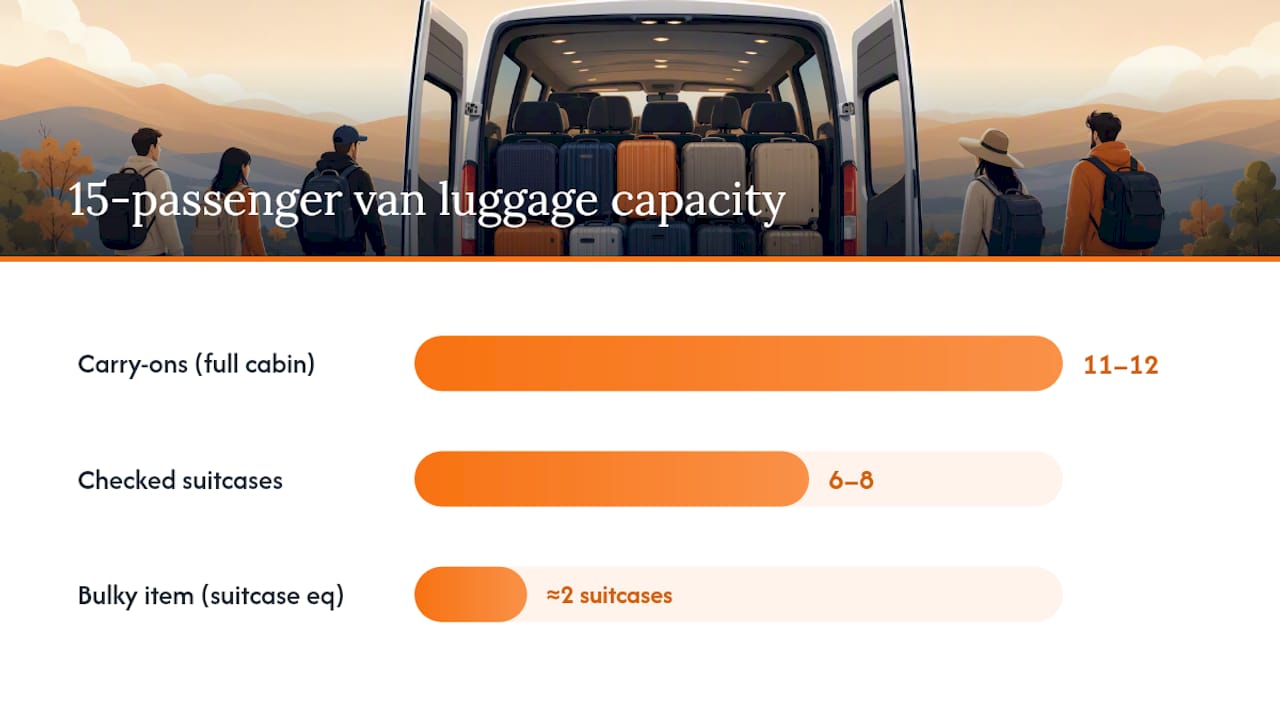
Scenario C: bulky gear. Skis, golf bags, hockey equipment, and instrument cases change the math fast. A single golf bag or ski bag can eat the space of two or three suitcases, and it usually has to ride across a seat or in the aisle footwell rather than stacked neatly. Bands and sports teams almost always sacrifice usable seats to bulky gear, which is the scenario where a 15-passenger van most often turns into an effective 10 or 11 passenger van.
A few real-world numbers to anchor your planning:
- 11 to 12 carry-ons fit in many standard 15-seat configurations without touching passenger space.
- 6 to 8 standard checked suitcases is the more realistic ceiling once bags get bigger than a carry-on.
- Near-zero dedicated cargo exists behind the last row in most standard-length layouts, according to owner and forum reports on rear cargo space behind the back row.
- Bulky items count double. One golf bag or ski bag often displaces the space of two checked suitcases.
Statistic Callout: Operators consistently cite the same rule across brands: roughly 11 to 12 carry-ons or 6 to 8 standard suitcases is the realistic ceiling for a fully seated 15-passenger van, not the 15 suitcases the seat count might suggest.
Variability by model and configuration is real, too. A high-roof extended van behaves differently than a standard-roof, standard-wheelbase model, which is exactly why the next section breaks down cargo by platform.
What Are the Cargo Dimensions by Van Model?
Reading a spec sheet without context is how most organizers overestimate what a 15-passenger van can carry. Three variables decide usable cargo space: wheelbase (regular or extended), roof height (low, medium, or high), and how many of the available seats are actually installed.
Wheelbase. A longer wheelbase adds length behind the rear axle, which can translate into more room behind the last row of seats, assuming the seating layout doesn’t simply stretch to fill that length. Roof height primarily affects vertical stacking room rather than floor footprint, but a high roof does let bags stand upright in a cargo well instead of lying flat.
Seat count. This is the variable people miss most. A van rated for 15 passengers and configured with all 15 seats installed will almost always have less usable rear cargo than the same chassis configured for 12 passengers, because those extra rows physically occupy space that would otherwise be cargo floor.
Sprinter: the 144-inch vs. 170-inch difference
The Mercedes-Benz Sprinter illustrates this trade-off clearly. The 144-inch wheelbase Sprinter is commonly configured as a 12-seat executive van, and that shorter layout typically preserves a genuine rear cargo area for suitcases. Step up to the 170-inch high-roof Sprinter configured for 15 passengers, and that same rear cargo area shrinks dramatically, sometimes to nothing more than the space directly behind the final row’s headrests.
That single distinction, 144 versus 170 with seating adjusted accordingly, is often the most useful thing to ask about when comparing quoted vehicles. Our own 15-passenger Sprinter interior page breaks down legroom and luggage notes by configuration if you want a closer look before booking.
Ford Transit: cargo volume swings by configuration
Ford publishes cargo volume figures across Transit passenger van configurations, and the numbers move substantially depending on roof height and wheelbase. Some extended, high-roof Transit configurations quote several hundred cubic feet of total cargo volume, but that figure reflects the van empty of seats. Once a 15-passenger seating layout goes in, real usable cargo behind the last row drops well below the advertised maximum. MotorTrend’s comparison of 15-passenger vans makes the same point: seating capacity and cargo orientation pull in opposite directions on every platform.
Chevrolet Express and GMC Savana
The Chevrolet Express and GMC Savana platforms follow the same pattern as their competitors. Both are body-on-frame vans available in extended lengths, and both lose meaningful rear cargo room once a 15-passenger interior is installed rather than a cargo or 12-passenger layout. They’re a useful reference point if you’re comparing platform types, but the underlying rule stays constant across every brand: more seats installed means less floor behind them.
| Configuration type | Typical seating | Usable rear cargo |
|---|---|---|
| Standard wheelbase, 15 seats | 15 | Minimal to none |
| Extended wheelbase, 15 seats | 15 | Small, varies by model |
| Standard or extended, 12 seats | 12 | Noticeably larger |
| High roof, 12 seats | 12 | Largest practical option |
The takeaway across every platform: if luggage matters as much as headcount, ask specifically about wheelbase, roof height, and installed seat count, not just the “15-passenger” label on the listing.
How Do You Pack a 15-Passenger Van Efficiently?
Good packing strategy can recover a surprising amount of usable space, even in a van with almost no dedicated trunk area. Follow this order:
- Choose soft-sided bags over hard-shell suitcases. Duffels, compression bags, and soft backpacks flex into gaps between seats and under armrests where a rigid suitcase simply won’t fit.
- Load heaviest and least-needed items first, toward the back. Bags nobody needs until arrival go against the rear doors or wall; anything needed mid-trip, like a diaper bag or medication, stays accessible near the front or under a seat.
- Use under-seat space deliberately. Most van seats have several inches of clearance beneath them, enough for a flattened duffel or a pair of shoes, and that space goes unused more often than not.
- Keep the center aisle completely clear. Loose bags in the walkway are both a safety hazard and, in most states, a violation of passenger van loading rules if they block emergency egress.
- Ask about seat removal before you load, not after. Many operators will pull one or two rows of seats if you request it in advance, converting a 15-passenger van into a functional 10 or 11 passenger van with real cargo space. This typically requires advance notice and sometimes a fee, and it is not something a renter should attempt on their own once the van is in hand.
- Secure everything that isn’t strapped to a seat. Cargo nets or tie-down straps keep bags from sliding during braking, which matters more in a tall van than most travelers expect.
Pro Tip: Weigh your heaviest bag at home before travel day. If it tops 50 pounds, tell the operator in advance. Loading a van with several oversized, heavy bags at the last minute is how organizers end up leaving suitcases at the curb.
When Should You Choose an Alternative to a Full 15-Seat Van?
Run through a short checklist before you commit to one van: How many people are actually riding? How many bags per person, and are any of them checked-size or larger? Does anyone have bulky gear like instruments, sports equipment, or oversized cases? And does your pickup or drop-off location have room for a trailer or a second vehicle if you need one?
If the answers point to more bags than seats can absorb, these are your realistic options:
- Switch to a 12-passenger configuration. Fewer seats installed means real cargo room returns, and it’s often the simplest fix for airport groups carrying checked luggage. Our 12-passenger Sprinter page covers how much space that trade-off actually recovers.
- Add a roof box. Roof cargo boxes work well for soft, lightweight bags, but they add height that can matter for parking garages and low bridges, so check clearance first.
- Tow a trailer. A cargo trailer solves the space problem outright, but it requires a hitch-rated vehicle, a driver comfortable towing, and extra time for loading and parking.
- Book a second vehicle. Splitting a large group across two smaller vans is often cheaper and less stressful than forcing one van to do double duty as a moving truck.
- Insist on written confirmation of configuration. Get the wheelbase, roof height, and seat count in writing before the trip, not a verbal assurance that “it’ll fit.”
The Sprinter Van Rentals seating capacity overview walks through how 12, 15, and executive configurations compare if you’re deciding between them.
How Sprinter Van Rentals Confirms Luggage Space Before You Book
Getting the right van starts with a specific conversation, not a general request for “a 15-passenger van.” When you call or submit a request through a van rental service, come prepared with a few concrete details so the booking team can match you to a configuration that actually fits your gear.
Tell the booking agent:
- Exact bag counts by type. How many carry-ons, how many checked-size suitcases, and how many people are riding.
- Any oversized or bulky items. Golf bags, ski equipment, instrument cases, or anything that won’t fit in a standard suitcase footprint.
- Whether you need a specific wheelbase or roof height. If cargo room matters more than the 15th seat, say so directly.
- Whether seat removal makes sense for your group. Fewer riders with more luggage often means pulling a row of seats is worth discussing upfront.
Our Mercedes-Benz Sprinter 15-passenger specs page and fleet configuration page lay out the wheelbase and roof options available across our nationwide inventory, so you can point to a specific configuration when you request a quote instead of guessing. Matching the van to your bag count before the trip, rather than discovering the shortfall at the curb, is the single most useful thing an organizer can do.
What Groups Get Wrong About Van Capacity
The biggest misconception in this entire topic is treating seat count and luggage capacity as the same number. They aren’t, and they were never designed to be. A 15-passenger van is built to move 15 people efficiently, and every seat installed is space the manufacturer intentionally took away from cargo. Expecting that same van to swallow 15 sets of checked luggage isn’t optimism, it’s a math error.
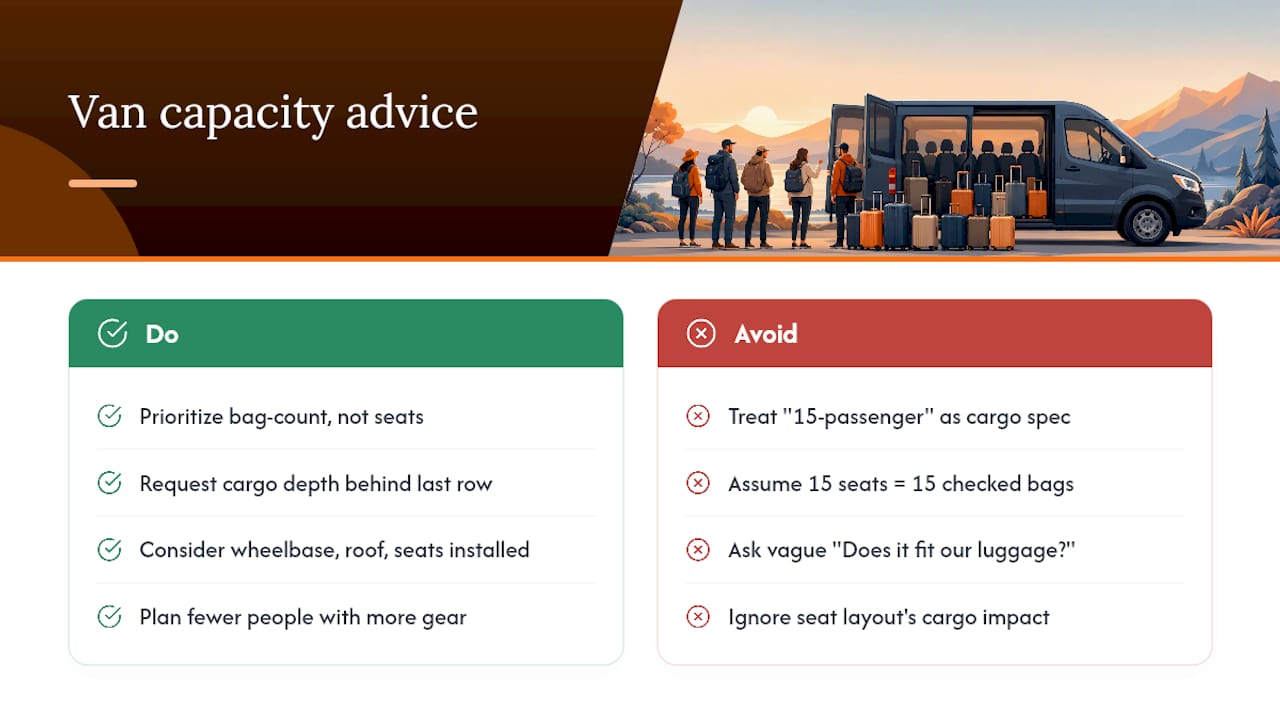
Where conventional advice falls short is in treating “15-passenger” as a fixed spec rather than a range. The same chassis behaves completely differently depending on wheelbase, roof height, and how many seats the operator actually installs. Readers who ask for a cargo depth measurement behind the last row, in inches, get a far more useful answer than readers who ask “does it fit our luggage,” because the second question invites a vague yes.
If you take one thing from this article, prioritize the bag count conversation over the seat count conversation. Fewer people with more gear beats more people with nowhere to put their bags, every single time.
— Gabriel
Book a Van That Actually Fits Your Luggage
This service provides a way to lock in the exact configuration your trip needs instead of gambling on a generic “15-passenger” listing, with 12- and 15-passenger Mercedes Sprinter, Ford Transit, and minivan options available nationwide.

When you submit a request, include three things: your exact bag counts (carry-on and checked, separately), any oversized items like golf bags or instrument cases, and whether you want a specific wheelbase or roof height confirmed in writing. That level of detail is what turns a guess into a booking you can trust on travel day.
Start your request on the Sprinter Van Rentals booking page and get a configuration matched to your group’s real luggage needs, not just its headcount.
Sources
- 2027 Ford Transit® Vans | Pricing, Photos, Specs & More
- How Many Passengers Fit in a Mercedes-Benz Sprinter Van?
- Space behind back row in 15 passenger | Ford Transit USA Forum
FAQ
How many suitcases can fit in a 15-passenger van?
Most fully seated 15-passenger vans handle around 6 to 8 standard checked suitcases or 11 to 12 carry-on bags, not both at once, since the last row typically leaves little to no dedicated cargo space.
How much cargo space does a 15-passenger van have?
It depends heavily on configuration. A standard-length, fully seated 15-passenger van often has near-zero usable cargo behind the last row, while extended or high-roof models with fewer seats installed can preserve meaningfully more room.
What is the luggage capacity of a Ford Transit 15-passenger van?
Ford’s Transit spec pages list total cargo volume by configuration, but that figure reflects the van without seats installed. Once a 15-passenger layout goes in, usable rear cargo drops well below the advertised maximum, so it’s worth asking the operator for the actual measured space behind the last row.
What is the seating capacity of a 15-passenger van?
A 15-passenger van seats up to 15 people across multiple rows, but that number assumes minimal luggage. With checked bags or bulky gear in play, most organizers should plan for a realistic capacity closer to 10 or 11 riders.
Recommended
Keep reading
How Much Is a Sprinter Van Rental? 2026 Pricing Guide
Real Mercedes-Benz Sprinter van rental prices in 2026 — daily rates, mileage, insurance, delivery fees, and how to lower your total.
How to Start a Sprinter Van Rental Business (2026 Playbook)
Step-by-step guide to launching a Sprinter van rental business — licensing, DOT/FMCSA rules, insurance, fleet financing, and marketing.
Mercedes Sprinter Van Rental in Orlando, FL — Where to Rent
Compare Mercedes-Benz Sprinter van rental options in Orlando, FL — MCO airport delivery, theme park runs, and 12 & 15-passenger pricing.