September 23, 2026 · 10 min read
Avoid Liability: Church Van Rental Requirements and 5 Pre Trip Checks
Avoid Liability: Church Van Rental Requirements and 5 Pre Trip Checks

Short answer: yes, your church can rent a 12 or 15 passenger van, but a few checks come first. Most trips don’t require a CDL, though for-hire or interstate arrangements can change that. Rental companies will check driver age and insurance before handing over keys, and NHTSA safety rules on seat belts, loading, and tire checks apply the moment you pull out of the lot.
TL;DR:
- Most churches can rent a 12 or 15 passenger van without a commercial license unless the trip involves crossing state lines or involves payment, which triggers federal for-hire regulations.
- Rental companies often require drivers to be at least 25 years old, with a clean driving record and proof of insurance, and they may impose additional driver verification rules.
- Fully loaded vans are significantly more prone to rollover risk, so safety measures include seat belt enforcement, avoiding roof loads, and limiting capacity below the maximum.
- Churches should establish strict driver standards, including driver orientation, documented driver files, and adherence to safety and load policies during every trip.
- For frequent or long-distance trips, consider renting vans from providers like Sprinter Van Rentals to reduce liability, ensure insurance coverage, and better manage safety protocols.
Table of Contents
- Church Van Rental Requirements: The Legal Baseline You Need to Know
- What Rental Companies Look for Before Handing Over the Keys
- Why NHTSA Flags Rollover Risk in Fully Loaded Vans
- Driver Vetting: The Standard Churches Should Hold Everyone To
- A Pre-Trip Checklist and Policy You Can Adopt This Week
- The Honest Case for Rethinking the 15-Passenger Van
- Renting a Safer, Insured Van Through Sprinter Van Rentals
- Sources
- FAQ
Church Van Rental Requirements: The Legal Baseline You Need to Know
Most churches renting a 12 or 15 passenger van for a single trip don’t need a commercial driver’s license or special operating authority. That changes fast once your trip starts to look like a commercial operation in the eyes of federal regulators.
The FMCSA explains that faith-based transportation crosses into for-hire territory when money changes hands for the ride itself, or when the trip crosses state lines as part of a broader commercial-style arrangement. A youth retreat where the registration fee bundles lodging and transportation together can trigger for-hire interstate rules even though your church isn’t a transportation business. Once that threshold is crossed, FMCSA financial responsibility minimums kick in: $1.5 million in liability coverage for vehicles seating 15 or fewer when operated for-hire in interstate commerce, and $5 million for vehicles seating 16 or more.
Licensing follows a similar pattern. Federal regulations under 49 CFR § 383.5 define when a commercial driver’s license applies, and in most states, private, non-for-hire operation of a van seating 15 or fewer doesn’t require one. A standard license with a clean record is typically enough for a church group heading to a conference or mission trip within state lines.
Two states break from that pattern in ways coordinators should flag before booking:
- California applies stricter licensing rules to vehicles designed to carry 10 or more passengers, which can require a special certificate even for non-commercial church use.
- New Jersey has its own passenger endorsement triggers that catch some vans that would be exempt elsewhere.
Because these rules shift by state and by how your trip is structured, call your state DMV and confirm directly with your rental company or insurer before you finalize plans. A five-minute phone call beats an expensive surprise on the day of departure.
What Rental Companies Look for Before Handing Over the Keys
Rental companies routinely enforce standards tighter than what the law technically requires, and that’s a good thing for your church, not an obstacle. Confirming these details early prevents a stressful scene at the counter on departure morning.
Expect the following from most passenger van rental agreements:
- A minimum driver age, often 25, with some companies allowing younger drivers for an added daily fee.
- A valid license held for a minimum period, sometimes two or three years, plus a clean driving record check.
- Proof of insurance or a required damage waiver, since many personal auto policies exclude rented commercial-style vehicles.
- A credit card hold or deposit at pickup, refunded after a post-trip inspection.
- Rules around additional drivers, meaning every person who might get behind the wheel typically needs to be listed and verified in advance.
Before you sign anything, ask the rental agent directly: does my church’s liability coverage extend to this vehicle, or do I need your damage waiver? What happens if a second driver takes over mid-trip without being listed? Get the answers in writing, either in the contract itself or in an email confirmation, so nobody is guessing when something goes wrong three states from home.
Why NHTSA Flags Rollover Risk in Fully Loaded Vans
NHTSA’s safety guidance on 15-passenger vans is blunt about one thing: these vehicles handle very differently when full. A loaded van sits higher, carries its weight farther back, and responds to sharp steering or sudden lane changes with a much greater risk of rollover than an empty or lightly loaded one. That single fact drives nearly every safety recommendation that follows.
Build these controls directly into how your church operates the vehicle:
- Require seat belts for every occupant, every trip, no exceptions for short drives.
- Never load cargo on the roof. Weight up high raises the center of gravity and makes rollovers more likely.
- Check tire pressure and tread weekly, not just before big trips.
- Fill seats front to back, keeping heavier loads and passengers forward of the rear axle rather than clustered at the back.
- Avoid pushing the van to its listed maximum capacity, even when you technically can fit everyone in.
Pro Tip: If your youth group regularly runs at or near full capacity, consider renting a second smaller vehicle instead of maxing out one 15 passenger van. Splitting the group reduces weight per vehicle and gives you a backup if one van has trouble on the road.
Operational habits matter as much as the equipment. Long drives call for scheduled rest stops, a hard limit on consecutive driving hours, and a second qualified driver ready to take over rather than pushing through fatigue to save time.

Driver Vetting: The Standard Churches Should Hold Everyone To
A van is only as safe as the person driving it. Set a written standard and apply it to every volunteer, no exceptions for the pastor’s nephew or the youth leader who’s “driven plenty of times.”
A defensible minimum standard includes:
- A minimum driver age, commonly 25, matching what most rental companies already require.
- A motor vehicle record (MVR) check showing no major violations or at-fault accidents in the past three to five years.
- Verification that the driver’s license class matches the vehicle, especially important if your state has passenger-endorsement rules.
- A short orientation covering the specific van’s handling, loading procedures, and emergency steps before the first trip.
Pro Tip: Keep a simple driver file for each approved volunteer: signed driver agreement, MVR consent form, emergency contact sheet, and a dated note confirming they completed orientation. If anything ever goes wrong, that folder is what shows your church acted responsibly.
Document everything. A verbal “he’s a good driver” carries no weight with an insurer or in a courtroom. A signed record does.
A Pre-Trip Checklist and Policy You Can Adopt This Week
Churches that keep detailed logs and written policies put themselves in a far stronger position, both for safety and for liability, than those relying on memory and good intentions. The GCFA’s sample church van policy offers a model worth borrowing directly.
Build your process around these steps:
- Inspect before every trip. Check tires, seat belts, headlights and taillights, the spare tire, and fluid levels. Log the date, mileage, and inspector’s initials.
- Set your seating plan in advance. Fill front to back, keep cargo forward of the rear axle, and never load the roof.
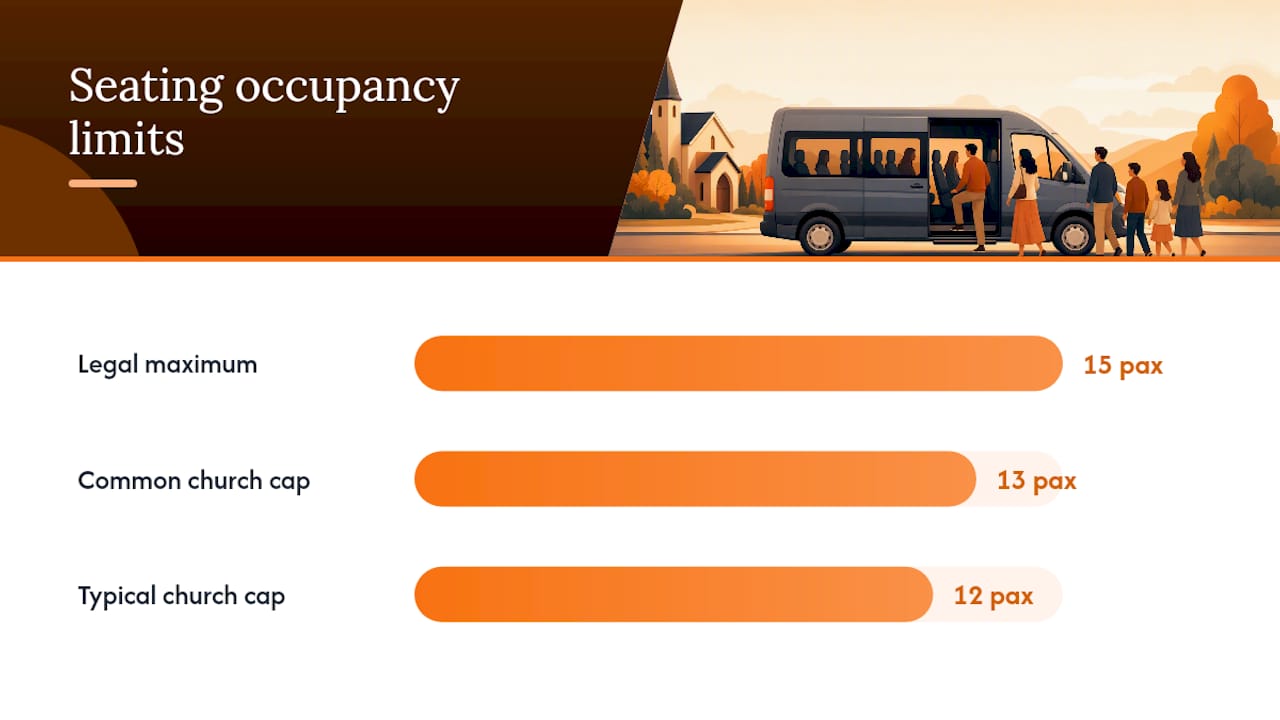
- Cap occupancy below the legal maximum. Many churches limit 15 passenger vans to 12 or 13 riders to improve stability, even though the seats technically allow more.
- Enforce belts and behavior rules on every trip, with a hard cap on consecutive driving hours and a relief driver named in advance for anything over three or four hours.
- Keep records after the trip. File the maintenance log, driver sign-off sheet, and passenger manifest together, and report any incident in writing within 24 hours.
A 15-passenger interior layout guide can help you map out seating and luggage placement before you ever get behind the wheel.
The Honest Case for Rethinking the 15-Passenger Van
Churches that transport groups every week, especially youth groups on long interstate drives, should treat a 15-passenger van as a decision that deserves regular review, not a permanent fixture. GCFA’s guidance and ChurchLaw&Tax’s liability analysis both point the same direction: frequent, long-distance use is where rollover risk and legal exposure stack up fastest.
If your insurer has already flagged the vehicle, or if your trips regularly run past three hours, it’s worth comparing the cost of a charter service or multiple smaller vans against the premium and liability you’re currently carrying. Talk to your insurer and legal counsel before your next renewal, not after an incident.
— Gabriel
Renting a Safer, Insured Van Through Sprinter Van Rentals
Sprinter Van Rentals provides an option to rent vans suitable for groups of 12 to 15 people. Instead of maintaining an aging van, tracking your own insurance minimums, and vetting drivers on a volunteer roster, you book a configured Sprinter for the specific trip and hand the liability questions to a rental agreement built for exactly this use case.
Before you request a quote, have three details ready: your total passenger count, trip length (including whether you’re crossing state lines), and whether you want to hire a professional driver instead of relying on a volunteer. Ask about insurance and damage waiver options up front so your finance committee has clear numbers before the trip is approved. If your group runs smaller, a 12-passenger Sprinter offers more stability margin than a fully loaded 15-seater, without leaving anyone behind.
Sprinter Van Rentals operates in many U.S. cities, making it possible for churches to find van rentals near their location. Check dates and get a quote on the main rental page before your next retreat, mission trip, or Sunday shuttle schedule locks in.
Sources
Print or bookmark these for your transportation committee: NHTSA’s 15-passenger van safety guidance covers rollover risk and loading rules, FMCSA’s faith-based transportation page explains for-hire and interstate triggers, and the GCFA van safety guide offers a sample policy template. ChurchLaw&Tax’s liability analysis rounds out the legal picture.
This article is general information, not a substitute for advice from a qualified lawyer. Consult a qualified legal professional about your own circumstances before acting on anything here.
- 15-passenger vans | NHTSA
- Faith-based organization-related transportation | FMCSA
- Risks Associated with the Use of 15-Passenger Vans | ChurchLaw&Tax
FAQ
Is a Church Van Considered a Commercial Vehicle?
Not automatically. A church van used for non-for-hire, single-state trips is generally treated as a private vehicle, but the same van can become subject to FMCSA commercial rules if the trip crosses state lines as part of a paid, package-style arrangement.
Do I Need a Special License to Rent a 15-Passenger Van?
Most drivers do not need a CDL for private, non-for-hire use of a 15-passenger van, and a standard license with a clean record is usually enough. Exceptions apply for for-hire or interstate operations, and states like California and New Jersey have their own stricter rules worth confirming with your local DMV.
How Many Seats Are in a Church Van?
Church vans typically come in 12-passenger and 15-passenger configurations, with seating arranged front to back for weight distribution. Many churches choose to cap actual ridership below the maximum, seating 12 or 13 people in a 15-passenger van to improve handling stability, based on GCFA’s operational recommendations.
Is a 15-Passenger Van Considered Commercial?
A 15-passenger van isn’t automatically commercial, but it can be classified that way once it’s used for-hire or in interstate service, which brings FMCSA insurance minimums into play. At that point, coverage requirements rise to $1.5 million in liability protection for vehicles seating 15 or fewer.
What Does Sprinter Van Rentals Charge for a 12- or 15-Passenger Van?
Sprinter Van Rentals lists Mercedes Sprinter Rentals starting at $250 as a one-off rate, with final pricing depending on location, trip length, and driver add-ons. Current availability and quotes are available directly on the booking site.
Recommended
Keep reading
How Much Is a Sprinter Van Rental? 2026 Pricing Guide
Real Mercedes-Benz Sprinter van rental prices in 2026 — daily rates, mileage, insurance, delivery fees, and how to lower your total.
How to Start a Sprinter Van Rental Business (2026 Playbook)
Step-by-step guide to launching a Sprinter van rental business — licensing, DOT/FMCSA rules, insurance, fleet financing, and marketing.
Mercedes Sprinter Van Rental in Orlando, FL — Where to Rent
Compare Mercedes-Benz Sprinter van rental options in Orlando, FL — MCO airport delivery, theme park runs, and 12 & 15-passenger pricing.