September 18, 2026 · 9 min read
Save on Church Group Transportation with Sprinter-Van-Rentals.com
Save on Church Group Transportation with Sprinter-Van-Rentals.com

Most church groups need one of two things: a full-size charter coach for large congregations and multi-day retreats, or a 12 to 15-passenger Sprinter van for smaller teams, leader groups, and airport runs. Pricing shifts with vehicle type and trip length, so request a written, itemized quote before you commit. Confirm the driver’s CDL and the operator’s safety record before you sign anything.
TL;DR:
- Full-size coaches are ideal for large groups on long-distance retreats, offering luggage capacity and onboard restrooms, while smaller vans suit airport transfers and leader teams.
- Comparing providers requires focusing on capacity, total cost structure, driver hours included, insurance, and cancellation policies, with written quotes essential to prevent hidden fees.
- Trip costs increase with mileage, stops, tolls, and seasonal demand, but consolidating pickups and booking early can significantly reduce per-person expenses.
- Confirming driver credentials, safety standards, and mobility accommodations before booking is crucial, with a safety check on CDL status and insurance documentation.
- For small groups, renting a Sprinter van offers flexibility, onboard configuration, and nationwide pickup; verify availability and safety standards before booking.
Table of Contents
- What Vehicle Types Work Best for Church Group Transportation?
- How Do You Choose Between Transportation Providers?
- What Drives the Cost of Church Group Transportation?
- When Should You Book and What Should the Checklist Cover?
- How Do You Plan Pickups, Stops, and Loading Logistics?
- How Do You Verify Driver Safety and Accessibility Needs?
- What Do Church Trip Coordinators Wish They’d Known Sooner?
- Why Sprinter Vans Fit Most Small Church Groups Best
- Where to Verify Safety and Planning Standards
- Sources
- FAQ
What Vehicle Types Work Best for Church Group Transportation?
Matching vehicle size to headcount is the single biggest decision in church group transportation planning. Book too big and you overpay by the mile. Book too small and you’re making two trips or leaving people behind.
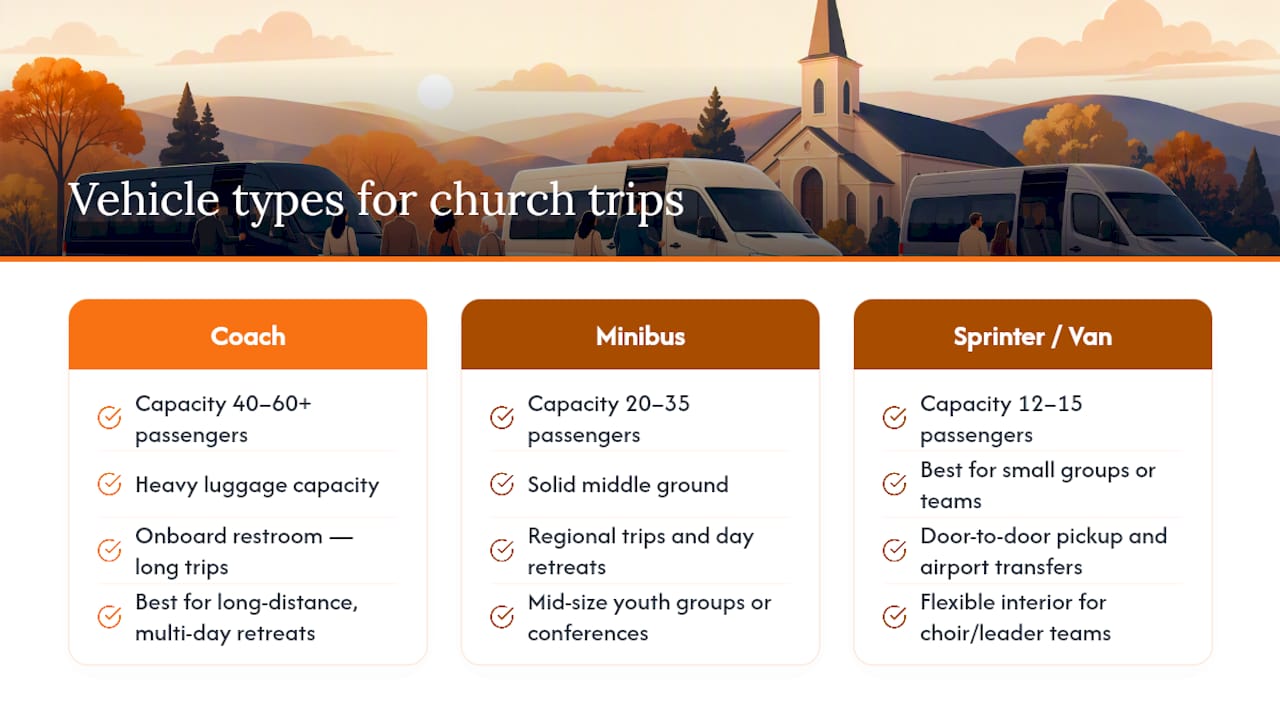
Full-size coach (40 to 60+ passengers). This is the right call for large congregations heading out on long-distance, multi-day retreats. Coaches carry serious luggage capacity and usually include an onboard restroom, which matters when you’re on the highway for four or five hours straight. Specialized charter providers consistently point to coaches as the go-to for long-distance retreats with heavy luggage needs.
Minibus (20 to 35 passengers). A solid middle ground for regional trips, day retreats, or a mid-size youth group heading to a conference two hours away.
Sprinter van or 12 to 15-passenger van. Best suited for small groups, ministry leader teams, choir sections, or airport transfers where door-to-door pickup matters more than raw capacity. A 12-passenger Sprinter van or the 15-passenger interior configuration also gives you flexibility a full coach can’t.
For multi-campus congregations, a hub-and-spoke pickup plan, where smaller vans feed into one main departure point, often saves vehicle-hours and driver cost compared to sending a coach to every location.
How Do You Choose Between Transportation Providers?
Comparing quotes gets confusing fast if you don’t know what actually matters. Focus on five things: passenger capacity, total cost structure (hourly, daily, or per-mile), how many driver hours are included, insurance limits, and the cancellation or overtime fee schedule.
Once you’ve narrowed your list, ask each provider these questions directly:
- Is this quote guaranteed in writing, or is it an estimate that can change?
- Is the driver CDL-licensed with a current background check on file?
- Can you provide recent maintenance and inspection records for the vehicle?
- Does the vehicle have the accessibility features (wheelchair lift, securement points) we need?
- What’s the overtime rate if the event runs long?
Watch for red flags: vague per-mile pricing with no floor or ceiling, brokers who won’t guarantee a specific vehicle, or any hesitation when you ask about insurance coverage.
Pro Tip: Ask for the quote in writing before you compare prices across providers, not after. A verbal number that sounds good on the phone can grow once fuel surcharges, tolls, or driver overtime get added later.
What Drives the Cost of Church Group Transportation?
Vehicle type and trip length set the baseline, but mileage, the number of stops, waiting time, and driver lodging on overnight trips all add up. Tolls, permits, and seasonal demand (spring retreat season, summer mission trips) push prices higher too.
A few tactics keep per-person cost down:
- Consolidate pickups at one or two hubs instead of door-to-door stops for every family.
- Split the total cost evenly across attendees rather than pricing per seat.
- Book early. Locking in a vehicle months out almost always beats a last-minute scramble.
- Get every fee, fuel, tolls, driver gratuity, overtime, listed in the written quote.
A local day trip for a youth group typically runs a modest per-person cost when split across 20 or 30 riders, a strategy similar to split-cost group flying methods used in other group travel models. A multi-day retreat with overnight driver lodging and long mileage costs meaningfully more per person, even before you factor in fuel. Charter and motorcoach travel remains one of the more cost-efficient ways to move a large group compared to everyone driving separately, since shared costs and a single driver replace a dozen individual trips.
When Should You Book and What Should the Checklist Cover?
Timing matters more than most coordinators expect. For peak seasons, think summer camps, spring retreats, holiday events, book three to six months ahead. Off-peak trips can usually be arranged four to six weeks out. Wait until the last minute and you’ll pay more for whatever’s left, if anything is left at all.
Before you sign a contract, run through this checklist:
- Confirm final headcount, including any late additions.
- Lock in pickup addresses and drop-off points.
- Note luggage volume and any accessibility or mobility needs.
- Share the complete itinerary, including worship or prayer times, with the provider.
- Collect emergency contact information for every rider.
- Get a written contract listing exact inclusions, fees, and cancellation terms.
Sharing your full itinerary early does more than keep everyone organized. Charter bus planning guides note that giving carriers a complete schedule up front helps them staff compliant driver hours and avoid overtime surprises on the back end.
How Do You Plan Pickups, Stops, and Loading Logistics?
A single pickup hub is faster to manage and cheaper to run than five scattered stops across town. It only makes sense to split pickups when your congregation spans multiple campuses too far apart to consolidate.
A few logistics habits prevent the most common day-of headaches:
- Label every bag with the rider’s name before boarding starts.
- Assign one or two volunteers as boarding marshals to keep the line moving.
- Build in extra loading time for older adults or anyone bringing mobility equipment.
- Share exact loading and access points with the venue and the driver ahead of the event, not the morning of.
A quick driver briefing the day before, covering pickup order and any tight turnaround windows, saves confusion when the group actually shows up.
How Do You Verify Driver Safety and Accessibility Needs?
Confirm the driver holds a valid CDL and has passed a background check, and ask whether the operator follows federal training standards for commercial drivers, which cover hours-of-service limits and driver qualification. Request maintenance records and current insurance limits in writing, and get any wheelchair lift or securement system confirmed before the trip, not discovered on the day of.
A commercial driver’s CDL status and training record are the clearest, most checkable safety signal a church coordinator has before booking. If a provider can’t produce that documentation on request, that’s the moment to walk away, not the moment to hope it works out.
Document any medical or mobility needs in advance so the provider can plan boarding assistance and secure storage for medical equipment.
What Do Church Trip Coordinators Wish They’d Known Sooner?
Assign roles before departure day: a loading marshal, a driver liaison, someone keeping headcount at every stop, and a designated first-aid contact. Label bags, stagger boarding by row or section, and keep both a printed and digital copy of the itinerary in case a phone dies.
None of this is complicated. It’s just easy to skip when you’re focused on the retreat schedule instead of the ride there. Keeping the group together and on time isn’t just about efficiency. It protects the fellowship time that’s often the actual point of the trip.
— Gabriel
Why Sprinter Vans Fit Most Small Church Groups Best
For smaller congregations, ministry leader teams, choir groups, or a quick airport run to pick up a guest speaker, a 12 or 15-passenger Sprinter van is often the more practical call than a full coach. This option is available to church coordinators without the overhead of chasing down a coach company for a group of 10 or 14 riders.
You get configurable seating, real luggage room, and the option to add a professional driver through the Sprinter Van Driver service if your team would rather not drive. Nationwide pickup covers major cities, and for events that call for something more polished, the Sprinter Van Limo Rental offers an executive-style configuration. Mercedes Sprinter rentals through the platform are offered at various rates.
If your congregation’s next trip is a small group retreat, a leader team heading to a conference, or an airport pickup for visiting speakers, request a quote at Sprinter Van Rentals and confirm availability in your city before your preferred dates fill up.
Where to Verify Safety and Planning Standards
- FMCSA driver training standards for confirming driver qualification rules.
- American Bus Association for industry safety and operational norms.
- United Motorcoach Association for operator standards and planning resources.
Sources
- FMCSA establishes national training standards for new truck and bus drivers — U.S. Department of Transportation
- Buses
FAQ
What’s the cheapest option for church group transportation?
For small groups, a shared Sprinter or 15-passenger van split across riders is usually the lowest per-person cost. For large congregations, a full-size coach with shared costs across 40 or more passengers often beats renting several smaller vehicles.
What’s the difference between a charter bus and a coach bus?
In practice, the terms are used interchangeably in the U.S. market. Both refer to a full-size motorcoach with 40 to 60+ seats, onboard restrooms, and luggage bays, typically hired for a specific trip or event rather than a fixed route.
What are some good activities for a church group during transportation?
Group singing, devotional readings, trivia, and rest stops built into the itinerary keep long rides enjoyable. Sharing the schedule with your driver ahead of time, including any planned worship time, helps them plan stops without running into overtime.
How far in advance should we book church group transportation?
Book three to six months ahead for peak seasons like summer camps and spring retreats. Off-peak trips can usually be arranged four to six weeks out, though earlier is always safer.
Does Sprinter Van Rentals offer driver options for church trips?
Yes. Coordinators can add a professional driver through the Sprinter Van Driver service, or drive the van themselves depending on the group’s needs.
Recommended
Keep reading
How Much Is a Sprinter Van Rental? 2026 Pricing Guide
Real Mercedes-Benz Sprinter van rental prices in 2026 — daily rates, mileage, insurance, delivery fees, and how to lower your total.
How to Start a Sprinter Van Rental Business (2026 Playbook)
Step-by-step guide to launching a Sprinter van rental business — licensing, DOT/FMCSA rules, insurance, fleet financing, and marketing.
Mercedes Sprinter Van Rental in Orlando, FL — Where to Rent
Compare Mercedes-Benz Sprinter van rental options in Orlando, FL — MCO airport delivery, theme park runs, and 12 & 15-passenger pricing.